

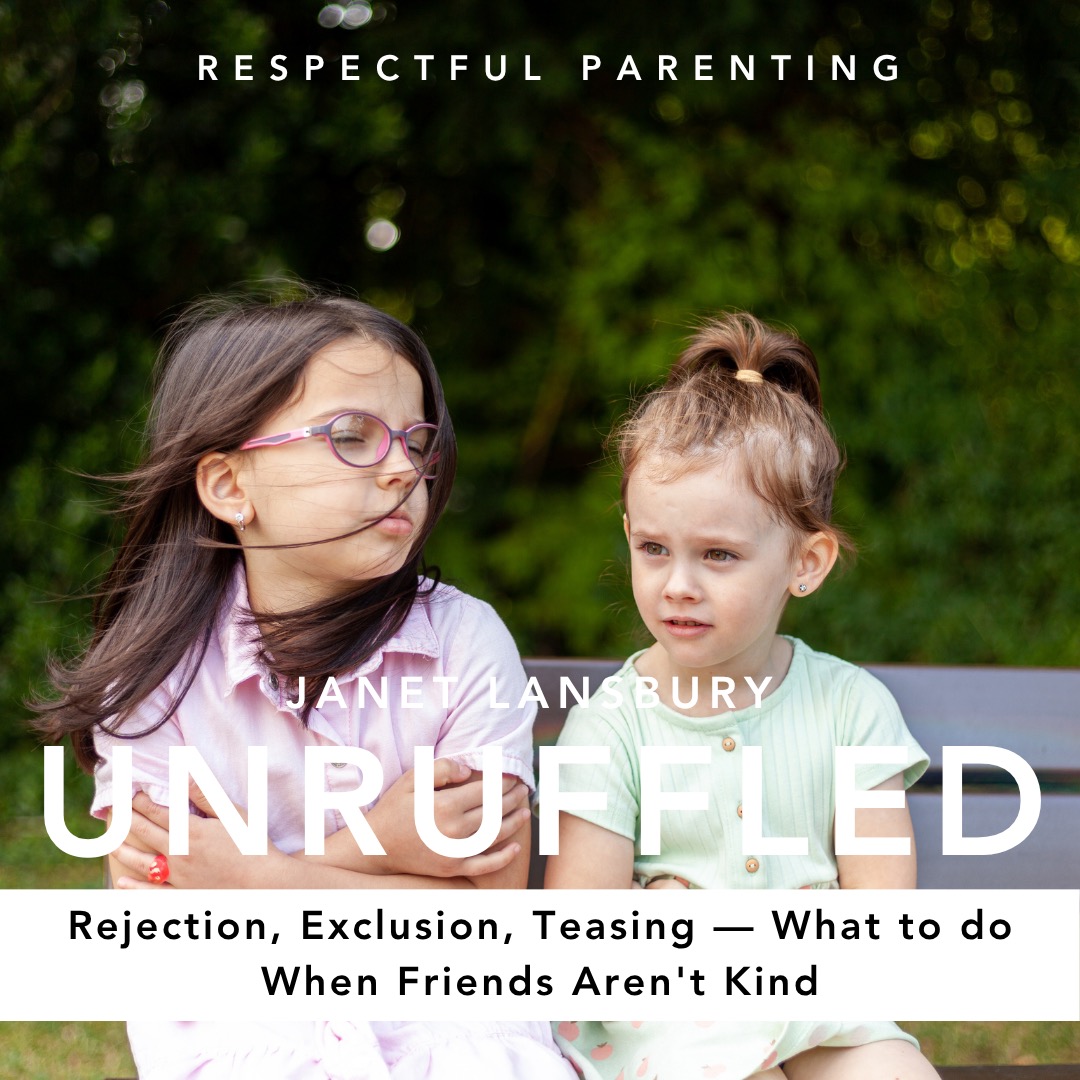
The delicate landscape of childhood friendships often presents parents with challenging scenarios, particularly when their children experience rejection, exclusion, or unkind behavior from peers. Renowned parenting expert Janet Lansbury, in a recent discussion on her podcast "Unruffled," offers a nuanced perspective on how parents can effectively support their children through these difficult social interactions without over-intervening. Lansbury’s approach centers on empowering children by helping them understand and manage the power dynamics inherent in social relationships, a skill she emphasizes is increasingly vital in today’s comparison-driven world.
Understanding the Core Issue: The Dynamics of Social Power
Lansbury’s central thesis is that "people only have power over us when we give it to them." This principle, while seemingly straightforward, carries profound implications for how parents guide their children through social challenges. She argues that while external authority figures naturally hold power, in most peer relationships, children have the agency to decide how much influence others wield over their emotions and self-perception. This concept is particularly relevant in an era saturated with social media, which can amplify feelings of inadequacy and the "fear of missing out" (FOMO) through constant comparison.
Lansbury uses a series of anonymized parental inquiries to illustrate her points, showcasing recurring themes of exclusion, conditional friendship, and emotional manipulation among children around the age of five. These situations, while distressing for parents, are framed not as insurmountable crises, but as opportunities for children to develop resilience and social intelligence.
Case Study 1: The Ultimatum and the Silent Treatment
One parent describes a recurring pattern with a five-year-old daughter’s friend. The friend issues ultimatums, such as "If you don’t do X, I won’t be your friend anymore," or resorts to the silent treatment and refusal to say goodbye. The parent, recalling similar dynamics in her own childhood that were resolved without adult intervention, expresses frustration and a desire to help her daughter navigate these exchanges. She questions whether to address the ultimatums directly or to facilitate problem-solving between the children.
Lansbury advises a significant step back from direct intervention in such scenarios. She validates the child’s feelings of hurt and disappointment but cautions against over-involvement, which can inadvertently amplify the power of the other child’s behavior. The parent’s instinct to broker agreements or dictate how children should interact, even with neutral phrasing, is seen as an attempt to control the outcome, thereby granting more power to the situation. Instead, Lansbury suggests acknowledging the child’s feelings ("Yes, I saw that. That hurt your feelings.") and trusting her to process the experience.
The core message for the child in this situation is to recognize that the friend’s behavior is not a reflection of her worth but rather a tactic for gaining attention or control. By not giving excessive emotional weight to the friend’s actions, the child can begin to disempower them. Lansbury encourages parents to remain curious about their child’s feelings and thoughts regarding the friendship, allowing the child to decide whether she wants to continue engaging with that friend. This approach fosters autonomy and teaches the child that she has the agency to choose who she invests her energy and emotional power in.
Case Study 2: Neighborhood Exclusion and Parental Diplomacy
A parent of two daughters, aged four and almost six, shares a distressing experience in a new country. Her outgoing older daughter, after quickly making friends, began to be excluded by two sisters in the neighborhood. These sisters not only excluded her but also discouraged other children from playing with her and even yelled at their younger siblings for interacting with her. The parent is struggling with the balance between supporting her daughter and allowing her to manage the situation independently, while also navigating relationships with the children’s parents, who are receptive to addressing the issue.
Lansbury commends the parent’s desire for her daughter to handle situations independently while feeling supported. This demonstrates an understanding of the child’s developmental journey. The exclusionary behavior, Lansbury notes, often stems from insecurity and a desire for control rather than genuine malice. The fact that the exclusion escalated suggests a dynamic where the aggressors felt threatened and sought to assert dominance.
Regarding parental intervention, Lansbury advocates for minimal involvement. She suggests that the child’s request to speak to the other girls’ mother is a good starting point, but any parental involvement should be guided by the child’s lead. The parent’s inclination to distance herself from the children exhibiting bullying behavior is understandable, especially as she wants to show solidarity with her daughter. However, Lansbury advises against actively excluding the children from neighborhood activities. Instead, she recommends focusing on nurturing the daughter’s positive friendships and reminding her that the exclusionary behavior is a reflection of the other children’s insecurity, not her own shortcomings.
The concept of "peace-offering situations" initiated by the parent is viewed with caution. While well-intentioned, such attempts can inadvertently validate the negative behavior by implying a need to "fix" the situation. Lansbury suggests that the parent’s primary role is to be a steadfast supporter, empowering her daughter with the understanding that she controls who receives her social and emotional investment. The younger daughter’s loyalty to her sister is a positive sign, indicating that children can often discern genuine friendship from manipulative tactics.
Case Study 3: The "Too Nice" Child and Parental Fears
A parent expresses deep concern for her five-year-old daughter, whom she describes as "naive, sweet, thoughtful, smart, and kind to absolutely everyone." This parent, who experienced being "walked all over" and bullied in her youth, fears her daughter will follow a similar path. She has witnessed instances of her daughter being excluded and accepting it, leading to sadness. The parent grapples with the urge to teach her daughter to be "mean back" or to "get people on her side," recognizing these are not appropriate lessons for a five-year-old.
Lansbury acknowledges the parent’s profound self-awareness and the understandable fear of her child repeating past traumas. However, she reframes the daughter’s kindness not as weakness but as a source of strength. Lansbury argues that cruelty is a sign of weakness, while compassion is a powerful attribute. The daughter’s current responses, even if tinged with sadness, demonstrate her ability to navigate difficult social interactions by disengaging rather than retaliating.
The parent’s anxiety about kindergarten is a significant factor. Lansbury stresses that the daughter is already demonstrating agency by making choices, such as walking away from exclusionary situations. This is a powerful position. The key for the parent is to support this innate strength by reinforcing the idea that her daughter has the power to choose who she gives her attention to. Instead of focusing on how to fight back, the focus should be on nurturing positive friendships and helping the daughter identify individuals who reciprocate kindness and respect.
Lansbury suggests that the parent’s own past experiences are coloring her perception. While validating the parent’s feelings, she emphasizes that the daughter’s journey will not necessarily mirror her own. The advice for the parent is to work on self-calming and to separate her own residual anxieties from her daughter’s present reality. By believing in her daughter’s inherent capabilities and reinforcing the concept of selective power-giving, the parent can equip her daughter with the resilience needed to navigate social challenges.
Case Study 4: Sibling-Like Bickering and Parental Triggers
In the final case, the dynamic shifts. A parent of a five-year-old only child describes her daughter as the one exhibiting unkind behavior towards her best friend. The daughters, comfortable with each other, engage in sibling-like bickering, with the daughter making comments like, "You’re shy" or "I’m better at X than you." The parent admits to finding this bickering "triggering" and often scolding her daughter, a behavior she regrets. She notes that her daughter is well-behaved in other settings and suspects her own discomfort as an only child is influencing her reaction.
Lansbury highlights the parent’s self-reflection and acceptance that the issue may lie with her own reactions. She points out that the bickering is described as mutual, suggesting a common dynamic between close friends. The parent’s discomfort with her daughter’s "strong-willed" behavior, particularly when it elicits a negative response from the friend, is where the power dynamic becomes apparent.
Lansbury reiterates that the core principle of not giving power to behaviors applies here. When the friend runs to the parent upset, the parent’s role is to be a supportive listener, reflecting the friend’s feelings without necessarily disciplining her own child. Phrases like, "Oh, what happened? You didn’t like that, huh? That doesn’t feel good. Did you tell her?" allow the child to articulate her experience. The parent’s own annoyance and regret in these moments inadvertently give more weight to the bickering.
The parent’s observation that her daughter behaves differently with other children is significant. It suggests that the dynamic with her close friend, and the parent’s reaction to it, might be creating a self-perpetuating cycle. By stepping back, supporting both children in their emotional responses, and refraining from intervening to "fix" the bickering, the parent can allow the children to navigate their relationship and learn from their interactions. This approach helps to remove the parent’s "trigger" and allows the situation to play out naturally, fostering the children’s ability to resolve their own conflicts.
Broader Implications and Parental Empowerment
Lansbury’s overarching message is one of trust and empowerment, both for children and parents. She emphasizes that children possess an innate capacity to navigate social complexities, provided they are not burdened by parental anxieties or over-interventions. The key is for parents to act as calm, supportive observers, offering guidance only when necessary and always framing social challenges as opportunities for growth.
The consistent theme across all cases is the parental tendency to either over-identify with their child’s distress or to become overly invested in controlling social outcomes. Lansbury’s approach encourages a shift towards recognizing and validating children’s feelings while simultaneously empowering them with the understanding that they control how much power they yield to others. This philosophy equips children not just for the playground, but for the entirety of their social lives, fostering resilience, self-awareness, and healthy relationship dynamics. In a world that often feels increasingly complex and competitive, Lansbury’s counsel offers a grounding perspective for parents seeking to raise confident, capable, and emotionally intelligent children.
