

Originally published November 2025. Last reviewed/updated by Craig Canapari, MD in December 2025.
The journey of childhood sleep is often a labyrinth for parents, pediatricians, and sleep consultants alike. Predicting when a child will naturally cease or consolidate their naps, a process known as nap transition, is notoriously difficult, and these shifts are rarely seamless. The challenge has even spurred a specialized industry dedicated to understanding and forecasting nap timing and transitions. Despite this established expertise, a recent social media excerpt from the "Sleep Edit" podcast, focusing on the science of napping, unexpectedly captured widespread attention, highlighting the enduring parental struggle with this developmental milestone.
A Viral Phenomenon: The Science of Sleep and Memory Captivates Parents
The excerpt, a short reel from a podcast episode titled "Napping: The Science of Sleep & Memory," achieved remarkable viral success on social media platforms. While Dr. Craig Canapari, the author and a pediatrician specializing in sleep, frequently shares podcast clips, this particular piece vastly outperformed previous content. As of November 2, 2025, it had garnered over 185,000 views on Instagram, 117,000 on TikTok, and over 1,100 on YouTube. The overwhelming engagement, evidenced by more than 60 comments on the Instagram post alone, underscores the significant parental concern and curiosity surrounding naps and their connection to a child’s developing brain.
At its core, the viral content briefly summarized research from the University of Massachusetts, proposing a compelling hypothesis: the maturation of the hippocampus, a brain region critical for memory formation, is intricately linked to nap transitions in early childhood. This intuitive connection—that changes in brain development directly influence evolving sleep needs—resonated deeply with parents navigating these complex stages.
Parental Voices: A Chorus of Shared Experiences
The online discussion following the post’s release illuminated the universal nature of nap-related challenges. Parents and clinicians chimed in with a mix of personal anecdotes, pressing questions, and a healthy dose of humor, solidifying nap transitions as a quintessential early childhood sleep dilemma. Several recurring themes emerged from the digital discourse:
The Spark of Curiosity: "So Interesting!"
A significant portion of the commentary expressed genuine interest and surprise at the link between naps and brain development. Phrases like, "So interesting! I never thought naps could be linked to brain development," and "Makes total sense once you think about memory consolidation," were common. This curiosity serves as a powerful entry point for understanding scientific concepts, demonstrating how parents naturally connect their home-based observations with research findings.
The Real-World Sleep Equation: "There’s No Winning"
Many parents shared their struggles with the "in-between" phases of nap transitions. Comments like, "If my three-year-old naps, bedtime is a disaster. If he skips it, he’s cranky for three hours – there’s no winning," and "We’re in the weird in-between: my son still needs a nap, but it ruins bedtime every single night," perfectly encapsulate the delicate balance parents must strike. These remarks highlight the common experience of children who still require rest but whose internal clocks are shifting, leading to unpredictable sleep patterns. Dr. Canapari often advises parents that children don’t unilaterally decide to stop napping; instead, there’s typically a period of resistance or inconsistency, where they might nap at daycare but refuse on weekends, or need a nap but resist it.
Individual Trajectories: "Every Child is Different"
A strong theme of individual variability was also evident. Parents shared stories of children who stopped napping early, such as, "My daughter stopped napping right after turning two and her memory is incredible," or "Our son gave up naps around 2½ and he’s seven now – super mature and focused." These anecdotes, while seemingly diverging from a singular developmental timeline, do not contradict the research but rather emphasize the wide spectrum of normal brain development. The process of synaptic pruning and hippocampal maturation is not a synchronized event across all children.
Seeking Clarity: "Does Dropping Naps Affect Other Growth?"
Several parents sought further clarification on the implications of nap cessation. Questions such as, "Does dropping naps that young affect other parts of growth?" and "Are we talking about dropping all naps or just cutting from three to two?" indicate a need for precise, evidence-based explanations. The research primarily focuses on the transition from multiple naps to one, and from one nap to none. The authors did not suggest immediate changes to a child’s sleep schedule based on this perspective.
Creative Solutions: "Quiet Time Instead of Naps"
Parents also shared their innovative strategies for managing nap transitions. One common workaround involved substituting naps with "quiet time," described as "books and soft music," which many found to be a "game-changer." This reflects a pragmatic approach where the goal is not to "win" the nap battle but to ensure adequate rest and maintain family equilibrium.
A Touch of Humor: "My Husband’s Hippocampus is Still Developing!"
Amidst the earnest discussions, a humorous comment, "I guess my husband’s hippocampus is still developing!" provided a lighthearted reminder of the universality of cognitive processes, even if applied humorously to adult behavior.
The Scientific Foundation: Understanding the Hippocampus and Sleep
The viral social media post was inspired by a "perspective" piece published in the Proceedings of the National Academy of Sciences of the United States of America (PNAS) by Spencer and Riggins (2022). This article, titled "Contributions of Memory and Brain Development to the Bioregulation of Naps and Nap Transitions in Early Childhood," synthesizes existing research to propose a novel model explaining nap timing based on neurodevelopment. It is not an experimental study but rather a theoretical framework.

The authors begin by outlining the two primary drivers of sleep-wake timing: sleep drive and the circadian clock. Sleep drive is the homeostatic pressure to sleep that builds with prolonged wakefulness. This drive accumulates more rapidly in infants and gradually slows as children mature, explaining the typical decrease in nap frequency from infancy to toddlerhood. However, the exact timing of nap transitions—from three to two naps, two to one, or the complete cessation of naps—remains unpredictable.
The typical nap transition timelines are broad:
- 3 naps → 2 naps: Occurs between 6–9 months, consolidating morning, midday, and late afternoon naps into morning and afternoon sessions.
- 2 naps → 1 nap: Typically observed between 12–18 months, with the morning nap often being dropped in favor of an afternoon nap.
- 1 nap → no naps: Usually happens between 3–5 years, with the afternoon nap gradually disappearing.
The PNAS perspective highlights research suggesting that the maturation of the hippocampus plays a crucial role in this transition. As the hippocampus becomes more efficient at memory consolidation, the brain may require fewer naps to process and store new information. The hippocampus, named for its seahorse-like shape, is a vital structure for forming new memories, particularly those with emotional content.
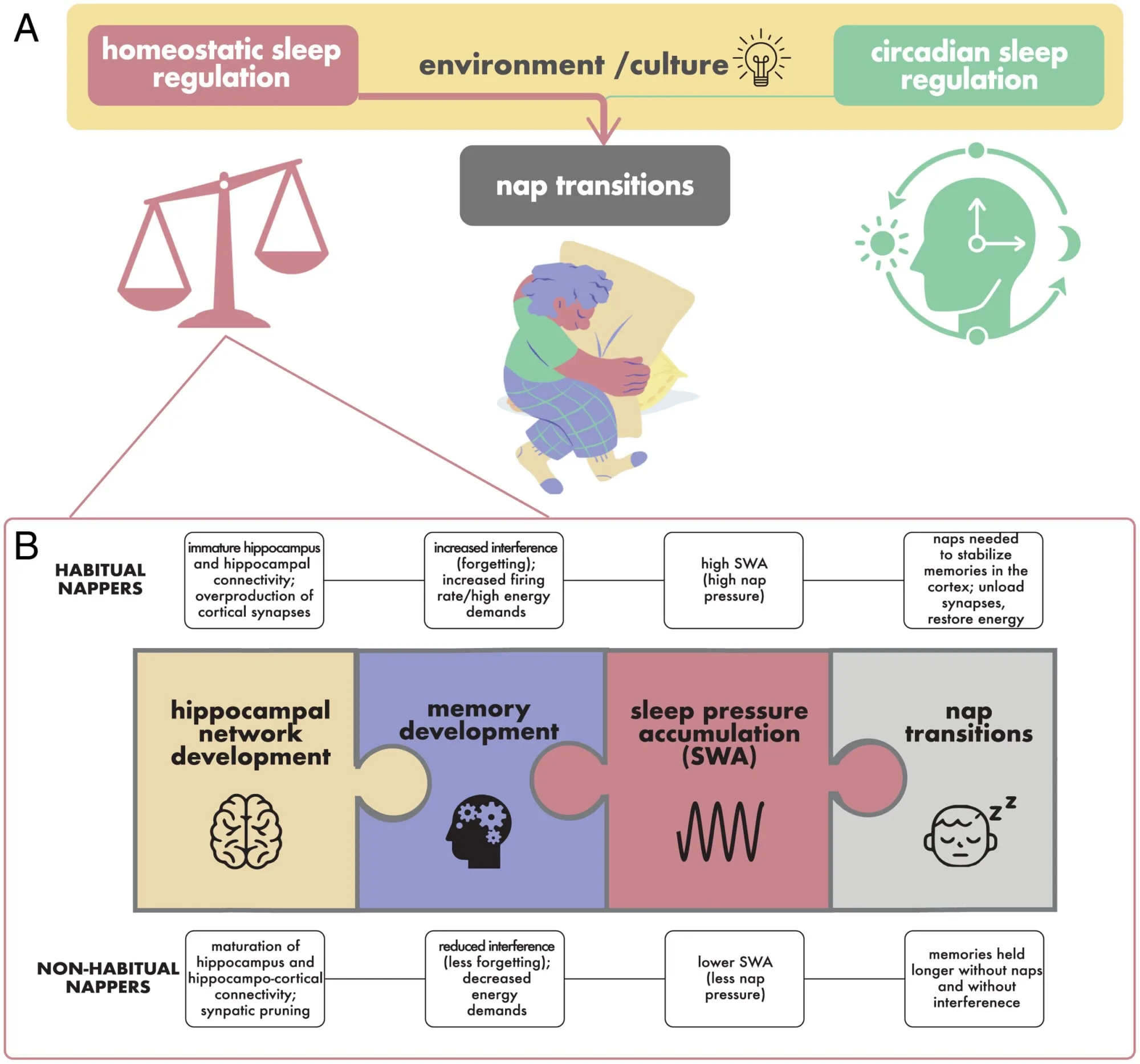
The authors posit that during early childhood, the brain faces a unique challenge: a massive influx of new information requiring learning, while the neural systems responsible for this learning are still under development. This leads to an overproduction of synapses, the connections between neurons, a process that peaks in early childhood before synaptic pruning begins to refine neural pathways.
"A unique problem exists early in human development; there is a massive amount of information that must be learned, yet the neural systems that support learning are still under construction," the authors state. They further propose that naps serve as a mechanism to manage this cognitive load. "We posit that early childhood is a time of competing demands of learning, which loads the brain (the hippocampus in particular), and sleeping, which may unload synapses across the cortex."
A diagram provided by Spencer and Riggins visually synthesizes this argument, illustrating the interplay between learning demands, hippocampal activity, and the role of sleep in synaptic regulation.
The research specifically points to slow-wave activity (SWA), characteristic of deep sleep, during naps. SWA in naps has been linked to the consolidation of emotional memories. The authors suggest that by consolidating emotional memories from the morning, naps can reduce emotional load, making children less reactive to stimuli. This offers a potential explanation for the "witching hour" phenomenon—the period of intense fussiness or dysregulation often observed at the end of the day in children who have missed their nap.
Translating Science into Practical Guidance
It is crucial to clarify what the research does not suggest. It does not advocate for parents to prematurely eliminate naps based on a child’s age, nor does it imply that children who stop napping early are necessarily more advanced. Every child matures at their own pace.
For parents facing nap challenges, general advice often includes:
- Observing Sleep Cues: Paying close attention to a child’s individual signs of tiredness.
- Consistent Sleep Schedules: Maintaining regular bedtimes and wake times, even on weekends, can help regulate the internal clock.
- Creating a Conducive Sleep Environment: Ensuring the bedroom is dark, quiet, and cool.
- Patience During Transitions: Recognizing that nap transitions are a process that can take weeks or months.
- Considering "Quiet Time": For older toddlers and preschoolers who are resisting naps, a period of quiet, independent activity can provide a similar restorative benefit without the pressure of sleep.
The Enduring Message: Developmental Milestones, Not Moral Victories
The core takeaway from this research and the subsequent parental discussion is that nap transitions are fundamentally developmental processes, not indicators of a child’s "goodness" or parental success. Each child follows a unique timeline. Parents are encouraged to avoid comparing their child’s sleep patterns to those of their peers and to understand that early nap cessation, while sometimes frustrating, is not typically a cause for concern.
Dr. Canapari invites ongoing dialogue, encouraging parents to share their experiences and strategies for navigating nap transitions. Further insights into nap transitions and sleep science can be found in Episode 15 of "The Sleep Edit" podcast and Dr. Canapari’s blog post on nap problems.
References for Nap Table:
[1] American Academy of Sleep Medicine. (2015). International Classification of Sleep Disorders: Diagnostic and Coding Manual.
[2] Gradisar, M., Jackson, K., Spurrier, N. J., Gibson, J., Whitham, J., Williams, N., … & Kennaway, D. J. (2011). The extended role of the sleep environment in the management of behavioral insomnia of childhood. Sleep, 34(8), 1077-1086.
[3] Iglow, S. R., & Kahn, A. (2008). The Science of Sleep: A Practical Guide to Sleep Hygiene.
[4] Mindell, J. A., & Williamson, A. A. (2018). Children’s sleep habits and styles in three countries. Sleep Medicine Reviews, 37, 48-55.
[5] O’Connor, T. G., & Capozzoli, M. (2009). Sleep in early development. Handbook of Infant Development, 355-377.
[6] Sadeh, A. (2011). Sleep in early childhood: developmental changes and their consequences. Pediatrics, 127(4), 697-704.
Wave Goodbye to Sleepless Nights
Struggling with your child’s sleep? My FREE Sleep Training Mini Course is your lifeline. Learn actionable steps to improve your family’s sleep quality. Subscribe today and say hello to better nights!
