

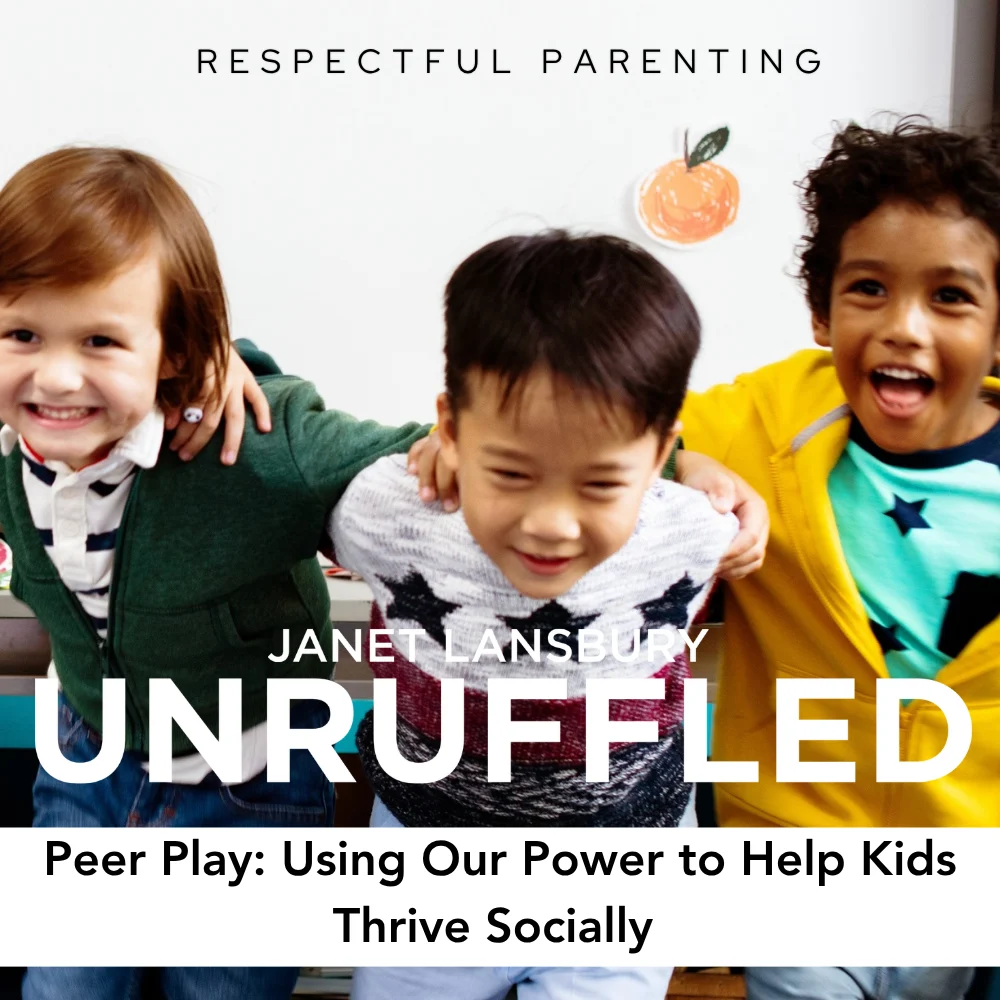
Renowned parenting expert Janet Lansbury, in a recent broadcast of her podcast "Unruffled" on June 16, 2026, addressed a trio of parental concerns centered on children’s social development, offering a nuanced perspective on how parents can more effectively foster confidence, resilience, and healthy peer interactions. The discussions, stemming from inquiries about a four-year-old’s rigid play directives, a three-year-old’s shyness, and a preschooler’s exclusion from group activities, highlighted a core theme: the significant, yet often underestimated, role parents play in shaping their children’s social competence.
Lansbury emphasized that while parental modeling of kindness and empathy is foundational, the development of complex social skills is not a direct instructional process. Instead, she posits that effective support for children’s social growth hinges on two critical, and often challenging, parental approaches: the assertion of firm, reasonable boundaries and a profound trust in the child’s developmental process.
Navigating the Nuances of Peer Play
The first case presented involved a four-year-old deeply immersed in imaginative play, who struggled when her peers did not adhere to her exact instructions. This child, who reportedly lives "80% of the day in character," created elaborate scenarios where friends were expected to follow precise dialogue and actions. The parent described situations where any deviation from the script led to the child’s distress, tears, and an inability to continue the play. This rigidity had begun to negatively impact her interactions with friends, resulting in repeated exclusion and frustration for all involved.
Lansbury’s analysis of this scenario underscored the critical role of parental boundaries, even within the context of seemingly free-flowing play. She suggested that the parent’s eagerness to engage with her child’s imaginative world, while well-intentioned, may have inadvertently granted the child excessive control, preventing her from experiencing natural social negotiations. "There are a couple of signs here… that when something seems so unreasonable in terms of the way we’re playing with our child or what they’re asking of us, then there’s a very good chance that what our child is really asking for is for us to have a reasonable boundary," Lansbury explained.
The Impact of Unmet Boundaries
The parent in this instance noted that a year of allowing the situation to "play out" with friends had not resolved the issue. Lansbury countered the idea that children will automatically learn social navigation through direct rejection by peers alone. She argued that a lack of parental boundaries can exacerbate these difficulties. When parents fail to set limits on a child’s demands, the child may continue to seek these boundaries in less supportive environments, such as with peers, leading to increased conflict.
"It’s one thing with her dad and I, but the problem is with friends," the parent stated. Lansbury reframed this, explaining that parents are the primary models for relationships. If parents do not assert their own needs and boundaries, children must seek them elsewhere, potentially leading to the very social friction they are experiencing. The key, Lansbury suggested, is for parents to recognize their own discomfort in such situations as a signal to establish a boundary. This act of self-care and boundary-setting provides a powerful model for children, teaching them that others have their own wishes and that not every demand will be met.
Addressing Social Exclusion and Perceived Bullying
The second case involved a four-and-a-half-year-old who was frequently excluded from playground games by her peers. The other children would sometimes pretend she was a "monster" and run away, or simply leave her out of their activities. The parent expressed concern, noting that while her daughter had positive one-on-one friendships with these girls, she was an "easy target in a group dynamic." The parent’s instinct was to let children work out their own conflicts, offering her daughter space to vent and suggesting alternatives.
However, the situation had escalated to the point where other parents were also intervening. One father’s direct instruction that his daughter must play with the concerned child resulted in temporary inclusion. The parent questioned whether this intervention aligned with respectful parenting and whether finding alternative play groups was a more appropriate solution.
Lansbury addressed the term "bullying," suggesting that for children of this age, exclusion and playful teasing are not necessarily indicative of bullying in the true sense. She cautioned against framing the child as a victim and highlighted the developmental gap between children, noting that a year’s age difference in preschool can significantly impact social-emotional development. "It makes a lot of sense that these girls kind of feel like they’re on a different wavelength and that their way of playing together could easily exclude somebody younger," she observed.
The Role of Trust in Navigating Group Dynamics
Lansbury advocated for trusting the child to navigate these challenging social situations. While acknowledging the parental instinct to alleviate a child’s distress, she emphasized that sometimes the most supportive action is to allow the child to experience and process the complexities of peer interactions. Interventions, such as an adult mandating play, can inadvertently prevent a child from developing their own coping mechanisms and social strategies.
"I would go into a situation like this really not expecting that my child is going to be able to play with these girls when they’re all together," Lansbury stated, recommending that parents set realistic expectations with their children. She proposed that rather than offering direct solutions, parents should empower their children to make informed choices about engaging with the group, knowing that it might not always be successful. This approach, she argued, fosters resilience and self-reliance.
Supporting Data on Child Development:
Developmental psychology research consistently shows that social skills are learned experientially and are highly context-dependent. The preschool years are a critical period for developing skills such as negotiation, compromise, and managing social rejection. Studies published in journals like Child Development indicate that children who are allowed to navigate minor social conflicts with peers, with appropriate parental support, tend to develop stronger conflict-resolution skills and a greater sense of self-efficacy compared to those whose conflicts are consistently mediated by adults. The American Academy of Pediatrics also highlights the importance of unstructured play in fostering social-emotional growth, emphasizing that children learn vital life lessons through these interactions.
Fostering Comfort in Reserved Children
The final inquiry, received via Instagram, concerned a three-year-old who was reserved around other people. The parent sought advice on helping the child become more comfortable. Lansbury’s response mirrored the principles discussed in the previous cases, emphasizing the power of trust and avoiding pressure.
"The answer is in trusting them to find their own way to feeling comfortable around other people by not pushing them, by not coaxing them to be comfortable," Lansbury advised. She cautioned against viewing a child’s reserve as a problem to be "fixed" or a weakness to be overcome. Instead, she suggested that parents should provide a secure base from which the child can explore social situations at their own pace.
The Foundation of Trust and Boundaries
Lansbury reiterated that while parents should offer a comfortable presence, they should also maintain their own boundaries. For instance, if a child wants to stay close, that is acceptable. However, if the child expects the parent to constantly follow them, a boundary can be set: "I’ll be here. I’ll be comfortable. I’ll have a boundary. I’ll take care of myself, and I trust you to do what you’re ready to do." This approach allows the child to feel safe while gradually expanding their comfort zone.
She concluded by stressing that children learn best on their own terms. The impulse to "fix" a child’s social discomfort or to force interactions can be counterproductive. Instead, focusing on the parent-child relationship, whether through establishing boundaries or fostering trust, provides the most effective foundation for a child’s social development. The underlying message across all three scenarios is that parents wield significant influence not by directly orchestrating their children’s social lives, but by creating a secure, supportive environment where children can learn, experiment, and grow through their own experiences.
Broader Implications for Parenting Philosophy
Lansbury’s insights offer a recalibration of the modern parenting approach, moving away from an emphasis on constant intervention and problem-solving towards a model of confident observation, boundary setting, and deep trust in a child’s innate capacity for development. This perspective challenges the notion that every social hiccup requires adult correction, instead positioning parents as facilitators of resilience and self-discovery. The recurring theme of trusting the child’s process, coupled with the assertion of parental boundaries, provides a framework for fostering social competence that is both respectful of the child’s individuality and grounded in realistic expectations of social interaction. This approach, when applied consistently, can equip children with the inner strength and adaptability needed to navigate the complexities of peer relationships throughout their lives.
