

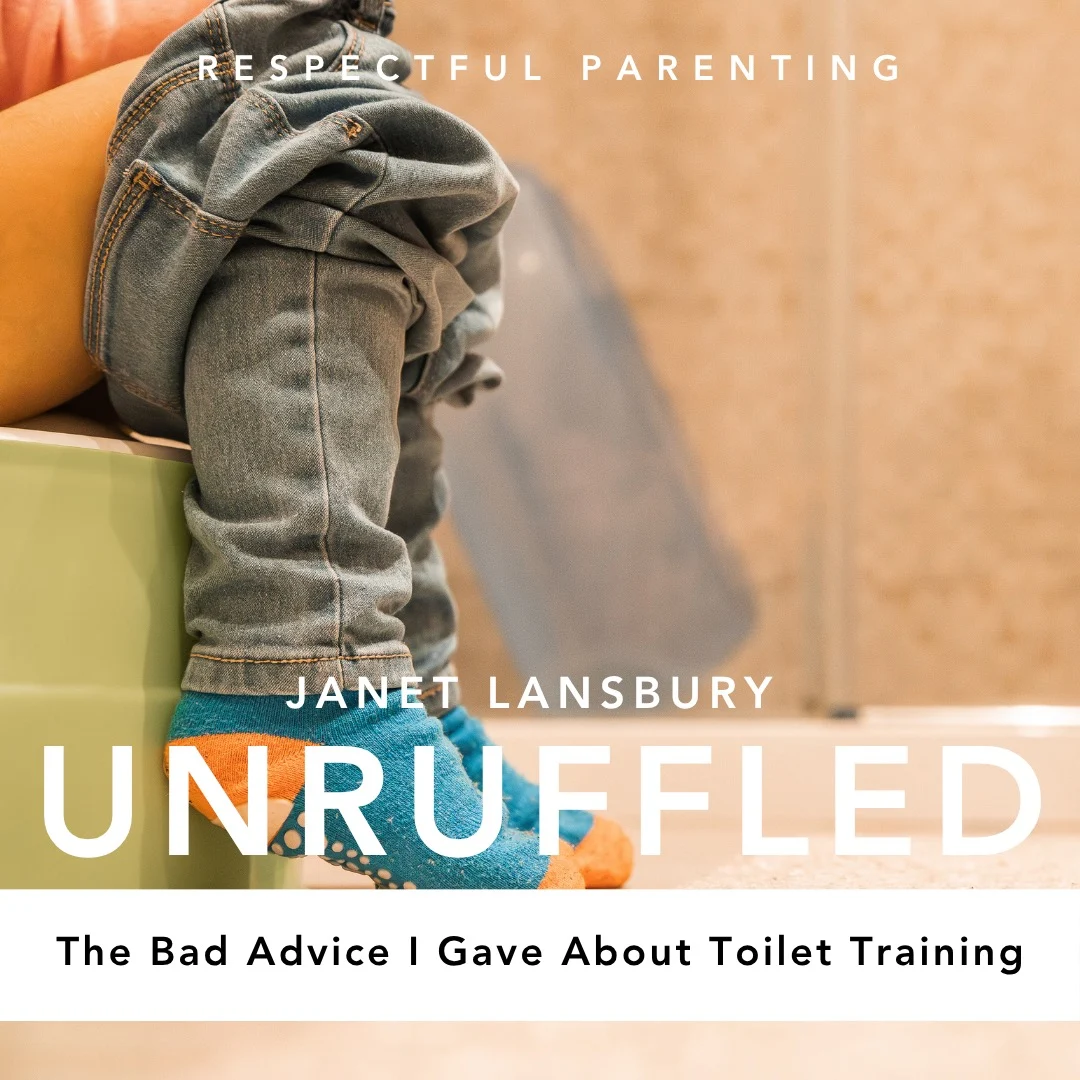
In a significant self-reflection on professional guidance, child development expert Janet Lansbury has publicly acknowledged providing advice on toilet training that ultimately proved unhelpful to a family. Lansbury, known for her "Unruffled" podcast and emphasis on child-led approaches, revisited a past episode where she counseled a parent struggling with a four-year toilet training journey. The parent’s subsequent update revealed that their daughter’s eventual success was achieved by diverging from Lansbury’s recommendations, prompting Lansbury to re-examine her own counsel.
The situation, detailed in a recent episode of "Unruffled," highlights the complexities of child development and the critical importance of aligning advice with a parent’s core beliefs and a child’s unique needs. Lansbury’s core philosophy generally advocates for "toilet learning" guided by the child’s autonomy and natural readiness, rather than a parent-led, often time-bound, training regimen. However, this case presented a scenario where the child’s persistent avoidance clashed with the parent’s growing concern that the "child-led" approach was enabling a developmental delay.
The Parent’s Predicament: A Four-Year Standoff
The initial query to Lansbury came from a parent whose then three-and-a-half-year-old daughter was "absolutely set on being in diapers ‘forever.’" The child displayed all outward signs of physical and cognitive readiness for toilet training, having done so for approximately eighteen months. Despite the parents’ consistent efforts to back off, remove pressure, and adopt an attitude of "I don’t care, you do you," the child remained resistant.
The parent expressed significant doubt, stating, "I’m honestly doubtful that, left to her own devices, she will ever get to the point of feeling ready." This sentiment stemmed from their experience with the child in other areas of life. The daughter was described as a "very fearful and avoidant kid" who consistently required parental guidance to navigate challenges and overcome fears. In these instances, the parents would acknowledge and validate her emotions but then gently encourage her to proceed, a strategy that consistently led to positive outcomes and the child’s eventual enjoyment of new experiences.
This led to a perceived contradiction: the "let-her-lead" approach for toilet training seemed to enable avoidance, potentially feeding a "fear cycle." The parent worried this was out of sync with the child’s otherwise capable and skilled demeanor, and felt like it was "enabling a phobia." The child was characterized as typically developing, though highly sensitive and strong-willed, with a demand-avoidant profile and a need for stable routines.
Lansbury’s Initial Advice: Trust, Boundaries, and Feelings
In the original "Unruffled" episode, titled "When Kids Don’t Seem Motivated (to Potty, Crawl, or Create)," Lansbury addressed situations where children appeared to lack motivation for developmental milestones. Her framework for helping children "get unstuck" and connect with their innate drive included three key remedies:
- Trust: Genuine belief in the child’s natural abilities, motivation, and inner direction, coupled with providing ample opportunities for practice.
- Reasonable Boundaries: Establishing clear limits, which can sometimes be the obstacle when a child seems stuck.
- Welcoming Feelings: Allowing children to experience and express uncomfortable emotions like frustration or uncertainty without parents feeling the immediate need to fix them.
Lansbury’s initial feedback to the parent in question centered on these principles, emphasizing the importance of trusting the child’s innate drive and the potential for mixed messaging to create anxiety. She suggested that the child’s strong resistance and declarations about remaining in diapers indicated she was pushing back against a perceived parental agenda, even if unintentional. Lansbury recommended a clear, unwavering commitment to either the child-led approach or a more decisive parental stance, believing that mixed signals could keep the child in a state of uncertainty. She leaned towards encouraging the parent to fully embrace trust in the child’s timing, suggesting that the child’s play with potty-related toys was a sign of her working through her own process.
The Turning Point: A Shift in Parental Strategy
After a prolonged period of adhering to Lansbury’s advice, the parent reported a lack of progress. As the daughter approached her fourth birthday, the parents, feeling a strong internal conviction that a change was necessary, decided to implement a firm approach. They set a clear boundary: diapers would no longer be an option past the age of four, regardless of the child’s interest.
The initial days of this new strategy were described as "grueling," marked by intense fear and resistance from the child. However, the parents persevered, pushing through the discomfort. The breakthrough, according to the parent, was significant and relatively swift. Within a week, the daughter had no accidents and began using the toilet willingly, with the issue no longer posing a problem.
Parental Reflection: Trusting Inner Instincts
The parent’s update to Lansbury was accompanied by a profound reflection on the experience. "I don’t quite know what to make of this all, and I’m curious about your interpretation," the parent wrote. She expressed regret for not listening to her own instincts earlier, feeling that her daughter was a "scared kid who needed help doing something she was fully capable of." She believed her daughter "could have gotten to age six and never initiated this" without direct parental intervention.
This experience led the parent to question the universality of the "developmental milestone" model for toilet training. For her child, she concluded, it was more akin to overcoming a phobia, requiring a "strong and firm push," similar to getting vaccinations rather than learning to walk. The success was attributed to the parents’ "a hundred percent certainty that it was time despite no interest on her part and that she could do it, but we needed to force the issue." The parent observed that her daughter was now proud of herself and exhibiting more age-appropriate behaviors in other areas, suggesting she "needed this."
Lansbury’s Re-evaluation: Acknowledging the "Bad Advice"
Upon receiving this update, Lansbury expressed genuine happiness for the family’s resolution and acknowledged the possibility that her advice had been unhelpful. She recognized that her previous counsel, while rooted in her established philosophy, may not have aligned with the parent’s underlying instincts and beliefs.
"I was really kind of promoting that she should go the trust direction," Lansbury stated in her re-evaluation. "And when I look back on all of this, that didn’t fit what this parent actually was feeling at all." She realized that suggesting a child-led approach to a parent who harbored significant doubts and anxieties about her child’s readiness created a "mixed messaging" situation that was detrimental. Children, Lansbury explained, are highly attuned to parental emotions and underlying beliefs. When a parent conveys a message of trust but inwardly harbors doubts, the child can sense this inconsistency, leading to anxiety and resistance.
Lansbury’s analysis highlighted that the parent’s description of herself as an "anxious overthinker" was a critical factor. This temperament, while not inherently negative, can be transmitted to children, creating a cycle of anxiety. The parent’s initial attempts to implement Lansbury’s advice, while well-intentioned, were likely undermined by her deep-seated doubts, which her daughter could perceive.
The Nuance of Parental Instinct and External Advice
The core of Lansbury’s re-evaluation lies in the crucial interplay between external advice and a parent’s innate instincts. She emphasized that while research and expert opinions can offer valuable perspectives, they are only effective if they resonate with a parent’s fundamental feelings and beliefs. "If parenting advice from anybody about any aspect of parenting doesn’t feel like that to us, it’s never going to work because it’s not right for us," she asserted.
Lansbury concluded that her advice was unhelpful because it pushed the parent towards a belief system she did not genuinely hold. The parent’s eventual success came from embracing her own conviction – that her daughter was capable and needed a firm push. Lansbury conceded that her prior emphasis on child-led toilet learning, while often effective, might not be universally applicable, particularly when a child exhibits strong avoidance patterns that could be interpreted as a phobia.
The situation underscores a broader implication for parenting advice: it must be personalized and congruent with a parent’s core values and emotional state. The parent’s own reflection, "I know what worked. It was us having a hundred percent certainty," serves as a powerful testament to this principle. Lansbury’s willingness to publicly re-examine her guidance in light of new information demonstrates a commitment to learning and refining her understanding of child development and effective parenting support.
Broader Implications: The Spectrum of Toilet Training Success
This case provides a valuable counterpoint to the dominant narratives surrounding toilet training. While many children do indeed follow a child-led path to independence, others may require a more directive approach, especially when deep-seated fears or anxieties are present. The parent’s experience suggests that for some children, toilet training is not merely a developmental milestone that unfolds organically but a skill that may necessitate parental intervention akin to addressing other challenges that require a clear and confident boundary.
The success achieved by the parent through a more assertive approach challenges the notion that child-led methods are universally superior. It highlights the potential for different strategies to yield positive outcomes, depending on the child’s temperament, the family’s dynamics, and the parents’ conviction. Lansbury’s self-correction serves as a reminder that while expert guidance is important, it should ultimately empower parents to trust their own judgment and align with their deepest instincts, ensuring that advice feels right and resonates with their personal approach to parenting. The ultimate goal, as both Lansbury and the parent agree, is the child’s well-being and confident development, achieved through methods that are authentic and deeply believed in by the caregiver.
