

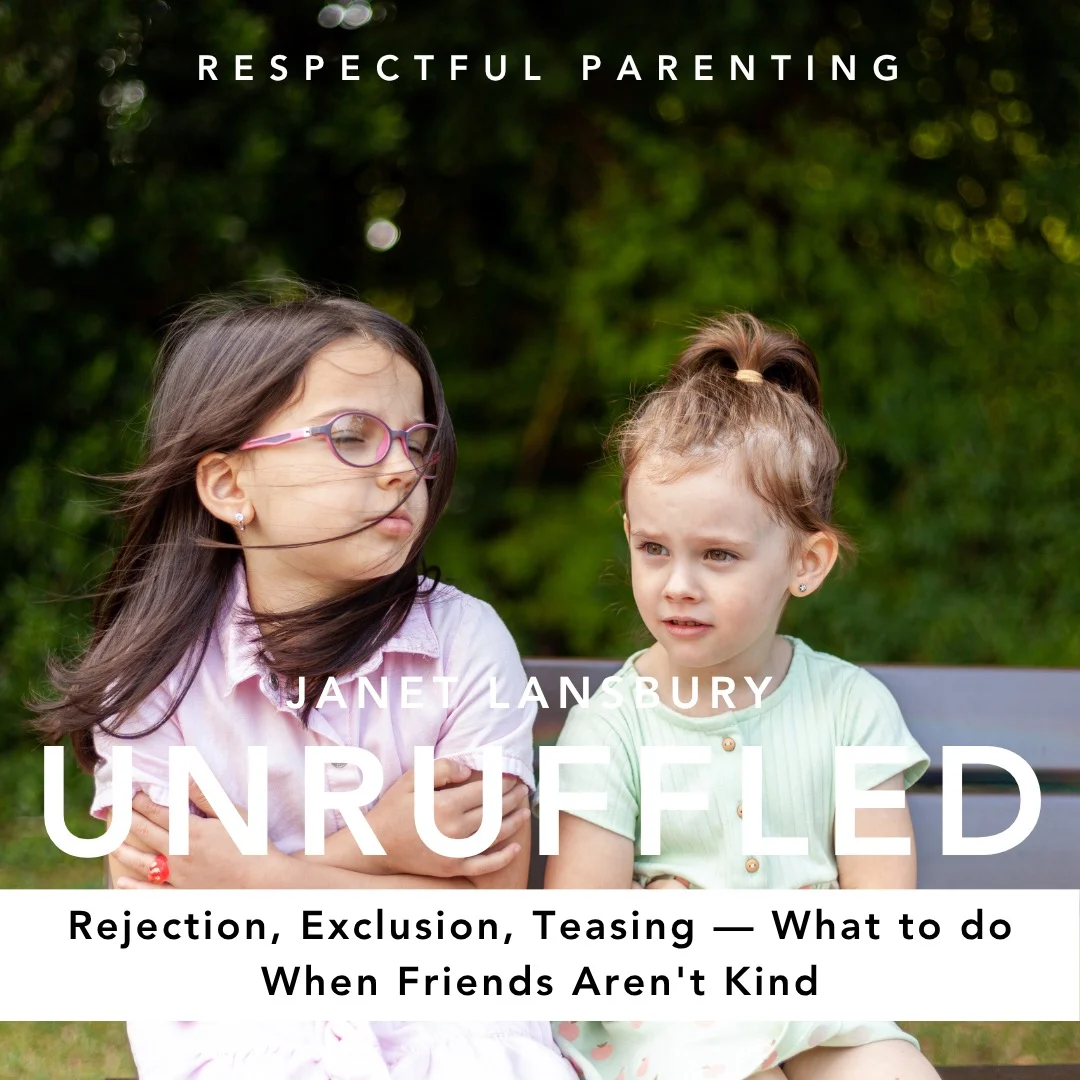
The delicate landscape of childhood friendships often presents parents with a challenging terrain: navigating situations where children experience rejection, exclusion, or teasing from their peers. This phenomenon, while a natural part of social development, can be deeply distressing for both children and their caregivers. Expert advice from early childhood educator Janet Lansbury, featured in a recent article, offers a framework for supporting children through these difficult social interactions. Lansbury’s approach emphasizes empowering children by shifting the focus from parental intervention to fostering their own resilience and understanding of social dynamics.
The core of Lansbury’s philosophy, as detailed in her recent discussion on the podcast "Unruffled," centers on a powerful principle: "People only have power over us when we give it to them." This concept, she argues, is increasingly crucial in an era saturated with social media comparisons and the resulting "fear of missing out" (FOMO). Applying this to childhood friendships, Lansbury suggests that children can learn to recognize when peers are attempting to exert undue influence or control, and that they possess the inherent power to decide how much weight to give to such behaviors.
Understanding the Dynamics of Peer Conflict
Lansbury’s recent insights stem from a compilation of concerns shared by parents of five-year-old daughters, all facing similar issues of unkind peer behavior. These anecdotes highlight common scenarios: friends issuing ultimatums, excluding children, or employing tactics like the "silent treatment" or abrupt endings to playdates. The parents’ distress often stems from witnessing their child’s hurt and confusion, coupled with a natural desire to protect them, which can sometimes lead to over-involvement.
One parent described a recurring pattern where a friend would threaten to end the friendship if her daughter didn’t comply with her wishes, or abruptly cease interaction. "She feels the power in withholding," the parent observed, recognizing the manipulative aspect of the friend’s behavior. This parent’s struggle, common among caregivers, lies in finding the balance between allowing children to resolve issues independently and offering necessary support. The urge to intervene, to mediate, or even to broker agreements between the children, is strong, yet Lansbury cautions against this, suggesting it can inadvertently amplify the perceived power of the negative behavior.
The Principle of Empowering Children: "Giving Power"
Lansbury’s central tenet—that individuals grant power to others—serves as a guiding principle for parents. She draws a parallel to adult experiences, such as focusing on a few critical voices in a crowd rather than the majority’s applause. For children, this translates to recognizing that the emotional impact of a peer’s unkindness is often amplified by the child’s own internal reaction and the attention given to it.
"We can’t let our kids do this, especially not with what they’re up against today," Lansbury states, referring to the constant barrage of social comparisons and perceived slights. The goal, therefore, is to equip children with the understanding that they have agency in how they respond to and are affected by their peers’ actions. This doesn’t negate the validity of their feelings; rather, it reframes the situation as one where the child has the power to choose not to grant significant influence to behaviors that are hurtful or manipulative.
Case Studies: Navigating Exclusion and Bullying
The article delves into specific parental concerns, illustrating how Lansbury’s philosophy can be applied:
-
Case Study 1: Relational Aggression and Exclusion: A parent of a five-and-a-half-year-old is concerned about relational aggression from a friend, including threats to friendship and "icing out" tactics. Lansbury advises stepping back, validating the child’s feelings ("Yes, I saw that," "That hurt your feelings"), but avoiding direct intervention in resolving the conflict. The focus should be on supporting the child’s processing of the experience and trusting her to decide whether to engage with the friend again. The parent’s attempt to orchestrate a rule that children must always respond, even negatively, is seen as an indirect form of intervention that can inadvertently give more power to the situation.
-
Case Study 2: Neighborhood Exclusion and Social Dynamics: A family new to a country faces a situation where two sisters in the neighborhood begin excluding their nearly six-year-old daughter, even encouraging other children to do the same. The parent grapples with how much to intervene and how to interact with the children exhibiting bullying behavior. Lansbury emphasizes trusting the child to manage the situation with parental support at home. She suggests that the parent refrain from direct confrontation with the offending children, as this can sometimes validate their behavior. Instead, focusing on nurturing positive friendships for her daughter and reminding her that the exclusion is a reflection of the other children’s insecurity, not her own worth, is paramount. The parent’s inclination to be less welcoming to the offending children is validated as a natural response, but Lansbury stresses maintaining a balanced approach while prioritizing the child’s emotional well-being.
-
Case Study 3: The "Too Nice" Child and Parental Fears: A parent of a five-year-old, who is described as exceptionally kind and empathetic, fears her daughter will be taken advantage of, mirroring her own past experiences of being bullied. She worries that her daughter’s kindness will be perceived as weakness. Lansbury counters this by distinguishing between kindness and allowing oneself to be mistreated. She highlights that the daughter’s current ability to accept and walk away from exclusion, though sad, is a sign of inner strength. The parent’s fear, rooted in her own history, is identified as a potential barrier to her daughter’s independent development. Lansbury advises against teaching the child to be "mean back," but rather to reinforce her inherent strength and power, encouraging her to seek out friendships with those who reciprocate her kindness.
-
Case Study 4: Bickering and Sibling-like Conflict: In this scenario, the parent’s concern is directed at her own daughter, who, in a familiar friendship dynamic, engages in teasing and annoying behaviors that trigger the parent. The parent admits to being less adept at handling conflict involving her own child compared to others. Lansbury reframes this, suggesting that the "bickering" is a form of power play between the children. She encourages the parent to support both children by reflecting their feelings and experiences back to them, rather than intervening to scold or "fix" the behavior. The parent’s discomfort, amplified by being an only child, is seen as a personal hurdle to overcome, allowing the children to learn from their own interactions.
Broader Implications and Expert Analysis
The recurring themes in these parental concerns—relational aggression, exclusion, and the parent’s struggle with intervention—point to a fundamental challenge in modern parenting: how to foster resilience and social competence in children without inadvertently undermining their agency. Lansbury’s approach offers a counter-narrative to the impulse to over-protect or over-manage children’s social lives.
Supporting Data and Context: Research in developmental psychology consistently underscores the importance of peer relationships in a child’s social and emotional development. Studies have shown that positive peer interactions contribute to the development of empathy, cooperation, and self-esteem. Conversely, experiences of rejection and exclusion can have significant negative impacts, potentially affecting a child’s mental health and academic performance. For instance, a longitudinal study published in the Journal of Personality and Social Psychology indicated that individuals who experienced chronic peer rejection in childhood were at a higher risk for depression and anxiety in adulthood.
The prevalence of social media among young children further complicates this landscape. A 2023 report by the Pew Research Center found that a significant percentage of children aged 8-12 are now using social media platforms, often without parental supervision. This constant exposure to curated online personas and the potential for cyberbullying or social exclusion online can exacerbate anxieties and insecurities that manifest in real-world interactions.
Analysis of Implications: Lansbury’s framework suggests that by empowering children with the understanding that they control the power they give to others’ actions, parents can cultivate a more robust sense of self-worth and resilience in their children. This approach shifts the focus from external validation to internal strength. It implies that while direct intervention may seem like the most immediate solution, it can sometimes disempower children by signaling a lack of trust in their ability to navigate social challenges.
The cases presented illustrate that while the specific behaviors may differ, the underlying parental anxieties often stem from personal experiences and a desire to shield their children from similar pain. This highlights the importance of parental self-awareness. As one parent astutely noted, "this admittedly has quite a lot to do with me." This recognition is a crucial first step in adopting a more supportive, rather than controlling, parenting style.
Conclusion: Cultivating Resilient Friendships
Janet Lansbury’s insights offer a valuable perspective for parents grappling with the complexities of childhood friendships. By focusing on empowering children to understand and control the power they grant to their peers’ actions, parents can foster a generation that is more resilient, self-aware, and capable of navigating the inevitable ups and downs of social life. The underlying message is one of trust—trust in children’s innate abilities to learn, to adapt, and to ultimately choose where they invest their emotional energy and social capital. This approach, while challenging to implement consistently, holds the promise of equipping children with the inner strength needed to build healthy, authentic, and enduring friendships.
