

Nap transitions, the often-turbulent periods when children shift their sleep patterns, present a significant challenge for parents, pediatricians, and sleep consultants alike. Predicting these shifts is notoriously difficult, and the process is rarely smooth. A recent surge in social media engagement surrounding a short video clip from the "Sleep Edit" podcast, specifically an episode dedicated to napping, highlights the widespread parental concern and scientific intrigue surrounding this developmental milestone. The video, which briefly recapped a study linking hippocampal development to nap transitions, garnered exceptional attention, demonstrating that this topic resonates deeply with families navigating early childhood.
A Social Media Phenomenon and its Underlying Science
The viral success of a short video discussing nap transitions and brain development underscores the universal nature of this parenting challenge. Originally published in November 2025 and last reviewed in December 2025 by Craig Canapari, MD, the article delves into the scientific underpinnings of why these transitions are so complex. The core of the discussion revolves around a hypothesis originating from the University of Massachusetts (UMass) that posits a direct correlation between the maturation of the hippocampus—a crucial region of the brain responsible for memory formation—and a child’s evolving napping habits.
This concept, that changes in brain development dictate shifts in sleep needs, intuitively makes sense. As the brain matures, its capacity to process and consolidate information changes, consequently altering the requirement for restorative sleep. The overwhelming response on social media platforms like Instagram, TikTok, and YouTube, with hundreds of thousands of views and numerous comments, indicates that this scientific perspective provides a much-needed framework for understanding a seemingly chaotic aspect of early childhood. Parents and caregivers frequently shared personal anecdotes, posed questions, and offered humorous observations, solidifying nap transitions as a quintessential early childhood sleep dilemma.
Parental Perspectives: The Real-World Nap Math
The online conversation revealed several recurring themes among parents grappling with nap transitions:
The Spark of Curiosity
A significant portion of the engagement stemmed from a newfound curiosity about the link between napping and cognitive development. Comments such as, "So interesting! I never thought naps could be linked to brain development," and "Makes total sense once you think about memory consolidation," highlight how this scientific insight provided a novel perspective on a familiar struggle. This natural curiosity serves as a valuable bridge between home-based observations and scientific inquiry.
The Inevitable "In-Between" Phase
Many parents described the frustrating reality of the "in-between" phase, a period characterized by conflicting sleep needs. One common sentiment was, "If my three-year-old naps, bedtime is a disaster. If he skips it, he’s cranky for three hours – there’s no winning." This accurately captures the dilemma where a child may still require a nap for overall well-being but is beginning to resist it, or naps inconsistently, leading to disrupted evening sleep. Dr. Canapari often advises parents that children do not unilaterally decide to stop napping; rather, there is a transitional period where their internal clocks are shifting, leading to resistance or altered sleep patterns.
Acknowledging Individual Variability
Parents also emphasized that each child’s developmental trajectory is unique. Anecdotes like, "My daughter stopped napping right after turning two and her memory is incredible," and "Our son gave up naps around 2½ and he’s seven now – super mature and focused," illustrate this point. These personal experiences do not contradict the scientific findings but rather underscore the inherent variability in brain development. The maturation of neural systems is not a synchronized event; it unfolds at different rates for each child.
Seeking Clarity and Deeper Understanding
Several parents sought more detailed explanations, asking questions such as, "Does dropping naps that young affect other parts of growth?" and "Are we talking about dropping all naps or just cutting from three to two?" These inquiries highlight the need for clear, evidence-based information. The referenced UMass study primarily focused on the transition from multiple naps to a single nap, and its findings do not suggest a need to alter established sleep schedules based solely on this research.
Ingenuity in Practice: Creative Solutions
The discussion also showcased parents’ ingenuity in finding practical solutions. For instance, when daycare mandates naps but evening sleep is disrupted, parents inquire about communicating with educators. Others shared successful strategies like replacing naps with "quiet time," involving books and soft music, which have proven to be "game-changers." These approaches demonstrate a pragmatic application of sleep science, prioritizing adequate rest and family harmony over rigid adherence to a specific nap schedule.
The Scientific Foundation: Decoding the Hippocampus and Sleep
The article refers to a seminal perspective piece by Spencer and Riggins, published in the Proceedings of the National Academy of Sciences of the United States of America (PNAS) in 2022. This publication is not a report of new experimental data but rather a synthesis of existing research, proposing a novel model for understanding the interplay between brain development and nap timing.
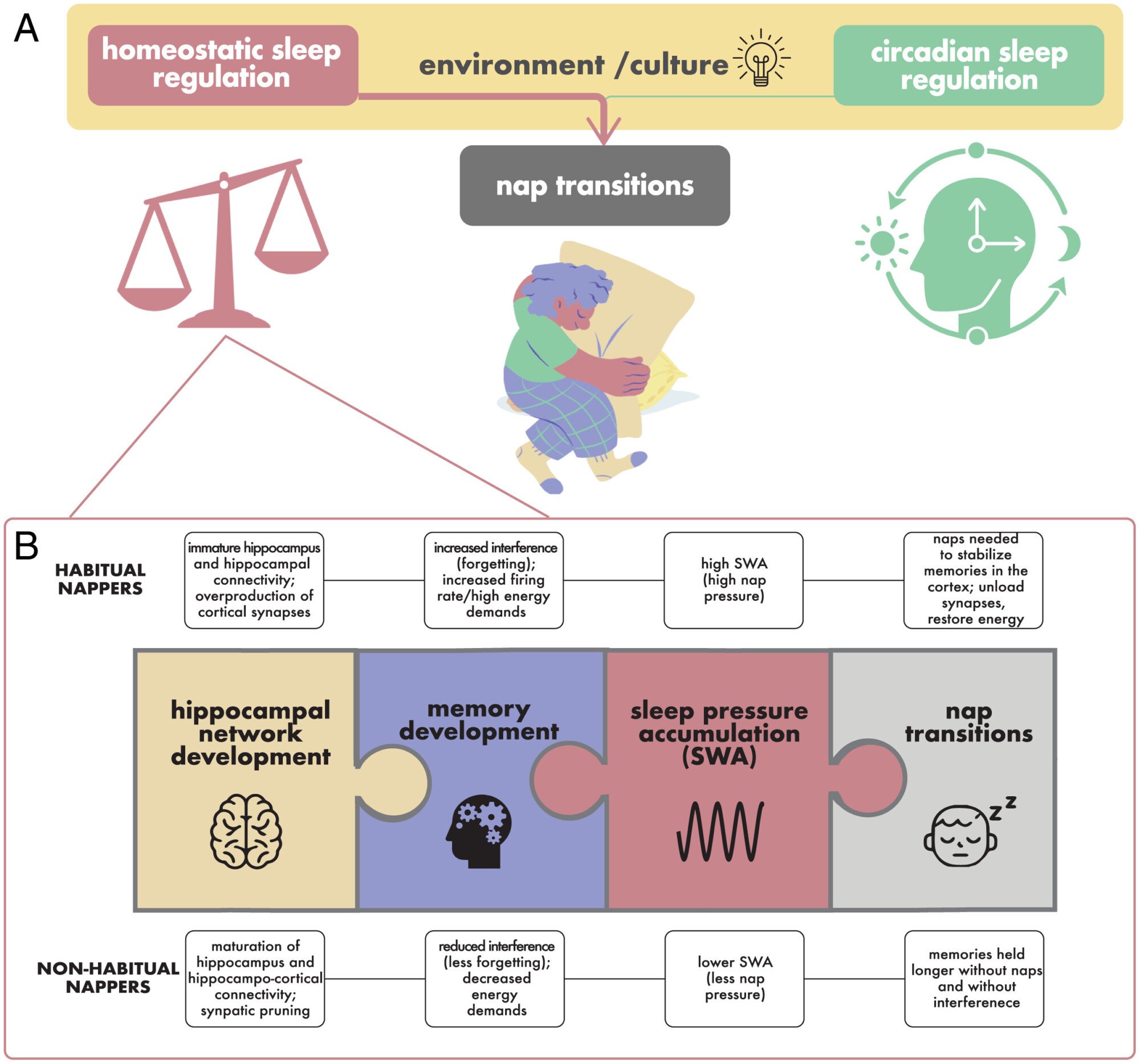
The authors begin by outlining the established factors influencing sleep-wake timing: sleep drive and the circadian clock. Sleep drive, a fundamental concept, refers to the increasing pressure to sleep the longer one is awake. This drive accumulates more rapidly in infants and slows down as children mature, explaining the progression from multiple naps in newborns to fewer naps in toddlers and preschoolers. However, the exact timing of nap transitions—from three to two naps, two to one, or ceasing naps altogether—remains unpredictable.
Typical Nap Transition Timelines:

| Nap Transition | Typical Age Range | Description |
|---|---|---|
| 3 naps → 2 naps | 6–9 months | Morning, midday, and late afternoon naps consolidate to two (morning and afternoon) naps. |
| 2 naps → 1 nap | 12–18 months | Morning nap drops; most children nap only in the afternoon. |
| 1 nap → no naps | 3–5 years | Afternoon nap gradually ceases; most children stop napping by age 5. |
The broad age ranges presented in this table underscore the inherent variability in these developmental milestones.
The UMass study posits that the maturation of the hippocampus plays a pivotal role in this variability. As the hippocampus becomes more efficient in memory consolidation, the brain may require fewer naps to process new information. The hippocampus, named for its seahorse-like shape, is a deep brain structure vital for learning and memory, particularly for emotional memories.
The authors articulate a unique developmental challenge in early childhood: "there is a massive amount of information that must be learned, yet the neural systems that support learning are still under construction." During this period, the brain undergoes rapid synaptic proliferation, forming numerous connections between neurons. This is followed by synaptic pruning, a process where less useful connections are eliminated to strengthen efficient pathways.
In early childhood, however, the sheer volume of new information encountered leads to an overproduction of synapses, peaking during these formative years. Naps, therefore, are theorized to act as a crucial mechanism for managing this cognitive load. The PNAS perspective suggests that "naps provide a solution to what is essentially a memory problem; high learning demands on an immature system create an overproduction of synapses that reaches its peak in early childhood. Sleep has been argued to help meet space and energy challenges associated with development… Thus, we posit that early childhood is a time of competing demands of learning, which loads the brain (the hippocampus in particular), and sleeping, which may unload synapses across the cortex."
This complex interplay is visually represented in a diagram from the Spencer and Riggins paper, illustrating how learning demands and sleep interact with brain development.
Specifically, slow-wave activity (SWA), characteristic of deep sleep, is strongly associated with the consolidation of emotional memories. The article highlights a particularly insightful passage: "Interestingly, SWA in children’s naps predicts the overnap protection of memory for emotional faces… and also, predicts reductions in the emotional attention bias following a nap in young children… We posit that consolidation of emotional memories from the morning decreases emotional load, and as a result, children are less reactive to emotional stimuli thereafter. This provides a potential explanation of the oft observed phenomena that habitually napping children are emotionally dysregulated at the end of the day if they do not nap (the ‘witching hour’)."
This suggests that a missed nap can lead to a child’s inability to process the day’s emotional experiences, resulting in heightened irritability and dysregulation, commonly referred to as the "witching hour."
Implications for Daily Parenting and Future Research
The scientific insights presented offer valuable context for parents, but it is crucial to interpret them correctly. The article explicitly states that the research does not suggest the following:
- Mandatory Nap Schedules: There is no indication that parents should force naps or rigidly adhere to a specific schedule beyond what is developmentally appropriate for their child.
- Negative Consequences for Early Nap Cessation: Children who stop napping earlier than average are not necessarily experiencing negative developmental outcomes.
- Universal Sleep Needs: The broad age ranges for nap transitions emphasize that every child’s developmental timeline is unique.
For families struggling with nap challenges, seeking personalized advice from pediatricians or certified sleep consultants is recommended. The article also alludes to the need for continued research to further elucidate the precise mechanisms by which hippocampal development influences sleep patterns and to develop more accurate predictive models for nap transitions.
The overarching message from this research and its public reception is clear: nap transitions are a normal part of child development, not a reflection of parental success or failure. The variability in these transitions underscores the importance of individualized approaches. Parents experiencing early nap cessation should not feel guilt; it is a common, albeit sometimes frustrating, developmental phase.
As Dr. Canapari encourages further dialogue, sharing strategies and experiences remains vital. The ongoing conversation on social media and in parenting communities highlights the shared journey of raising children and the collective effort to understand their complex developmental needs. For those seeking more in-depth information, resources such as Episode 15 of "The Sleep Edit" podcast, which includes helpful graphics in its YouTube version, and Dr. Canapari’s blog post on nap problems, offer further guidance.
The science behind napping and memory consolidation provides a compelling framework for understanding these developmental shifts. By bridging the gap between scientific discovery and practical parenting, these insights empower families to navigate nap transitions with greater understanding and a more evidence-based approach. The continued exploration of this fascinating intersection of sleep, memory, and brain development promises to offer even more clarity and support for parents in the future.