

The complex journey of childhood sleep, particularly the often-turbulent transitions between nap stages, has captured significant attention, sparking widespread discussion among parents, pediatricians, and sleep specialists alike. Originally published in November 2025 and updated by Craig Canapari, MD, in December 2025, this exploration delves into the scientific underpinnings of these developmental shifts, highlighting a recent surge in interest fueled by a viral social media post. The post, an excerpt from the "Sleep Edit" podcast, focused on a UMass-based hypothesis linking nap transitions to the maturation of the hippocampus, a crucial brain region for memory.
A Viral Phenomenon: Unpacking the Public’s Fascination with Nap Science
In late 2025, a short-form video shared across social media platforms unexpectedly achieved remarkable virality, garnering hundreds of thousands of views and sparking a robust online conversation. The reel, a brief recap of a podcast episode discussing napping and brain development, significantly outperformed any previous content shared by Dr. Craig Canapari. On November 2nd, 2025, the video had amassed 185,000 views on Instagram, 117,000 on TikTok, and over 1,100 on YouTube. This widespread engagement, evidenced by over 60 comments on the Instagram post alone, underscores the profound impact and universal challenge of nap transitions for families worldwide. The core of the viral content centered on research suggesting that the evolving capacity of the hippocampus to manage memory consolidation is intrinsically linked to changes in a child’s nap schedule. This intuitive connection—that as a child’s brain develops, their sleep needs adapt—resonated deeply with a broad audience.
Parental Perspectives: The Real-World Impact of Nap Transitions
The online discussion surrounding the research revealed a consistent pattern of parental experiences and concerns. Many commenters expressed immediate curiosity, noting how the scientific explanation offered a new perspective on observed behaviors. "So interesting! I never thought naps could be linked to brain development," one user shared, while another commented, "Makes total sense once you think about memory consolidation." This initial curiosity often segued into discussions about the practical challenges of navigating these transitions.
A prevalent theme emerged: the "no-win" scenario many parents find themselves in. "If my three-year-old naps, bedtime is a disaster. If he skips it, he’s cranky for three hours – there’s no winning," expressed one parent. This sentiment was echoed by others describing the "weird in-between" phase where a child still seems to require a nap, but its timing or duration disrupts nighttime sleep. Dr. Canapari often advises parents that children don’t simply "decide" to stop napping; rather, there’s frequently a period of resistance or inconsistency, where a child might nap at daycare but refuse on weekends, or need a nap but resist it, leading to overtiredness.
Furthermore, parents frequently shared anecdotes highlighting the variability in developmental timelines. "My daughter stopped napping right after turning two and her memory is incredible," stated one commenter, while another noted, "Our son gave up naps around 2½ and he’s seven now – super mature and focused." These personal accounts, while not contradicting the scientific findings, effectively illustrate the broad range of typical development. The maturation of the hippocampus, like other developmental milestones, is not a synchronized event across all children.
Requests for greater clarity also surfaced. Questions such as, "Does dropping naps that young affect other parts of growth?" and "Are we talking about dropping all naps or just cutting from three to two?" indicate a need for more detailed, evidence-based guidance. The authors of the foundational research primarily focused on the transition from multiple naps to one, with no indication that such changes necessitate altering a child’s established sleep schedule. The conversation also included the sharing of practical solutions, such as switching to "quiet time" with books and soft music instead of a formal nap, a strategy reported to be a "game-changer" for some families. These creative workarounds demonstrate the pragmatic approach parents take to balance their child’s need for rest with the family’s daily routines and overall well-being. Amidst these earnest discussions, a humorous observation stood out: "I guess my husband’s hippocampus is still developing!"
The Scientific Foundation: Memory, Synaptic Pruning, and the Hippocampus
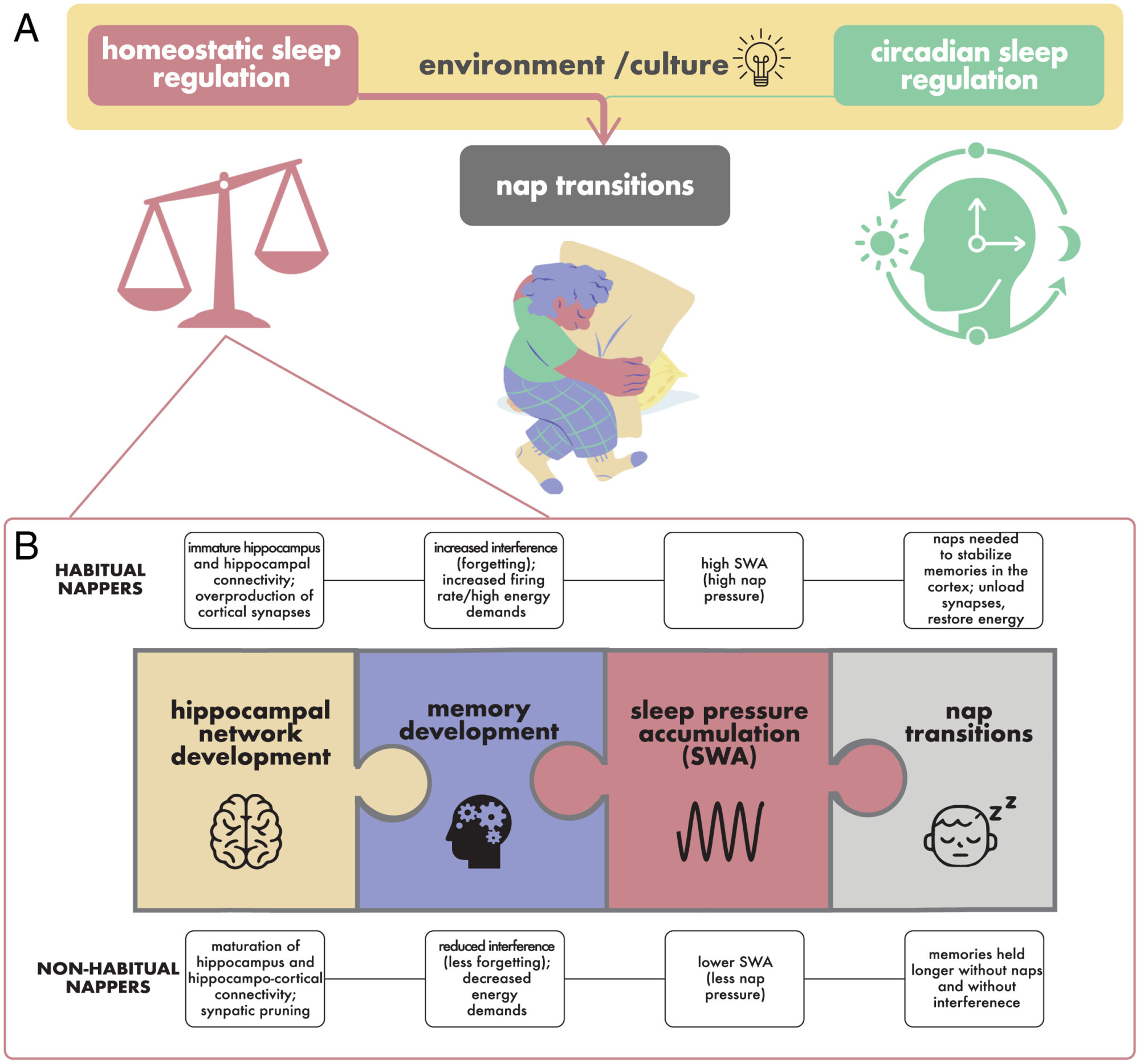
The research that ignited this widespread interest is a perspective piece titled "Contributions of Memory and Brain Development to the Bioregulation of Naps and Nap Transitions in Early Childhood," published in the Proceedings of the National Academy of Sciences of the United States of America (PNAS) in 2022 by Spencer and Riggins. This article is not an experimental study but a synthesis of existing research, proposing a novel framework for understanding nap patterns through the lens of brain development.
The authors begin by outlining the two primary regulators of sleep-wake cycles: sleep drive and the circadian clock. Sleep drive, the cumulative effect of being awake, naturally increases the urge to sleep. This drive accumulates more rapidly in infants and slows as children mature, explaining the decreasing number of naps throughout early childhood—from multiple naps for newborns to one nap for toddlers and, eventually, no naps for preschoolers. However, the exact timing of nap transitions remains notoriously unpredictable.

The PNAS article posits that the maturation of the hippocampus plays a significant role in this unpredictability. The hippocampus, a seahorse-shaped structure deep within the brain, is fundamental to learning and memory consolidation, particularly for emotional experiences. As the hippocampus becomes more efficient at processing and storing information, the brain’s demand for naps—which are crucial for "offloading" newly acquired data—may decrease.
This hypothesis is rooted in the understanding of synaptic plasticity during early childhood. The brain experiences a period of rapid synapse formation, creating an abundance of neural connections. However, to optimize cognitive function, this exuberance is followed by synaptic pruning, a process where less-used connections are eliminated, and stronger ones are reinforced. The authors suggest that naps, especially those with significant slow-wave activity (deep sleep), are vital during this developmental stage. They propose that sleep helps manage the "space and energy challenges" associated with this intense period of learning, acting as a mechanism to "unload synapses across the cortex" and prevent the brain from becoming overwhelmed.
The authors highlight the connection between slow-wave activity during naps and the consolidation of emotional memories. Naps, by processing morning experiences, can reduce the emotional load on the brain. This, they argue, can explain the common phenomenon of the "witching hour"—the end-of-day dysregulation observed in overtired children who have missed their naps. Without the restorative processing of emotions that a nap provides, children may become more reactive to stimuli, leading to increased irritability and difficulty winding down for bedtime.
Typical Nap Transitions: A Broad Developmental Timeline
Understanding the general trajectory of nap transitions provides a helpful context for the scientific discussion:
| Nap Transition | Typical Age Range | Description |
|---|---|---|
| 3 naps → 2 naps | 6–9 months | Consolidation of morning, midday, and late afternoon naps into two naps. |
| 2 naps → 1 nap | 12–18 months | Dropping of the morning nap, with most children transitioning to one afternoon nap. |
| 1 nap → no naps | 3–5 years | Gradual cessation of the afternoon nap, with most children stopping by age five. |
The broad age ranges associated with these transitions underscore the inherent variability in this developmental process. This variability is not a sign of concern but rather a reflection of individual differences in brain maturation and environmental influences.
Implications for Parents and Guardians
The research offers valuable insights for parents navigating nap transitions:
- Developmental, Not Moral: The article emphasizes that nap transitions are a normal part of child development, not a measure of parental success or failure. Each child progresses at their own pace, and comparing one child’s sleep patterns to another’s can be counterproductive.
- Understanding the "Why": The link between hippocampal development and nap needs provides a scientific rationale for why nap schedules change. It shifts the focus from a behavioral battle to a developmental process.
- Flexibility is Key: The broad age ranges for nap transitions highlight the importance of observing individual children rather than adhering to strict schedules. Some children may naturally transition earlier or later than the typical timeline.
- No Recommended Schedule Changes: The study does not advocate for altering a child’s sleep schedule based on this research. Instead, it offers an explanation for observed changes.
- Emotional Regulation and Naps: The connection between naps and the processing of emotional memories offers a scientific explanation for increased fussiness when naps are missed. This understanding can help parents approach these challenging moments with more empathy and patience.
Broader Impact and Future Directions
The viral dissemination of this information underscores a growing public interest in the intersection of sleep science and child development. The overwhelming engagement suggests a societal need for accessible, evidence-based information on topics that directly impact family well-being. This widespread discussion can empower parents with a deeper understanding of their child’s needs, potentially reducing parental anxiety and fostering more informed decision-making regarding sleep routines.
Future research could explore longitudinal studies to further validate the proposed link between specific patterns of hippocampal maturation and the precise timing and duration of nap transitions. Investigating the influence of various environmental factors, such as educational settings and daily routines, on these developmental sleep changes would also be beneficial. Furthermore, translating these complex neuroscientific findings into practical, easily digestible guidance for parents remains a critical endeavor.
The conversation initiated by this research highlights that while the science of sleep is intricate, its impact on everyday family life is profound. By understanding the underlying biological mechanisms, parents can approach the challenging, yet ultimately rewarding, journey of childhood sleep with greater knowledge, patience, and a renewed appreciation for the remarkable development occurring within their child’s brain.