

Published November 2025. Reviewed by Craig Canapari, MD.
The approaching holiday season, a time often associated with joyous family gatherings and cherished traditions, frequently brings with it a significant underlying concern for parents: the potential disruption of their children’s sleep schedules. For many, the meticulous effort invested in establishing consistent sleep patterns—from sleep training to maintaining regular bedtimes—feels precariously balanced against the realities of travel, unfamiliar environments, and shared accommodations. However, pediatric sleep medicine experts suggest that much of this parental anxiety may be disproportionate to the actual impact on children’s sleep.
Dr. Craig Canapari, a pediatrician with 21 years of experience in sleep medicine and an 18-year parent himself, asserts that children possess a remarkable degree of resilience when faced with short-term disruptions to their sleep routines. He posits that parental anxiety, rather than the disruptions themselves, often exacerbates the situation. This perspective is drawn from years of clinical practice and personal experience, including a period where his own child’s sleep was significantly affected by travel.
"My oldest child used to experience a night terror every single night we slept in a new place," Dr. Canapari recounts. "Neither my parents nor my in-laws lived in large houses, so his screaming would wake the entire household. Nothing undermines your credibility as a ‘sleep expert’ quite like being unable to soothe your child through a prolonged nighttime episode." This personal anecdote underscores the common parental struggle to reconcile professional knowledge with the emotional intensity of a child’s sleep distress.
Dr. Canapari’s insights, shared with a broad audience through his newsletter and online platforms, aim to alleviate the pervasive stress many parents associate with holiday travel and sleep. He emphasizes that the fundamental principle for navigating these disruptions lies not in rigidly adhering to exact timings, but in preserving the core elements of the bedtime routine.
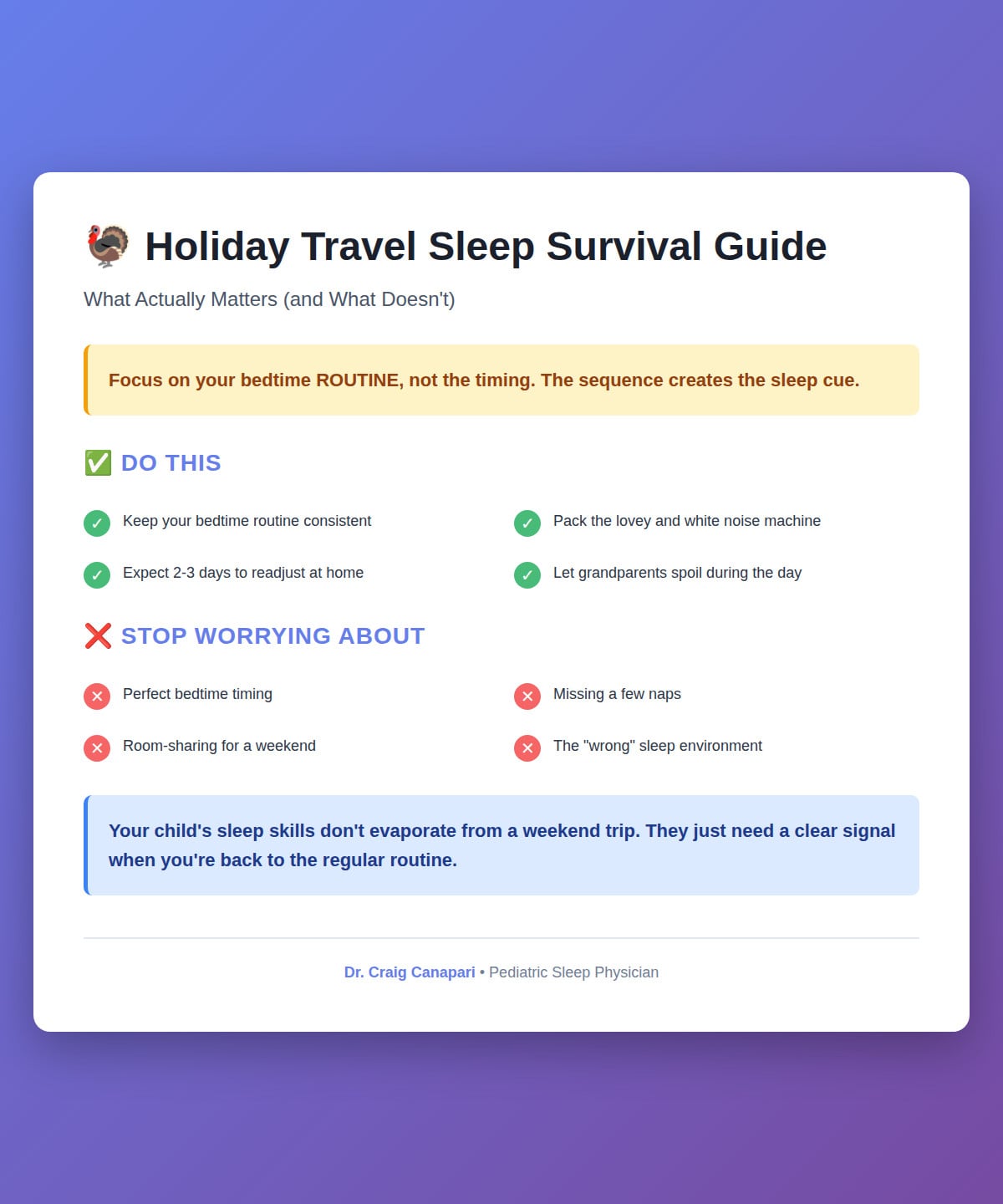
"The sequence of events preceding sleep is the crucial cue for a child’s body and mind that it’s time to wind down," Dr. Canapari explains. "Whether it’s a bath followed by a book, or pajamas, teeth brushing, stories, and then lights out, replicating this established sequence, even if the timing shifts by an hour or two, provides a vital sense of continuity and predictability." This consistent ritual acts as an anchor, offering comfort and a signal for sleep, thereby reducing the anxiety for both child and parent.
The Foundation: Prioritizing Routine Over Exact Timing
The cornerstone of Dr. Canapari’s advice for managing sleep during holiday travel revolves around the concept of maintaining the bedtime routine itself, rather than fixating on precise timings. This approach acknowledges the reality that travel inherently introduces variables that make strict adherence to a schedule impractical, if not impossible.
"If your home routine involves a bath, followed by a story, and then bedtime, the objective is to replicate that sequence at your destination," Dr. Canapari advises. "Even if this means the bath happens at 9 PM instead of the usual 7:30 PM, the act of going through the familiar steps provides a powerful sleep cue. This consistency is far more beneficial than the exact clock time."
This principle is supported by research in child development, which highlights the importance of predictability and routine in fostering a sense of security for young children. When children know what to expect, their anxiety levels tend to decrease, making it easier for them to transition into sleep. The sensory experiences associated with familiar bedtime rituals—the warm water of a bath, the texture of a favorite book, the sound of a parent’s voice—all contribute to a calming effect that can override the novelty and potential stress of a new environment.
Addressing Common Parental Concerns: Expert-Led Q&A
Dr. Canapari’s expertise is frequently sought by parents grappling with specific travel-related sleep challenges. His newsletter subscribers recently shared their most pressing worries, which he addresses directly, offering practical, evidence-based solutions.
Shared Rooms and Sibling Dynamics
One of the most frequently cited concerns involves sharing sleeping spaces with multiple children, particularly when siblings have not previously shared a room. Christina, a parent of a baby and a toddler, expressed her apprehension: "I’m concerned about room sharing with both children. We currently share a room with the baby, but the baby and toddler have never slept in the same room together. The toddler likes to ‘play’ with the baby, and we need to keep a close eye on him."
Dr. Canapari acknowledges the legitimacy of this concern, especially when safety is a factor. He proposes a "staged bedtime approach" to manage this situation effectively. This involves putting the younger child (the baby, in this case) to bed first, ensuring they are settled. Once the baby is asleep, the older child (the toddler) can be brought into the room and settled. This minimizes the opportunity for the toddler to disrupt the baby’s sleep.
"If the toddler is likely to wake the baby, consider strategies like a separate, dimly lit space for the toddler to wind down before entering the shared sleeping area," Dr. Canapari suggests. He also advises against practicing new room-sharing arrangements at home specifically to prepare for travel, arguing that it can create unnecessary stress and that children often adapt more readily in the context of the travel experience itself. The emphasis remains on managing the immediate situation with practical tactics rather than preemptive, potentially anxiety-inducing, practice sessions.
Post-Sleep Training Travel
For parents who have recently completed sleep training, the prospect of travel can be daunting. Lashay, whose 9-month-old was sleep-trained using the Ferber method just a month prior, worries about regression during a two-week stay with her parents: "We just sleep trained our 9-month-old using Ferber last month. We’re staying at Grandma and Grandpa’s for 2 weeks. What if she wakes up every hour crying? What do I say to my parents who are hearing their granddaughter cry?"
Dr. Canapari reassures parents that a successfully sleep-trained baby typically retains those skills even in new environments. The key is to recognize that any crying is likely a temporary adjustment rather than a complete loss of training.
"A sleep-trained baby will often fall asleep independently in a new environment," he states. "While there may be some initial fussiness as they adjust to the new surroundings, they are equipped with the tools to resettle themselves." He advises parents to anticipate a brief period of adjustment, perhaps 10-15 minutes of crying at bedtime, and to communicate this expectation clearly to their hosts.
"Before you arrive, have a frank conversation with your parents," Dr. Canapari recommends. "’She might cry for 10-15 minutes at bedtime while she adjusts. This is normal, and she’s not in distress. We’ll be right outside the door, but we’re not going to pick her up unless something is genuinely wrong. If you hear crying, please don’t knock or come in, as that will make it harder for everyone.’" He suggests leveraging his professional standing if necessary, stating, "Our pediatric sleep doctor said this is normal adjustment, and we should stick to our routine." This approach empowers parents to maintain their chosen sleep strategies while managing the expectations of family members.
Navigating Bedtime During Road Trips
The logistics of road travel, particularly when it intersects with bedtime, present another common challenge. Sarah’s concern about driving home at bedtime exemplifies this: "We’re leaving at 7:30 PM and won’t be home until 10 PM. Both kids go to sleep before 9 PM every night. Should I do a modified routine before we get in the car, or wait until we get home?"
Dr. Canapari advocates for a proactive approach that minimizes disruption. "Before the drive, initiate a brief, abbreviated bedtime routine at your destination," he advises. This could include putting on pajamas and reading a quick story. The goal is to signal that bedtime is approaching, even if the full routine cannot be completed.
"In the car, allow for sleep to happen naturally," he continues. "If they fall asleep, let them. Upon arrival home, the key is to get them into their own beds as quickly as possible, even if they are still drowsy. A full bedtime routine is not necessary at this late hour." He notes that children typically wake at their usual time the following morning, regardless of when they fell asleep, and suggests allowing a slight extension of sleep the next day if possible, enabling parents to enjoy a moment of quiet.
Extended Vacations and Hyperactivity
Longer trips, such as a 2.5-week vacation to Hawaii, introduce the challenge of sustained disruption and heightened excitement. Lisa, whose children are 4 and 7, notes: "My kids get really hyper and excited on trips and usually share a room/bed. They stay up really late. It’s fun for a few days, but when we travel for longer than 5-6 days, it gets exhausting."
For extended stays, Dr. Canapari stresses the need for a more structured approach beyond mere survival mode. He points to a combination of excitement and the "circadian ‘forbidden zone’"—a period when children are overtired and may become more hyperactive—as contributing factors.
"Establish a ‘vacation bedtime’ that is later than their usual home bedtime, but still within a reasonable range," he recommends. This might involve a bedtime that is 30-60 minutes later than usual, gradually extended over a few days. "The key phrase to use is, ‘Vacation bedtime starts now. You don’t have to sleep, but you do have to stay in your bed quietly.’" This provides boundaries while acknowledging the vacation context.
Regarding Hawaii specifically, Dr. Canapari notes that the two-hour time difference can be advantageous. "Their 8:30 PM Hawaii time is 10:30 PM body time, so they’ll likely be tired," he explains, while also acknowledging the potential for sleep to shift later in the day. He elaborates on time zone adjustments in a later section, emphasizing that while time differences require strategic management, they can also offer unexpected benefits.
The Drive Home Nap Dilemma
The disruption of naps during travel is a significant concern, particularly when it leads to overtiredness. Evan’s question about a mid-day Thanksgiving travel scenario highlights this: "Our Thanksgiving is 1.5 hours away and starts at 12:30 PM. We’ll be home for bedtime, but naps will be a mess. Early bedtimes when they skip naps only make our early wake-ups worse."
Dr. Canapari confirms the validity of this observation, noting that an overly early bedtime can sometimes trigger even earlier wake-ups. His recommended strategy focuses on maintaining some semblance of a nap schedule and avoiding drastic bedtime shifts.
"If your child typically naps, try to facilitate a nap in the car on the way to your destination," he suggests. "Even a shortened nap is better than none." Upon arrival, if the nap is missed, the focus should be on maintaining the usual bedtime, rather than moving it earlier. "For children who are already 6 AM risers, an early bedtime can trigger a 4:30 AM wake-up. It’s preferable to have one slightly cranky evening than several difficult mornings."
Time Zone Transitions: A Deeper Dive
Time zone changes, whether due to red-eye flights or significant geographical shifts, are acknowledged as more challenging than simple itinerary changes. Jamie and Christina’s shared concern about time zone differences is a common one.
Dr. Canapari outlines a strategic approach for managing time zone travel: "For flights that depart after bedtime, consider initiating the bedtime routine at home, then boarding the plane. Once on board, you can continue the routine with a book or quiet activity. The goal is to create a sense of normalcy within the travel environment."
He introduces the "3-hour rule" for time zone adjustments: "If you are crossing three or more time zones, plan for three to five days of adjustment upon arrival and a similar period upon returning home, if you intend to shift your child’s schedule to the local time." This acknowledges that biological clocks do not instantly recalibrate.
Time Zone Notes:
For shorter trips, typically three to four days, Dr. Canapari advises maintaining the home schedule as much as possible, especially if traveling with immediate family. Controlling light exposure through blackout curtains can be particularly helpful in both scenarios.
- Traveling East: This is generally easier for children, as it tends to shift their natural sleep and wake times earlier. For example, a child who typically sleeps from 7 PM to 6 AM at home might find their body clock adjusting to a 10 PM to 9 AM schedule in a later time zone. While perfect alignment is rare, this shift can allow for more relaxed evenings and potentially later morning wake-ups, especially with the aid of blackout curtains to block early morning light.
- Traveling West: This can be more challenging for younger children, as it encourages later wake times. A 7 PM to 6 AM sleeper in one time zone might find their natural rhythm shifting to 4 PM to 3 AM in a westward destination. For families anticipating evening activities, a gradual shift of bedtime by 30-60 minutes each day in the week prior can be beneficial. Blackout curtains are crucial here to help children fall asleep earlier at the local bedtime when daylight may still be present.
Upon returning home, children generally readjust relatively quickly, though some adjustment period is still expected. Dr. Canapari addresses an unusual case where a one-year-old took two months to recover sleep patterns after a trip, suggesting that persistent issues might indicate underlying factors beyond simple time zone adjustment, such as significant routine changes or other sleep disorders. He recommends consulting a pediatrician or sleep specialist if sleep patterns do not normalize within one to two weeks.
Theme Park Sleep Chaos
Theme parks, with their sensory overload, present a unique set of sleep challenges. Sonya’s question about Disney trips reflects this: "Tips on sleep during holiday Disney trips would be great. Would they get overstimulated from the lights, people, noise? What about during transport—car/plane?"
Dr. Canapari acknowledges theme parks as significant sleep disruptors, but reiterates that for short trips, this is an acceptable trade-off for the experience. His "Disney survival strategy" involves:
- Prioritizing naps: "Allow naps to happen, even if they are shorter than usual," he advises. "You cannot control every nap on a Disney trip."
- Embracing the routine: "Stick to your bedtime routine as closely as possible, even if it’s later than usual." This provides a familiar anchor amidst the excitement.
- Managing stimulation: "After a long day, create a calm environment in the hotel room. Dim lights, avoid screens, and engage in quiet activities."
For transport naps, he reiterates: "Let them happen. Don’t fight it." The unpredictability of naps during such trips is part of the experience, and parents are encouraged to be flexible.
Essential Packing for Sleep Success
Based on these common concerns, Dr. Canapari provides a curated list of items that are truly beneficial for managing sleep while traveling:
- Essential:
- Familiar comfort item (blanket, stuffed animal)
- Portable white noise machine
- Blackout curtains (travel versions are available)
- Helpful:
- Travel crib or familiar sleep sack
- Snacks for pre-bedtime or night waking
- Comfortable pajamas
- Skip:
- New toys that could overstimulate
- Excessive amounts of snacks that might disrupt sleep
- Unnecessary gadgets that add to packing burden
Three Areas of Parental Relief: What to Stop Worrying About
Dr. Canapari identifies three key areas where parents can significantly reduce their anxiety:
- Room-sharing for a weekend: While it can cause temporary disruption, the long-term impact of a few nights of shared sleeping arrangements is minimal. The stress of worrying about it can be more detrimental than the actual experience.
- Missing naps: A few shortened or skipped naps will not permanently derail a child’s sleep habits. The strategy is simple: an earlier bedtime that night and then moving on.
- The "wrong" sleep environment: While ideal conditions are always preferable, children are remarkably adaptable. If a room is too bright or too loud, portable solutions like sound machines and blackout curtains can mitigate these issues. Catastrophizing about minor environmental imperfections is counterproductive.
A Structured Approach: Before, During, and After Travel
A comprehensive strategy for managing sleep during holiday travel involves proactive planning and consistent follow-through.
- Before you leave:
- Discuss expectations with your child (age-appropriately) about the upcoming travel and sleep arrangements.
- Pack familiar comfort items to create a sense of continuity.
- Ensure your travel itinerary allows for some flexibility around nap times and bedtimes where possible.
- While you’re there:
- Prioritize maintaining the bedtime routine, focusing on the sequence of events.
- Be flexible with timings, but firm on the routine.
- Utilize blackout curtains and white noise machines to create a more conducive sleep environment.
- Encourage daytime outdoor light exposure to help regulate circadian rhythms.
- When you get home:
- Immediately resume your regular home sleep schedule and routines.
- Expect a day or two of adjustment, but most children will quickly resettle.
- Avoid the temptation to overcompensate with excessively early bedtimes, which can sometimes lead to earlier wake-ups.
The Real Survival Strategy: Re-establishing Routine
The ultimate goal of holiday travel sleep management is not perfection, but rather the ability to return to established routines with minimal long-term disruption. Dr. Canapari likens this to dietary habits: "If you eat pie for three days, you don’t forget how to eat vegetables. Your body just needs a day or two to readjust." Similarly, a child’s sleep skills do not vanish due to a temporary change in environment. They simply require a clear signal that normal routines have resumed.
When to Seek Professional Guidance
While most travel-related sleep disruptions are temporary, there are instances where professional intervention is warranted. Parents should consult their pediatrician or a sleep specialist if:
- Their child exhibits persistent, significant changes in sleep patterns (e.g., prolonged difficulty falling asleep, frequent night awakenings) that do not resolve within a week or two of returning home.
- The child experiences new or worsening sleep issues, such as sleepwalking, night terrors, or significant changes in breathing patterns during sleep.
- The sleep challenges are causing considerable distress for the child or the family, impacting daily functioning.
A Final Thought on Holiday Sleep
Dr. Canapari concludes with a message of reassurance: "If your child struggles with travel sleep, it is not a reflection of your parenting or the effectiveness of your sleep training. Some children adapt more easily to new environments than others, and both are normal. These challenges are rarely permanent."
Reflecting on his own journey as a parent, with children now in college and high school, he shares a perspective that often resonates with seasoned parents: "I laugh about the weird sleep arrangements and midnight awakenings now, and I even miss the chaos and fun of holidays with little kids. Don’t be too hard on yourselves. You are doing your best."
The overarching message is one of acceptance and a focus on the broader joys of the holiday season. The sleep disruptions, while stressful in the moment, are temporary. By prioritizing routine, managing expectations, and utilizing practical strategies, parents can navigate the holiday travel period with greater peace of mind, knowing that their children’s sleep skills are resilient and that the return to normalcy is achievable. The emphasis is on enjoying the present moments, with the understanding that the sleep will ultimately sort itself out.