

Originally published August 2024. Last reviewed/updated by Craig Canapari, MD in December 2025.
While many parents associate sleep training with the "cry it out" (CIO) method, also known as extinction, experts increasingly advocate for gentler approaches, particularly for older toddlers and preschoolers, especially those exhibiting anxiety. Dr. Craig Canapari, a pediatrician and author, highlights two such techniques: the "Excuse Me Drill" and "Taking a Break." These methods, detailed in his book "It’s Never Too Late To Sleep Train," offer a supportive framework for children aged two and older who require parental presence to fall asleep. These are classified as "progressive break" techniques, designed to gradually increase a child’s independence in settling down.
Understanding the Target Audience for Gentle Sleep Training
These progressive break techniques are generally most effective for children who have transitioned from cribs to beds, typically around the age of three and older. The "Excuse Me Drill" has been successfully implemented with children as young as two. Several prerequisites are generally considered essential for the successful application of these methods:
- Age Appropriateness: The child should be old enough to understand simple instructions and tolerate short periods of separation from a parent.
- Bed Transition: The child should be sleeping in a bed rather than a crib, allowing for greater mobility and interaction during the sleep training process.
- Established Bedtime Routine: A consistent and predictable bedtime routine is crucial to signal to the child that it is time to wind down and prepare for sleep.
- Parental Commitment: These methods require consistent application and patience from parents, as progress can be gradual.
- Child’s Temperament: While beneficial for anxious children, a basic level of cooperation and an ability to remain in bed are helpful.
The Core Principles of Progressive Break Sleep Training
Both the "Excuse Me Drill" and "Taking a Break" share fundamental principles: the parent remains with the child until they fall asleep, and the process involves brief, controlled departures from the room. The primary distinction lies in the frequency and duration of these departures.
The bedtime routine is followed as usual, with lights dimmed approximately 30 minutes before the anticipated sleep onset. Once lights are out, the parent initiates short breaks, returning to the child’s room before overt distress manifests. Upon returning, the parent offers calm, effusive praise for the child’s efforts, such as staying in bed, looking cozy, or acting bravely. This positive reinforcement is a cornerstone of the techniques, leveraging the powerful impact of parental attention. The ultimate goal is for the child to transition to sleep independently during one of these parental absences, achieving a peaceful sleep onset without crying or fuss.
Differentiating the "Excuse Me Drill" and "Taking a Break"
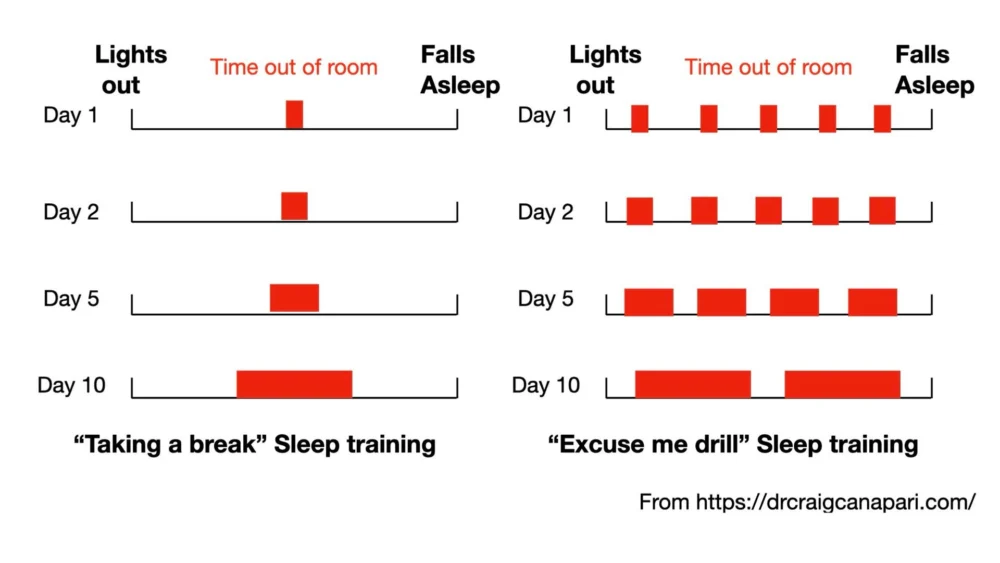
The "Excuse Me Drill" involves multiple, very brief departures from the room during the interval between lights out and sleep onset. The duration of these breaks gradually increases over time. This approach can be likened to a "thick" reinforcement schedule, offering frequent opportunities for positive feedback.
Conversely, "Taking a Break" involves a single departure from the room. This departure occurs approximately at the midpoint of the interval between lights out and sleep onset. The duration of this single break is progressively increased each night. This can be viewed as a "thin" reinforcement schedule, with less frequent but potentially longer periods of independence.

The accompanying visual aids, often presented as diagrams, illustrate these differences. They typically depict a timeline from lights out to sleep onset, with red blocks representing the periods the parent is outside the room. The "Excuse Me Drill" shows multiple, shorter red blocks that lengthen over successive nights, while "Taking a Break" features a single, centrally placed red block that also grows in duration daily.
Implementing the Breaks: Strategies and Excuses
During each break, parents are instructed to provide a brief, plausible excuse for their temporary absence. The specific reason is less important than the consistent delivery of the message that the parent will return shortly. Common suggested excuses include:
- "Excuse me, I need to go to the bathroom for a second. I’ll be right back!"
- "Excuse me, I need to grab a drink of water. I’ll be right back!"
- "Excuse me, I need to check on something downstairs. I’ll be right back!"
- "Excuse me, I need to quickly tidy up your toys. I’ll be right back!"
Upon returning to the room, parents are encouraged to offer calm, positive reinforcement. This can include gentle touches, affirming statements about the child’s bravery, or praise for their efforts in staying in bed. It is crucial to maintain a calm demeanor to avoid over-exciting the child, while still conveying pride in their progress.
Choosing the Right Technique for Your Child
Dr. Canapari generally favors the "Taking a Break" technique due to its relative simplicity and reduced energy demands on tired parents. A prerequisite for this method is the child’s ability to tolerate a brief absence of at least one minute.
However, the "Excuse Me Drill" has demonstrated efficacy in specific populations, including children with Angelman Syndrome, a developmental disorder characterized by significant sleep difficulties. The frequent, short checks associated with this method provide repeated positive reinforcement, making it a potentially better option for children who struggle with even short periods of separation. This technique can be particularly beneficial if a child can only tolerate an absence of less than a minute initially.
A Detailed Look at the "Excuse Me Drill"
The "Excuse Me Drill," developed by Dr. Brett Kuhn, a sleep behaviorist at the University of Nebraska, is a gentle sleep training method well-suited for anxious children in beds. It builds upon principles similar to gradual extinction or "Ferberizing," but with a focus on positive reinforcement through frequent check-ins. Dr. Canapari was introduced to this technique by Dr. Sarah Honaker.
Consider a scenario with lights out at 8:00 p.m. and an anticipated sleep onset of 8:30 p.m.
- Night One: Parents would perform multiple brief departures, perhaps five to fifteen repetitions, each lasting less than a minute. During each return, warm affection and attention are provided to reinforce the child’s bravery in being apart from the parent. This constitutes a "thick" reinforcement schedule.
- Subsequent Nights: The duration of these breaks gradually increases each night. The goal is to extend the time spent outside the room incrementally until the child begins to fall asleep independently.
This method can be effectively combined with "bedtime fading," a technique where bedtime is strategically adjusted to align with the child’s natural sleep window. This combined approach has shown promise for older, anxious children and has been studied in children with developmental challenges, including Angelman Syndrome. A comprehensive sleep training plan is always recommended.

A Detailed Look at the "Taking a Break" Technique
The "Taking a Break" method is also implemented with a planned bedtime and sleep onset. Using the same example of 8:00 p.m. lights-out and 8:30 p.m. sleep onset:
- Initial Stage: After the bedtime routine and lights out, the parent stays with the child until they are drowsy. Then, the parent announces they will take a brief break, stating an excuse and promising to return. The initial break might be very short, perhaps 30 seconds to a minute.
- Progression: The duration of this single break is increased daily, often by approximately one minute each night. The key is to find an interval that allows the child to relax and settle without becoming overly distressed.
- Return: Upon returning, the parent offers praise and reassurance, reinforcing the child’s ability to stay in bed. The goal is to gradually extend the break until the child falls asleep during the parent’s absence.
Addressing Common Challenges and Troubleshooting
Child Follows Parent Out or Becomes Upset: This often indicates that the duration of the parental interval is too long. The optimal interval is one where the child remains calm and relaxed in bed. Parents may need to increase the intervals more slowly. Practicing short departures during the day can also help desensitize the child and reduce anxiety.
Child Sleeps Independently at Bedtime but Wakes at Night: This is a common occurrence, often linked to "sleep onset association disorder," where a child becomes reliant on specific conditions (like parental presence) to fall asleep, and this association extends to natural nighttime awakenings. In many cases, night wakings resolve within a month as the child adapts to independent sleep onset. If persistent, the same progressive break techniques used at bedtime can be applied during night wakings. For instance, after placing the child back in bed, the parent could stay for a short period, then implement a break of the duration currently practiced at bedtime, followed by a return.
Broader Implications and Expert Endorsements
The emphasis on gentle, progressive sleep training methods reflects a growing understanding of child development and the impact of sleep on a child’s overall well-being. These techniques acknowledge that for some children, especially those prone to anxiety, a gradual, supportive approach is more effective and humane than abrupt methods. The research supporting these techniques, particularly the "Excuse Me Drill" in populations with developmental disorders, underscores their clinical validity.
The principles of positive reinforcement, gradual independence, and consistent parental support are widely recognized as essential components of effective child-rearing. By offering structured yet gentle pathways to independent sleep, these methods empower parents and children to navigate sleep challenges collaboratively, fostering healthier sleep habits and a more harmonious family environment.
The development and refinement of these techniques by sleep behaviorists like Dr. Kuhn and pediatricians like Dr. Canapari signify a move towards evidence-based practices that prioritize the emotional needs of children alongside the practical goal of achieving restful sleep. The availability of resources such as Dr. Canapari’s book and affiliated educational materials further supports parents in implementing these strategies effectively.
