

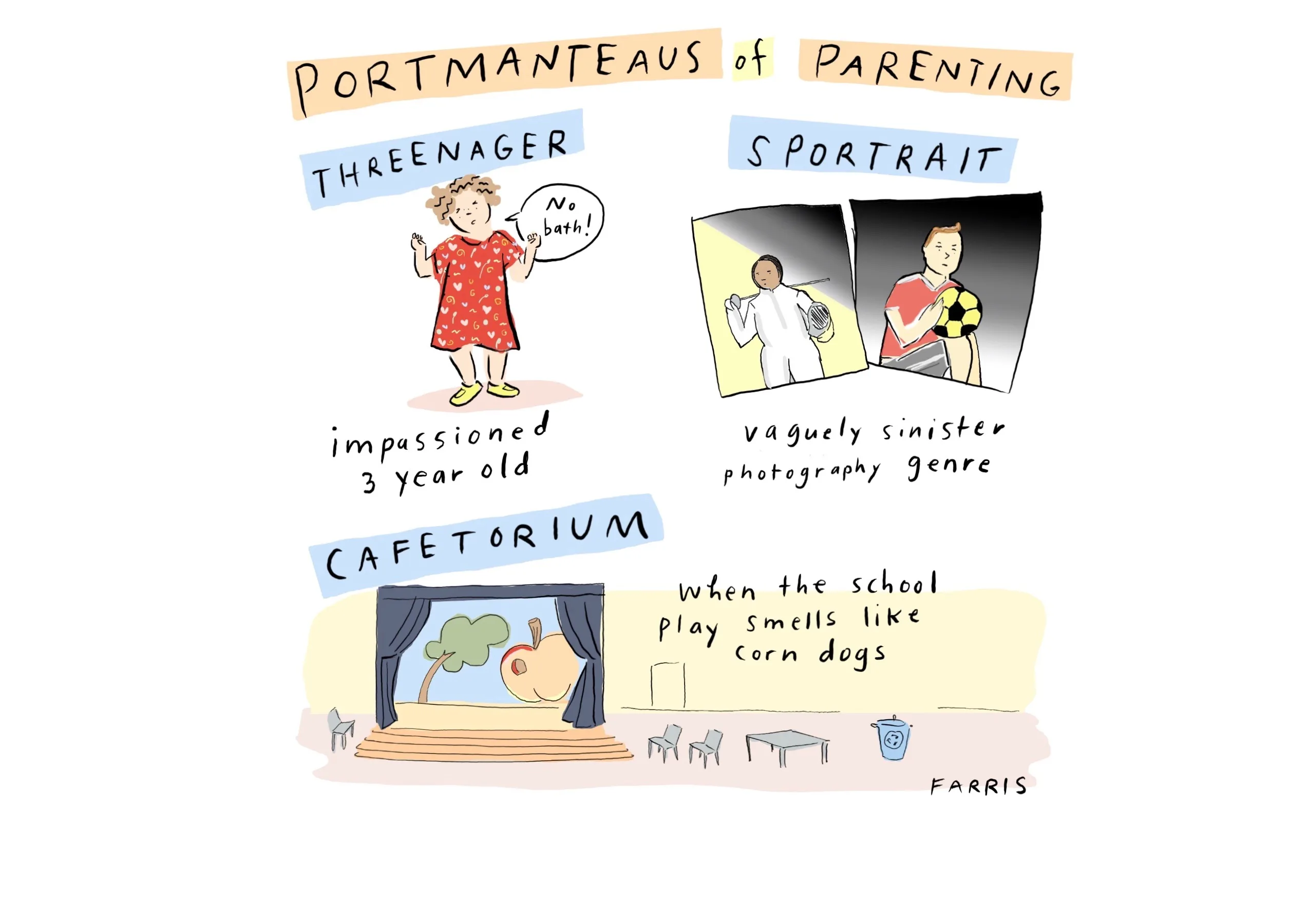
The recent publication of new literary work by acclaimed author and illustrator Grace Farris has sparked a significant cultural dialogue regarding the evolution of the English language, specifically the increasing prevalence of portmanteaus in daily discourse. Farris, widely recognized for her previous success with Mom Milestones, has shifted her focus toward the complexities of the medical profession, prompting readers to examine how hybrid words—or portmanteaus—serve as essential cognitive and social tools. From the domestic "snacktivity" to the professional "sportrait," these linguistic blends are no longer merely clever wordplay; they have become a standard method for categorizing the multifaceted experiences of modern life, parenting, and high-pressure careers.
The Linguistic Evolution of the Portmanteau
A portmanteau, a term popularized by Lewis Carroll in the 19th century, refers to a linguistic blend of words in which parts of multiple words are combined into a new one. Historically, these terms were used to describe new inventions or social phenomena, such as "smog" (smoke and fog) or "motel" (motor and hotel). However, in the 21st century, the frequency of portmanteau creation has accelerated, driven by digital communication and a societal need for "linguistic shorthand."
Sociolinguists suggest that the current surge in portmanteaus—exemplified by the community reactions to Farris’s work—reflects a desire for efficiency and emotional resonance. By merging two concepts, speakers can convey a complex state of being or a specific object more accurately than a single standard word might allow. For instance, the term "procrasticlean"—the act of cleaning to avoid a more daunting task—captures a specific psychological state that resonates with thousands of individuals across different demographics.
The "Sportrait" Phenomenon and Visual Culture
One of the most prominent examples of this lexical shift is found in the "sportrait," a blend of "sports" and "portrait." In suburban communities, particularly in the greater Atlanta metropolitan area, the use of sportraits has become a staple of graduation season. Local neighborhoods have adopted the practice of displaying large-scale banners featuring graduating seniors in their athletic attire. These images are not merely photographs; they are stylized, high-production portraits that celebrate both academic completion and athletic commitment.
The adoption of the term "sportrait" by professional photographers and parents alike indicates a shift in how milestones are documented. According to market data from the professional photography industry, the demand for specialized athletic portraiture has grown by an estimated 15% annually over the last five years. The term provides a professional category for a service that exists between traditional school photography and commercial sports marketing, legitimizing the niche and making it more marketable to families.
Domestic Vernacular and the Psychology of Household Language
Beyond public banners and professional services, portmanteaus play a critical role in the "micro-languages" of individual households. Reader testimonials indicate that families often develop their own unique lexicons to describe shared habits or favorite items. Examples such as "chalmonds" (chocolate-dusted almonds) or "blobs" (chocolate-covered macadamia nuts) serve as more than just nicknames; they function as social glue.
Psychological studies on family dynamics suggest that the creation of "inside" language strengthens bonds and creates a sense of exclusive belonging. In one reported instance, a couple utilized the term "blobs" as a form of motivational currency, using the treat as a reward for collaborative household chores. This use of language transforms a mundane grocery item into a symbol of shared humor and cooperation, demonstrating how portmanteaus can alleviate the friction of daily domestic responsibilities.
Parenting, Pregnancy, and the Biological Portmanteau
The parenting community has been particularly prolific in generating new terminology to describe the physiological and emotional toll of raising children. Farris’s work often highlights these intersections. A notable example emerging from recent discourse is "hornauseous," a term used to describe the contradictory state of high hormonal libido coupled with intense morning sickness during pregnancy.
This term highlights a gap in medical and standard English terminology. While clinical language can describe these symptoms in isolation, it often fails to capture the lived experience of experiencing them simultaneously. By creating a portmanteau, individuals are able to normalize these confusing biological states, providing a sense of relief and community through shared humor. Similarly, "snacktivity"—a combination of "snack" and "activity"—describes the common parenting tactic of using food as a form of entertainment or a time-consuming craft for young children, usually involving a significant cleanup effort.
Professional Implications in the Medical Field
The release of Farris’s new book, which addresses the medical profession, coincides with a long-standing tradition of mnemonic devices and linguistic shortcuts in clinical training. The adage "See one, do one, teach one" has served for generations as the central tenet of clinical competency in medicine. However, modern medical professionals are finding that traditional phrases are being supplemented by new, more descriptive terms that address the mental health challenges of the field.
The term "hangxiety"—a blend of "hangover" and "anxiety"—though often used in social contexts, has gained traction in discussions regarding the physiological impact of alcohol on the nervous system. In high-stress environments like hospitals, where "decision fatigue" is a constant threat, the ability to label these physiological states accurately is viewed by some as a necessary component of self-care and professional longevity.
Institutional and Educational Adoption
The trend of lexical blending has also moved into institutional settings. In several educational facilities, multi-purpose rooms are being officially designated with portmanteaus. One school has gained attention for its "Cafegymatorium," a space that serves as a cafeteria, gymnasium, and auditorium. This is not merely a nickname used by students; it is the official designation inscribed on the building’s signage.
This institutional adoption reflects a broader trend in architecture and urban planning toward "flex-spaces." As budgets tighten and the need for multi-functional infrastructure grows, the language used to describe these spaces must evolve. The "Cafegymatorium" represents a literal blending of functions that mirrors the blending of the words themselves, providing a clear example of how language adapts to physical and economic realities.
Global and Political Contexts: "Facho-Anxiété"
The use of portmanteaus is not limited to the English-speaking world. In France, the term "facho-anxiété" (fascist anxiety) has emerged as a derivative of "éco-anxiété" (eco-anxiety). This term is used to describe the specific psychological distress associated with the rise of far-right political movements and the perceived erosion of democratic norms.
The emergence of "facho-anxiété" demonstrates that portmanteaus are being used to navigate not just domestic or professional life, but global political climates. By attaching a specific label to a complex set of fears, individuals can better communicate their concerns and find solidarity with others experiencing similar stressors. This highlights the portmanteau’s role as a tool for political and social expression in an era of rapid information exchange.
Analysis of Broader Impact
The widespread adoption of these terms across various sectors of society suggests a fundamental change in how information is processed. The portmanteau is a reflection of a "multi-hyphenate" culture where individuals are rarely just one thing—they are parent-professionals, athlete-students, or activist-citizens.
From an SEO and marketing perspective, portmanteaus like "tracklete" (track athlete) or "shenaniganizing" (the act of planning shenanigans) allow for the branding of specific behaviors. For authors like Grace Farris, these words provide a hook that makes their work relatable and shareable in a digital landscape. The "shareability" of a word like "procrasticlean" is significantly higher than a standard sentence describing the same action, making these terms viral by nature.
Conclusion
The discourse surrounding the work of Grace Farris and the subsequent outpouring of community-driven portmanteaus reveal a society that is actively reshaping its language to fit a more complex reality. Whether used to describe the specialized photography of "sportraits," the domestic negotiation of "blobs," or the political weight of "facho-anxiété," these words serve as vital bridges between experience and expression. As the boundaries between work, home, and global citizenship continue to blur, the portmanteau will likely remain an essential tool for the modern individual to navigate a world that is increasingly "multi-tasking" and "multi-faceted." The success of Mom Milestones and Farris’s subsequent medical-themed literature underscores the public’s appetite for language that is as creative and resilient as the people who speak it.
