

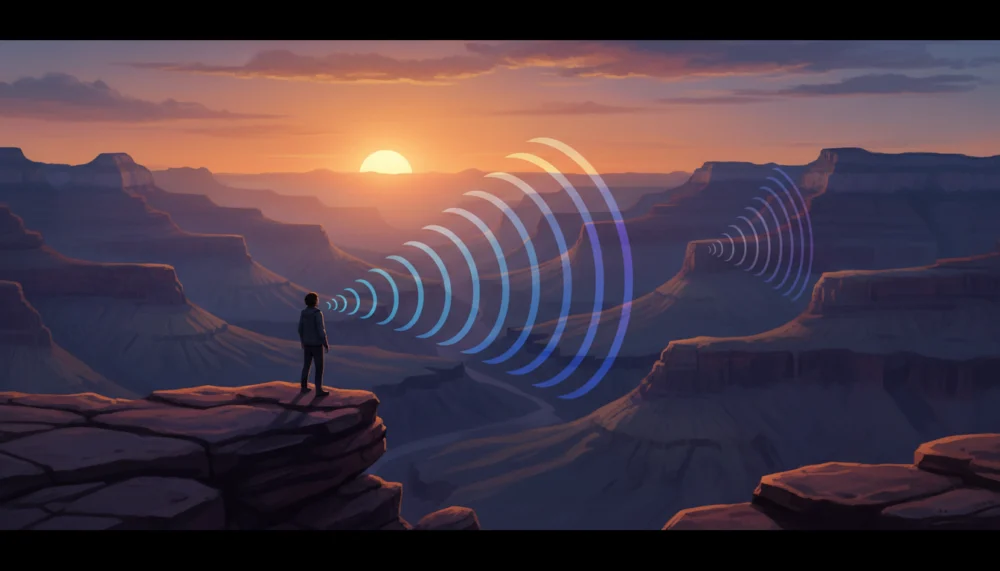
Sound is a fundamental part of our daily experience, yet the mechanics of how it interacts with our environment can often seem like magic. One of the most intriguing auditory phenomena is the echo. An echo occurs when a sound wave reflects off a surface and returns to the listener with a noticeable delay. This reflection is not just a simple bounce; it is a complex interaction governed by the laws of physics and the properties of the medium through which sound travels.
The Fundamental Physics of Sound Reflection
At its core, sound is a mechanical wave that travels through a medium, such as air, water, or solid objects. When these waves encounter an obstacle, they behave much like a ball bouncing off a wall. The energy of the sound wave hits the surface and, depending on the material, is either absorbed, transmitted, or reflected. An echo is specifically the result of sound reflection.
For an echo to be clearly audible, the reflecting surface must be relatively hard and non-porous. Soft materials like foam, carpet, or heavy curtains tend to absorb sound energy, converting it into heat rather than reflecting it back. This is why empty rooms often sound ‘echoey’ until furniture and rugs are added to dampen the sound.
The Role of Surface Texture and Density
The quality of an echo depends heavily on the texture of the reflecting surface. A smooth, flat surface like a concrete wall or a cliff face provides a clear, distinct reflection because the sound waves bounce back in a uniform direction. Conversely, rough or irregular surfaces scatter the sound waves in multiple directions, a process known as diffusion, which prevents a clear echo from forming.
The Critical Factors: Distance and Timing
Not every sound reflection is an echo. To perceive a reflection as a distinct echo, there must be a specific time delay between the original sound and the reflected sound. The human brain processes sound in a way that blends noises occurring within approximately 0.1 seconds of each other. If the reflection returns faster than this, we hear it as a continuation of the original sound rather than a separate event.
The 17-Meter Rule
To achieve a delay of at least 0.1 seconds, the sound wave must travel a certain distance. Given that the speed of sound in air is approximately 343 meters per second (at room temperature), the sound must travel a total round-trip distance of about 34 meters. This means the reflecting surface must be at least 17 meters (about 56 feet) away from the source of the sound.
- Short Distances: Result in reverberation rather than distinct echoes.
- Long Distances: Provide the necessary time gap for the human ear to distinguish the reflected sound.
- Temperature Effects: Sound travels faster in warm air, which can slightly alter the minimum distance required for an echo.
Echoes vs. Reverberation
It is common to confuse echoes with reverberation, but they are distinct acoustic concepts. Reverberation is the persistence of sound after the source has stopped, caused by multiple reflections blending together. You might experience this in a large cathedral or a tiled bathroom where the sound feels ‘full’ or ‘lingering’ but you cannot distinguish a clear repetition of your voice.
An echo, by contrast, is a discrete repetition. You hear the original sound, a moment of silence, and then the reflected sound. This distinction is vital in architectural acoustics, where engineers design spaces to either enhance reverberation for music or minimize it for clear speech.
Architectural Considerations
In concert halls, some reverberation is desirable to give music a rich, immersive quality. However, in lecture halls or cinemas, echoes and excessive reverberation are undesirable because they interfere with the clarity of speech. Acoustic engineers use a variety of tools to manage these reflections, including:
- Absorbers: Materials like acoustic foam that soak up sound energy.
- Diffusers: Irregular surfaces that break up sound waves to prevent direct echoes.
- Bass Traps: Specialized absorbers designed to manage low-frequency sound energy.
Natural and Technological Applications of Echoes
Echoes are more than just a curiosity; they are a vital tool in nature and technology. Many animals have evolved to use sound reflections to navigate and hunt in environments where vision is limited. This process is known as echolocation.
Echolocation in the Animal Kingdom
Bats and dolphins are the most famous practitioners of echolocation. By emitting high-frequency clicks and listening to the echoes that bounce off objects, they can determine the size, shape, distance, and even the texture of their surroundings. This biological sonar allows bats to catch tiny insects in total darkness and dolphins to navigate murky waters.
Technological Uses: Sonar and Radar
Humans have mimicked this natural ability through technology. SONAR (Sound Navigation and Ranging) is used by ships and submarines to map the ocean floor and detect underwater objects. By sending out sound pulses and measuring the time it takes for the echo to return, computers can create highly accurate 3D maps of the underwater environment.
Similarly, RADAR (Radio Detection and Ranging) uses electromagnetic waves instead of sound waves, but the principle of reflection remains the same. Medical professionals also utilize echoes in ultrasound imaging, where high-frequency sound waves reflect off internal organs to create visual images for diagnostic purposes.
Common Environments for Hearing Echoes
If you want to experience a perfect echo, certain environments are better than others. Canyons, mountain ranges, and large caves are classic locations. The vast distances and hard rock surfaces provide the ideal conditions for sound to travel and reflect clearly.
Urban Echoes
In urban settings, you might hear echoes in tunnels, underpasses, or between tall skyscrapers. These ‘urban canyons’ can sometimes create multiple echoes, where the sound bounces back and forth between two parallel buildings, creating a fluttering effect known as a ‘flutter echo.’
Conclusion: The Harmony of Physics and Perception
The phenomenon of the echo is a perfect intersection of physical laws and biological perception. It requires the right material, the right distance, and a specific window of time to manifest. Whether it is a bat hunting in the night or a hiker shouting into a canyon, echoes remind us of the constant, invisible interaction between sound and the physical world around us.
