

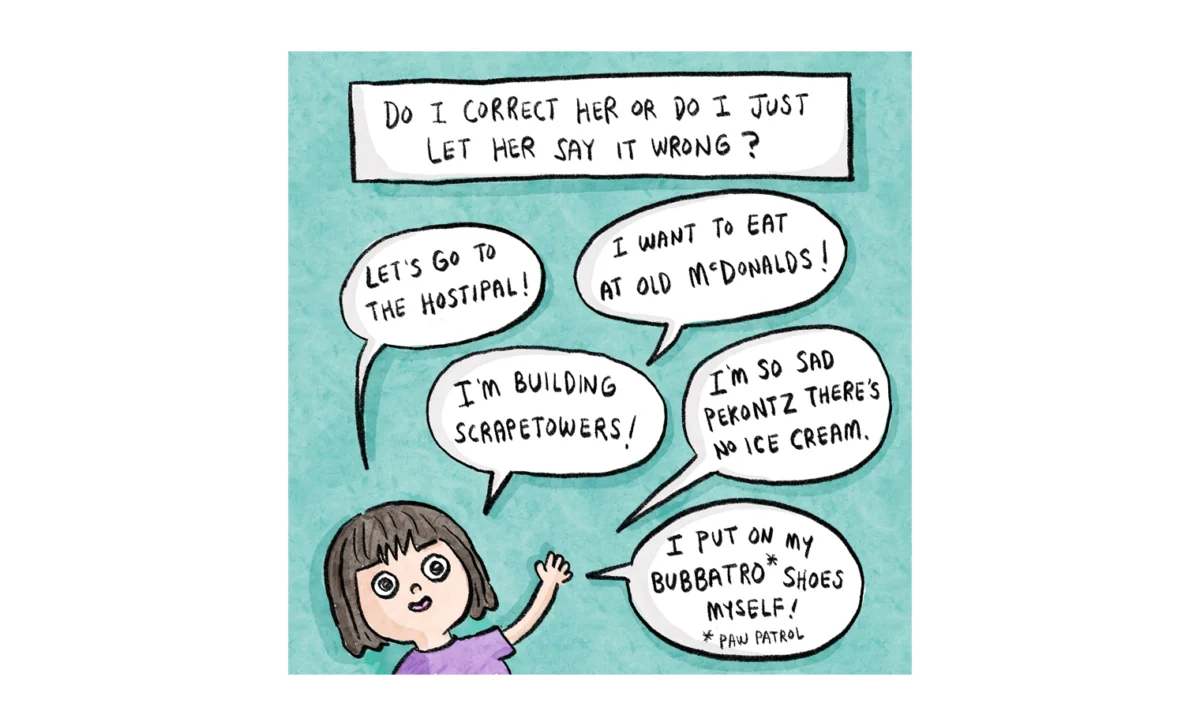
The phenomenon of childhood linguistic development, characterized by idiosyncratic mispronunciations and creative word substitutions known colloquially as "kid-isms," serves as a critical window into the cognitive and neurological maturation of the human brain. While often dismissed as mere "cute" errors, these verbal quirks—ranging from a toddler’s insistence on "hanitizer" to the transposition of complex phonemes—represent a sophisticated process of pattern recognition, phonetic simplification, and morphological over-regularization. Recent ethnographic data and parental testimonials suggest that these linguistic artifacts do more than just mark a developmental stage; they form the bedrock of unique family "lects" or internal dialects that persist for decades, even after the child has mastered standard syntax.
The Mechanics of Phonological Development
At the heart of childhood mispronunciation are predictable phonological processes. Speech-language pathologists note that young children often lack the fine motor control required to produce certain sounds, leading to "substitution" and "simplification." For example, the substitution of /t/ for /k/—as seen in a child’s transition from "kiddy pool" to "tiddy pool"—is a documented process known as velar fronting. In this instance, the child replaces a "back" sound produced by the soft palate with a "front" sound produced by the tongue against the teeth.
Similarly, the simplification of consonant clusters is a universal hurdle. When a toddler hears "l, m, n, o" in the alphabet song and interprets it as "elmo," they are utilizing a cognitive shortcut, mapping an unfamiliar sequence of sounds onto a known, high-frequency entity. This process of "lexical mapping" allows the child to participate in social rituals, such as singing, before their phonetic inventory is fully equipped to handle the individual letters.
Other common processes include:
- Gliding: Replacing liquids like /l/ or /r/ with glides like /w/ or /j/ (e.g., "lellow" for "yellow" or "wa-wa" for "agua").
- Assimilation: Changing a sound to be more like a neighboring sound (e.g., "salamami" for "salami").
- Cluster Reduction: Dropping one or more consonants from a group (e.g., "pider" for "spider" or "tar" for "star").
Morphological Over-regularization and Logic-Based Language
Beyond simple mispronunciations, many "kid-isms" are the result of advanced logical reasoning. Children are inherently pattern-seekers; once they grasp a grammatical rule, they apply it with rigorous consistency, often ignoring the irregularities of the English language. This is known as morphological over-regularization.
A child who describes themselves as "unthirsty" after finishing a glass of water is applying the prefix "un-" to denote the reversal of a state, a perfectly logical application of English morphology. Likewise, the creation of "stepfoots" instead of "footsteps" or "nailtoes" instead of "toenails" demonstrates a child’s attempt to reconstruct compound words based on their component parts. These errors are actually indicators of high-level cognitive processing, as they show the child is no longer just mimicking sounds but is actively attempting to engineer language.
In one notable case, a child referred to the YMCA as "The Big Y," conflating the acronym with a regional grocery chain. This highlights the "environmental mapping" phase, where children attempt to categorize their surroundings using a limited but growing vocabulary.
Chronology of Linguistic Milestones
The timeline of these linguistic developments generally follows a structured path, though individual variation is common.
- 12–18 Months (The Holophrastic Stage): Children use single words to represent entire sentences. Phonetic simplifications like "coco" for "shoes" or "goh-guh" for "water" are prevalent here.
- 18–24 Months (The Two-Word Stage): The emergence of "telegraphic speech." Basic grammar begins to form, but phonemes like /s/, /z/, /sh/, and /ch/ are frequently substituted or omitted.
- 2–4 Years (The Expansion Stage): This is the "peak" of kid-isms. Vocabulary grows exponentially. Children begin to use prefixes and suffixes, leading to over-regularization (e.g., "I seed" instead of "I saw").
- 5–7 Years (The Refinement Stage): Most phonological errors disappear. Complex sounds like /th/ and /r/ are mastered. Children start to recognize their own errors, often leading to "incorrect corrections," such as an older sibling telling a younger one that it’s not "nuppin," it’s "nuffin."
The Impact of Socio-Cultural Environment
Language development does not occur in a vacuum; it is heavily influenced by the child’s immediate environment. The COVID-19 pandemic, for instance, introduced a new lexicon to households worldwide. Toddlers growing up during this era became intimately familiar with "hanitizer" (hand sanitizer), a word that likely would not have entered a three-year-old’s high-frequency vocabulary in previous decades.
Pop culture also plays a significant role. The pervasive nature of brands like McDonald’s or franchises like Paw Patrol creates a shared linguistic ground. When a child refers to McDonald’s as "Old MacDonald’s," they are merging the global brand with the familiar nursery rhyme, a process of "cultural synthesis" that helps them make sense of the commercial world.
Even high-profile families are not immune to these patterns. Historical records indicate that the late Queen Elizabeth II was affectionately called "Gary" by her grandson, Prince William, during his childhood because he could not yet pronounce "Granny." The name reportedly persisted within the private royal circle for years, illustrating how a childhood mispronunciation can evolve into a permanent family term of endearment.
The Parental Dilemma: To Correct or to Cherish?
A recurring theme among parents is the emotional weight attached to these linguistic errors. There exists a tension between the pedagogical impulse to correct a child’s speech and the sentimental desire to preserve the "innocence" of the mispronunciation.
In many households, these errors are not merely tolerated but are "adopted" by the adults. Terms like "liberry" (library), "jimamas" (pyjamas), and "rainbrella" (umbrella) often become the standard terminology within the family unit long after the child has learned the correct pronunciation. Speech-language pathologists generally suggest that while parents should model correct speech, there is little harm in enjoying these idiosyncratic phases, as most children naturally outgrow them through social exposure and formal education.
However, the transition out of this phase can be bittersweet. Parents often report a sense of loss when a child suddenly says a word "correctly" for the first time. This shift marks the end of a specific developmental window and the beginning of a more standardized, adult-like interaction with the world.
Associated Developmental Milestones: The Haircut Debate
The discussion of "preserving childhood" often extends beyond linguistics into physical milestones, such as the "first haircut." Data suggests that the timing of a child’s first haircut is deeply polarized among parents. Some prioritize convenience and hygiene—noting that "fine, wispy baby hair" often becomes matted with food—while others view the first haircut as a "loss of the baby self."
This debate mirrors the linguistic one: both are concerned with the child’s transition from an idiosyncratic, protected state into a more groomed, socially conforming one. Whether it is the first time a boy gets a "regular short" cut or the first time a girl correctly pronounces "caterpillar" instead of "callapidder," these moments represent the inevitable march toward maturity.
Broader Implications and Family Legacy
The long-term impact of these childhood "kid-isms" is the creation of a "family lect"—a private language that strengthens domestic bonds and creates a shared history. These words often survive into the child’s adulthood, serving as linguistic "souvenirs" of their early years.
From a sociological perspective, these internal languages function as a form of social glue. They are "insider" markers that distinguish the family unit from the outside world. When a college-aged student still refers to a "brownschweiger sandwich" as "mommy meat" or uses the term "coldee" to describe a prank involving cold hands, they are accessing a deep-seated emotional connection to their formative years.
In conclusion, the mispronunciations of early childhood are far more than developmental errors. They are the result of a complex interplay between neurological growth, logical reasoning, and environmental influence. By documenting and occasionally adopting these "kid-isms," families preserve a unique period of human development characterized by a raw, unrefined attempt to map the infinite complexities of human language. While the "gaggery system" may eventually become the "digestive system" and "Old MacDonald’s" will eventually just be "McDonald’s," the linguistic artifacts of childhood remain a testament to the creative power of the developing mind.
