

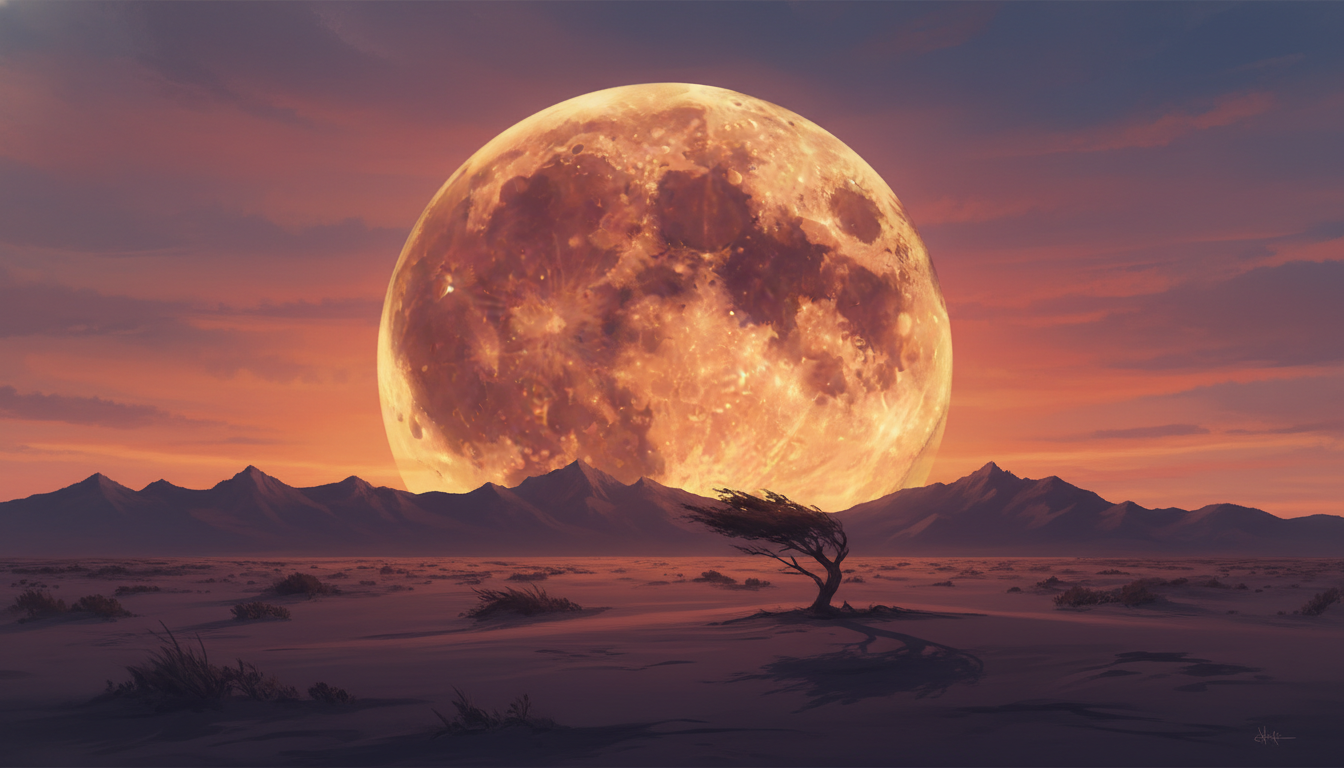
Have you ever looked at a full moon rising over the horizon and been struck by its massive size, only to look again a few hours later and find it looking small and distant? This phenomenon is known as the Moon illusion, and it has puzzled humanity for thousands of years.
Despite how it looks to your eyes, the Moon does not actually change its physical size as it moves across the sky. In fact, if you were to measure it with a ruler or a camera, you would find that its angular diameter remains virtually identical regardless of its position.
Understanding the Moon Illusion
The Moon illusion is a cognitive optical illusion, meaning it happens in the brain rather than in the physical world. While many people believe that the Earth’s atmosphere acts like a magnifying glass, science has proven this to be false.
The Role of Angular Size
Angular size refers to how large an object appears from a specific vantage point. When the Moon is at the horizon, it subtends an angle of about 0.5 degrees. Surprisingly, this measurement stays the same when the Moon is directly overhead at its zenith.
The Ponzo Illusion Theory
One of the most popular explanations for this effect is the Ponzo Illusion. This theory suggests that our brains judge the size of an object based on its background and surrounding visual cues.
When the Moon is near the horizon, we see it alongside familiar objects such as:
- Distant trees
- City skylines
- Mountain ranges
- Power lines
These objects provide a sense of scale that the empty upper sky lacks.
The Flattened Dome Model
Another psychological factor is the apparent distance theory. Humans tend to perceive the sky not as a perfect hemisphere, but as a flattened dome. We perceive objects on the horizon as being further away than objects directly above us.
Because the brain knows the Moon is far away, when it appears next to distant horizon markers, the brain compensates by making the Moon look larger to maintain a logical sense of perspective.
Debunking Atmospheric Refraction
A common misconception is that the atmosphere magnifies the Moon. While atmospheric refraction does occur, it actually has the opposite effect. It causes the Moon to look slightly shorter vertically, giving it an oval or squashed appearance rather than a larger one.
The Ebbinghaus Illusion Connection
The Ebbinghaus illusion demonstrates that our perception of an object’s size is influenced by the size of the objects surrounding it. Surrounding the Moon with small distant terrestrial objects makes the Moon appear gargantuan by comparison.
How to Prove the Illusion Yourself
You can easily test this phenomenon at home using a few simple methods. These experiments help strip away the contextual clues that trick your brain and reveal the truth of the lunar size.
The Paper Tube Experiment
Roll a piece of paper into a tube and look at the giant Moon through it. By isolating the Moon and removing the horizon from your field of vision, the Moon will instantly appear to shrink to its normal size.
The Camera Test
Take a photo of the Moon when it is near the horizon and another when it is high in the sky using the same zoom settings. When you compare the two images side-by-side, you will see that the Moon is exactly the same number of pixels in both shots.
The History of the Mystery
Historical records show that philosophers like Aristotle and Ptolemy debated this effect. Aristotle originally thought the atmosphere was responsible, while later scholars began to suspect the psychological roots of the vision.
Modern Neurological Perspectives
Today, neuroscientists use MRI scans and eye-tracking technology to study how the visual cortex processes these images. While there is no single consensus theory, most agree it is a complex interaction of depth perception and spatial processing.
Best Times to Observe
To see the Moon illusion at its most dramatic, you should look for the Moonrise during a Full Moon. This is when the contrast between the lunar disk and the terrestrial landscape is most prominent.
The Impact of Color
The orange or reddish hue often seen at the horizon can also enhance the effect. This color change is caused by Rayleigh scattering, where shorter wavelengths of light are scattered by the atmosphere, leaving only the longer red wavelengths.
Conclusion
The Moon illusion is a beautiful reminder of how our brains interpret the world around us. Even though we know it is an optical trick, the sight of a massive, golden moon rising over the horizon remains one of nature’s most breathtaking displays.