

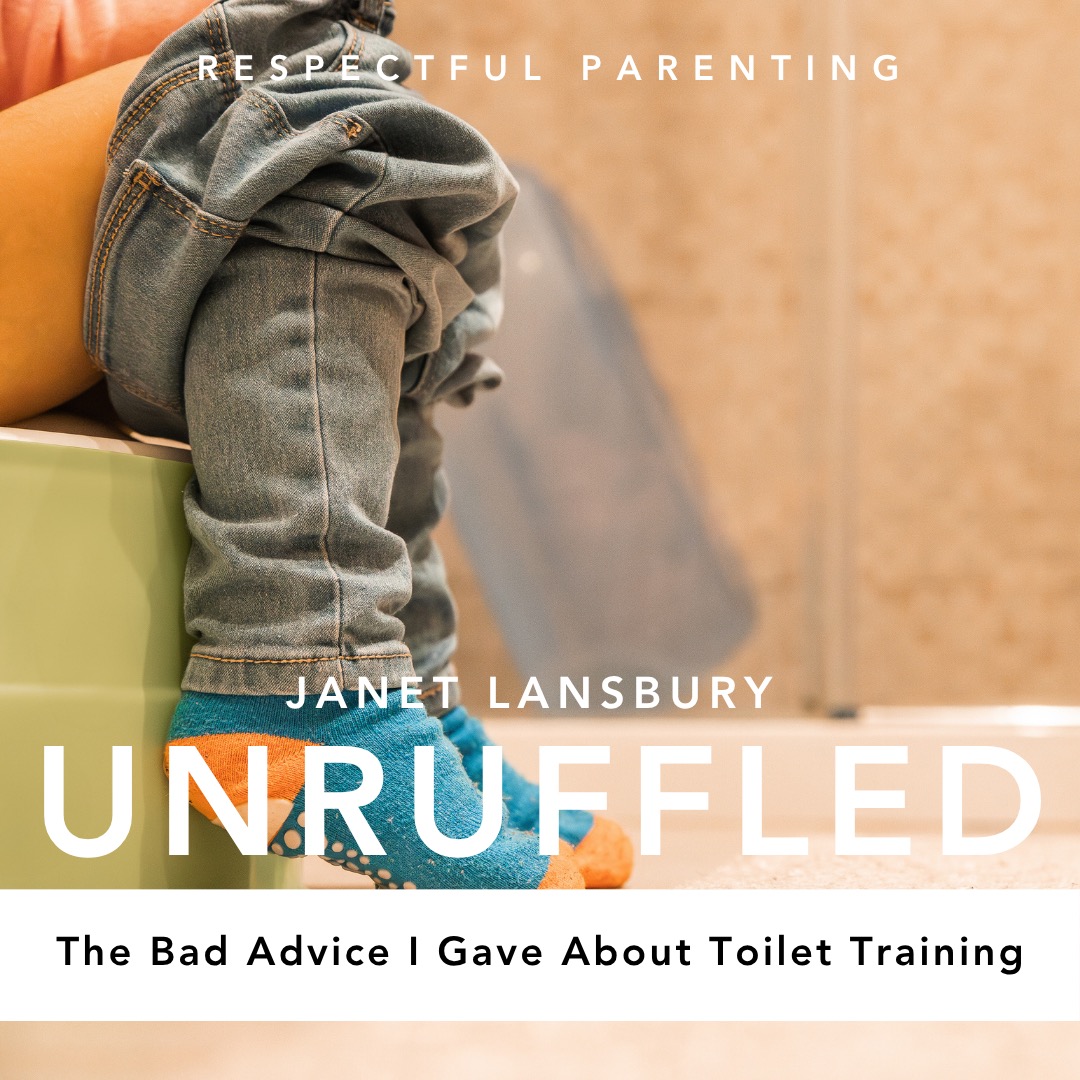
In a candid reflection, parenting expert Janet Lansbury has revisited a previous episode of her podcast, "Unruffled," to acknowledge and analyze advice she provided on toilet training that, in retrospect, proved to be unhelpful for a specific family. The situation came to light when a parent, who had initially sought Lansbury’s guidance on her daughter’s prolonged toilet training journey, reached out with an update: her daughter’s four-year struggle had finally concluded, not by adhering to Lansbury’s recommendations, but by adopting a diametrically opposed approach. This reassessment offers a valuable insight into the nuances of child development, parental intuition, and the limitations of generalized advice.
The Genesis of the Conflict: A Child-Led Approach Under Scrutiny
Lansbury’s foundational philosophy, often espoused on "Unruffled," centers on a child-led approach to significant developmental milestones, including toilet learning. She advocates for allowing children to initiate and progress at their own pace, emphasizing the importance of supporting their innate drive and autonomy. This perspective stems from the belief that mastering such skills independently fosters a sense of accomplishment and self-efficacy, crucial for a child’s overall development.
However, this philosophy was challenged by a parent whose daughter, at three and a half years old, exhibited a persistent and seemingly ingrained resistance to toilet training, despite showing clear signs of physical and cognitive readiness. The parent, describing her daughter as "absolutely set on being in diapers ‘forever’," expressed a profound struggle to reconcile Lansbury’s "let-her-lead" approach with her own observations.
A Parent’s Dilemma: Navigating Fear and Avoidance
The parent’s detailed account, shared in the initial podcast episode, highlighted a recurring pattern of fear and avoidance in her daughter’s behavior, extending beyond toilet training. In various contexts, the child would express fear and reluctance towards new activities, yet the parents consistently guided her through these challenges, acknowledging her emotions while gently encouraging her to engage. This consistent approach, the parent noted, resulted in the child’s eventual enjoyment and mastery of these activities.
This led to a perceived conflict: if her daughter responded positively to being guided through fears in other areas, why should toilet training be an exception? The parent voiced concerns that a purely child-led approach in this instance might be enabling avoidance and reinforcing a "fear cycle," potentially hindering her daughter’s development and creating an unnecessary developmental delay. She questioned whether toilet training was indeed a purely "developmental milestone that kids inherently do when they’re ready," or if, in some cases, it required a more directive parental intervention, akin to a necessary medical procedure rather than an organic developmental step.
Lansbury’s Initial Counsel: Trust, Boundaries, and Feelings
In the original "Unruffled" episode, titled "When Kids Don’t Seem Motivated (to Potty, Crawl, or Create)," Lansbury offered three core remedies for children who appeared "stuck":
- Trust: Genuine trust in the child’s natural abilities, motivation, and inner direction, coupled with ample opportunities for practice.
- Reasonable Boundaries: Recognizing that sometimes parental boundaries are necessary to facilitate progress.
- Welcoming Feelings: Allowing children to express and experience uncomfortable emotions, such as frustration or uncertainty, without the parent feeling the immediate need to "fix" them.
Lansbury’s initial advice to the parent in question leaned heavily on the "trust" aspect, emphasizing the belief that children are inherently motivated to learn and develop. She suggested that the child’s strong resistance might be a reaction to perceived parental pressure, even if unintentional. The core recommendation was to commit fully to a child-led approach, taking the parents’ own desires out of the equation to avoid sending mixed messages. She also advised against reminding the child or trying to "make it fun," suggesting instead to trust the child’s own process, including her play with stuffed animals around the potty, as a sign of her working through her own anxieties at her own pace.
The Parent’s Update: A Four-Year Saga Concludes
Approximately a year after the initial podcast, the parent provided Lansbury with a significant update. Approaching her daughter’s fourth birthday, and with her peers largely toilet-trained, the parent made a firm decision: diapers would no longer be an option. This decision was not born from a sudden change in her daughter’s interest, but from the parent’s own resolve.
The initial days of this new approach were described as "grueling," marked by intense fear and resistance from the child. However, the parent persevered, pushing through the child’s emotional struggle. The outcome was a breakthrough: within a week, the daughter had no accidents and was willingly using the toilet.
This success prompted the parent to reflect on the journey and Lansbury’s previous advice. She expressed regret for not trusting her own initial instincts, which had identified a child who was "scared" but "fully capable" and "stuck," needing a "strong and firm push." She concluded that, for her daughter, toilet training was not an organic developmental milestone but a "phobia" that required parental intervention to overcome. She highlighted the critical role of "a hundred percent certainty" from the parents that it was time, regardless of the child’s interest.
Lansbury’s Re-evaluation: Acknowledging "Bad Advice"
This update prompted Lansbury to dedicate a new "Unruffled" episode to reassessing her own counsel. She expressed genuine pleasure at the parent’s success and relief, while also acknowledging that her previous advice had, in this specific instance, been "bad advice."
Lansbury’s self-reflection centered on the principle that while a child-led approach is often beneficial and provides valuable opportunities for autonomous achievement, it must resonate with the parent’s own deeply held beliefs and instincts. She realized that by strongly advocating for the "trust" approach, she had pushed the parent towards a belief system she did not genuinely inhabit. The parent’s underlying anxiety and doubts, coupled with her description of herself as an "anxious overthinker," were transmitted to her daughter, creating a cycle of mixed messaging that hindered progress.
Lansbury acknowledged that her initial recommendation for the parent to "make a clear choice one way or the other" was sound, but she felt she had wrongly steered the parent towards the "trust" option when the parent’s gut feeling leaned towards intervention. The parent’s eventual success stemmed from her own conviction and willingness to "force the issue," a path Lansbury had initially discouraged.
The Nuances of Parental Intuition and Advice
The situation underscores a critical aspect of parenting advice: its applicability is highly individual. While general principles of child development and psychology offer valuable frameworks, they cannot always account for the unique dynamics within each family and child. Lansbury’s revised perspective emphasizes that even well-intentioned advice can be unhelpful if it does not align with a parent’s core beliefs and instincts.
Supporting Data and Context:
- Developmental Timelines: While many children achieve toilet independence between 18 months and 3 years, there is a wide range of normal. The American Academy of Pediatrics notes that readiness cues are more important than age. Factors like bladder control, the ability to communicate the need to go, and a willingness to cooperate are key indicators.
- Behavioral Psychology: Concepts like "learned helplessness" and "avoidance conditioning" can be relevant. A child’s persistent refusal, especially when accompanied by fear, can create a cycle where the behavior is reinforced. Conversely, a parent’s unwavering conviction can signal a clear, albeit challenging, boundary.
- Parental Anxiety: Research consistently shows that parental anxiety can impact a child’s emotional state and behavior. Children are highly attuned to their parents’ emotions, and overt or subtle anxiety can be internalized, leading to increased apprehension in the child.
Broader Implications:
This case serves as a powerful reminder for both advice-givers and advice-seekers in the parenting sphere. For experts, it highlights the importance of:
- Individualized Assessment: Recognizing that a one-size-fits-all approach is rarely effective.
- Respecting Parental Instincts: While offering guidance, empowering parents to trust their own judgment, especially when it conflicts with generalized advice.
- Acknowledging the Complexity of Child-Rearing: Understanding that developmental milestones are not always linear and can be influenced by a multitude of factors, including parental emotional states and the unique child-parent dynamic.
For parents seeking advice, the takeaway is to:
- Filter Advice Through Personal Intuition: Consider expert recommendations, but ultimately, trust what feels right for your family and your child.
- Be Honest About Your Own Beliefs: If a particular approach feels fundamentally at odds with your core values or instincts, it is unlikely to be sustainable or effective.
- Recognize the Interplay of Emotions: Understand that your own emotional state can significantly influence your child’s experience and progress.
Lansbury’s willingness to openly discuss giving "bad advice" and to learn from the experience demonstrates a commitment to authentic dialogue and continuous growth in her role as an educator. Her final reflection underscores the paramount importance of parents grounding their decisions in their own deeply held convictions, acknowledging that the most effective parenting is that which is truly embraced and believed in. The parent’s successful navigation of her daughter’s toilet training journey, by ultimately trusting her own read of the situation, offers a compelling testament to the power of parental intuition when it is allowed to guide action.