

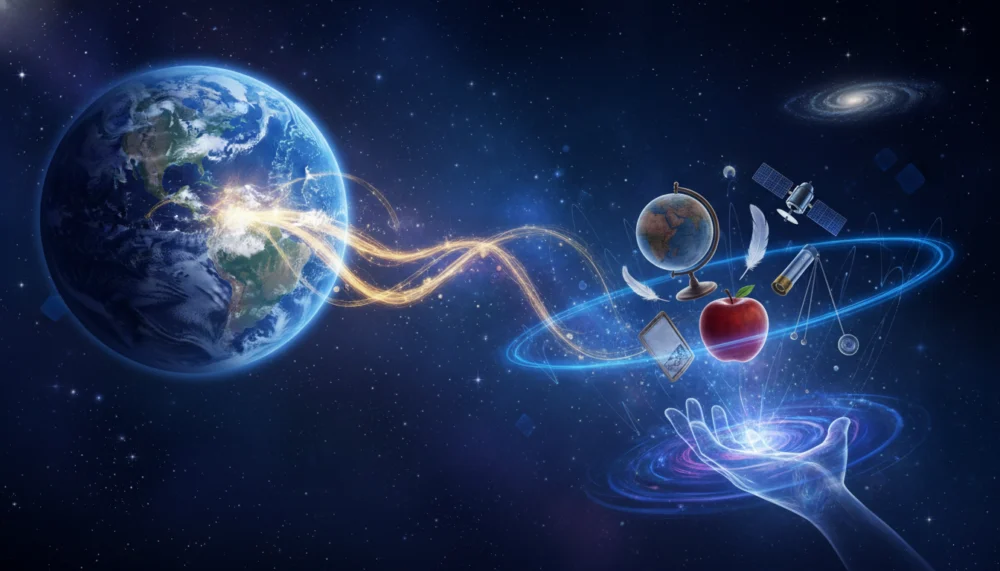
Gravity is one of the four fundamental forces of nature, acting as the invisible glue that holds our universe together. From the way a ball returns to the ground after being thrown to the way planets orbit stars, gravity is constantly at work, yet its mechanism remains a subject of deep scientific study.
At its most basic level, gravity is an attractive force that exists between any two objects with mass. Whether it is a grain of sand or a massive star, every object in the universe exerts a gravitational pull on every other object. However, the strength of that pull depends on two critical factors: mass and distance.
The Foundation of Gravity: Newton’s Perspective
In the 17th century, Sir Isaac Newton formulated the Law of Universal Gravitation. He proposed that every particle of matter in the universe attracts every other particle with a force that is directly proportional to the product of their masses and inversely proportional to the square of the distance between their centers.
This means that the more mass an object has, the stronger its gravitational pull. Because the Earth is incredibly massive compared to the objects on its surface, its gravitational force dominates our daily experience, making it feel as though everything is being pulled ‘down’ toward the ground.
Mass and Distance: The Core Variables
The relationship between mass and gravity is linear; if you double the mass of an object, you double its gravitational pull. Conversely, the relationship with distance is an inverse-square law. If you double the distance between two objects, the gravitational force between them drops to one-fourth of its original strength.
This explains why we do not feel the gravitational pull of a nearby building or a car. While those objects do have mass and therefore exert gravity, their mass is so minuscule compared to the Earth that their pull is completely undetectable without sensitive scientific instruments.
Einstein and the Curvature of Spacetime
While Newton’s laws accurately describe how gravity behaves, they do not explain what gravity actually is. In the early 20th century, Albert Einstein revolutionized our understanding with his General Theory of Relativity. Einstein suggested that gravity is not a ‘pulling’ force in the traditional sense, but rather a result of the curvature of spacetime.
Imagine placing a heavy bowling ball in the center of a stretched-out trampoline. The ball causes the fabric of the trampoline to sag or curve. If you place a smaller marble near the bowling ball, it will roll ‘down’ the curve toward the center. Einstein argued that massive objects like the Earth do the same thing to the fabric of the universe.
Understanding the Fabric of the Universe
In this model, spacetime is a four-dimensional fabric that combines the three dimensions of space with the fourth dimension of time. Massive objects warp this fabric, and we perceive this warping as gravity. When you drop a pen, it isn’t being ‘pulled’ by a rope; it is simply following the natural curvature of spacetime created by the Earth’s mass.
This perspective changes the definition of ‘falling.’ According to general relativity, an object in freefall is actually moving along the straightest possible path through curved spacetime. Because the Earth is so massive, the path of least resistance for any nearby object leads directly toward the Earth’s center.
Defining ‘Down’: Directional Gravity
When we say gravity pulls objects ‘down,’ we are using a relative term. In physics, ‘down’ is simply the direction toward the center of the mass that is exerting the strongest gravitational force. For us, that mass is the Earth. If you were standing on the South Pole, ‘down’ would still be toward the center of the Earth, which would be ‘up’ from the perspective of someone at the North Pole.
The Earth’s gravity acts as if all its mass is concentrated at a single point called the center of gravity. For a nearly spherical planet like Earth, this point is at the very core. Therefore, no matter where you are on the surface, gravity pulls you directly toward that central point.
Gravity on a Spherical Planet
Because the Earth is an oblate spheroid—slightly flatter at the poles and bulging at the equator—gravity is not perfectly uniform everywhere. You actually weigh slightly more at the poles than at the equator because you are closer to the Earth’s center of mass at the poles. This subtle difference highlights how sensitive gravitational force is to distance.
The Difference Between Mass and Weight
It is common to use the terms ‘mass’ and ‘weight’ interchangeably, but in science, they represent very different concepts. Understanding this distinction is key to understanding how gravity works across different environments, such as on the Moon or in deep space.
- Mass: This is the amount of matter in an object. It remains the same regardless of where the object is located in the universe.
- Weight: This is a measure of the gravitational force exerted on an object. Weight changes depending on the strength of the local gravitational field.
On the Moon, which has about one-sixth the mass of Earth, you would have the same mass but weigh significantly less. This is because the Moon’s smaller mass creates a shallower curve in spacetime, resulting in a weaker ‘pull’ toward its center.
Gravity’s Role in the Solar System
Gravity does more than just keep our feet on the ground; it governs the motion of every celestial body. The Sun’s immense gravity keeps the Earth in orbit, while the Earth’s gravity keeps the Moon from drifting away. This cosmic balancing act is a result of the velocity of the orbiting body countering the gravitational pull of the larger mass.
If the Earth stopped moving in its orbit, the Sun’s gravity would eventually pull it into the solar core. However, because the Earth is moving at a specific speed, it stays in a constant state of ‘falling’ around the Sun, creating a stable orbit.
Escaping Gravity: The Concept of Velocity
To leave the Earth’s surface and head into space, an object must reach what is known as ‘escape velocity.’ This is the speed required to overcome the Earth’s gravitational pull. For Earth, this speed is approximately 11.2 kilometers per second (about 25,000 miles per hour). Without reaching this threshold, gravity will always eventually pull the object back down.
Common Misconceptions About Gravity
One common myth is that there is no gravity in space. In reality, gravity is everywhere. Astronauts on the International Space Station (ISS) experience weightlessness not because gravity is absent, but because they are in a constant state of freefall. They are moving sideways fast enough that as they fall toward Earth, the planet curves away beneath them.
Another misconception is that gravity is a ‘strong’ force. In fact, gravity is the weakest of the four fundamental forces. You can overcome the gravity of the entire Earth just by picking up a paperclip with a small magnet. However, because gravity is always attractive and works over vast distances, it dominates the large-scale structure of the cosmos.
In conclusion, gravity pulls objects down because mass warps the fabric of reality, creating a path that leads toward the center of the most massive nearby object. Whether viewed through Newton’s equations or Einstein’s geometry, gravity remains the essential architect of our physical world.
