

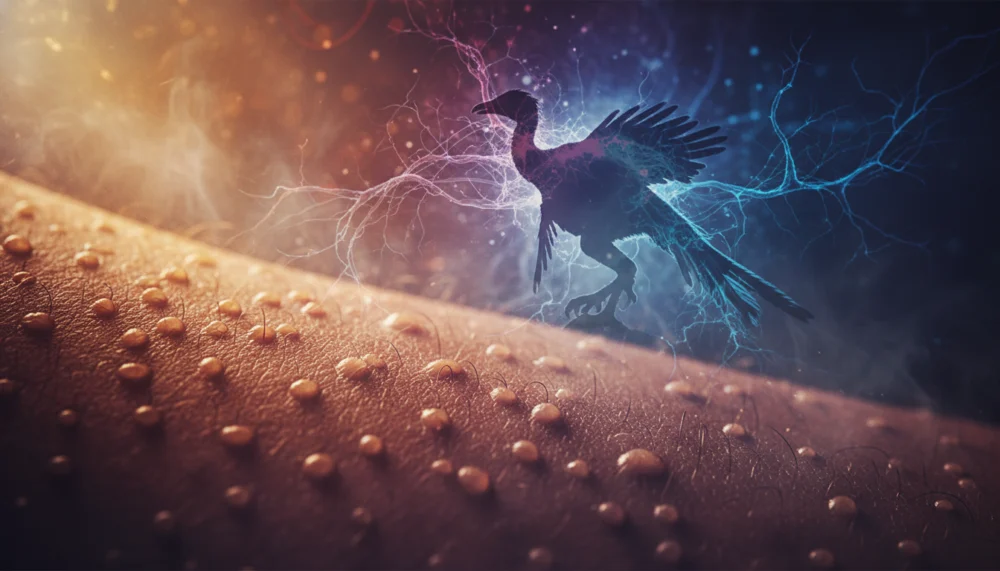
Have you ever felt a sudden chill or a wave of emotion and noticed tiny bumps appearing on your skin? This common phenomenon, often accompanied by hairs standing on end, is something we have all experienced. While it might seem like a minor quirk of the human body, the science behind why we get goosebumps is rooted in our evolutionary history and complex physiological systems.
Scientifically known as piloerection, goosebumps are an involuntary reaction of the body. The term ‘goosebumps’ comes from the resemblance of the skin to that of a plucked bird, particularly a goose. Understanding this reaction requires looking at both the mechanics of our skin and the history of our ancestors.
The Physiology of Goosebumps
At the base of every hair follicle on your body lies a tiny, smooth muscle called the arrector pili. These muscles are connected to the nervous system and react to specific stimuli. When these muscles contract, they pull the hair follicle upward, causing the hair to stand straight up and creating a shallow depression on the skin surface, which results in the characteristic ‘bump.’
The Role of the Sympathetic Nervous System
The contraction of the arrector pili muscles is controlled by the sympathetic nervous system. This part of our nervous system is responsible for most of our involuntary actions, including the ‘fight or flight’ response. Because it is involuntary, you cannot consciously make goosebumps appear or disappear.
When the brain perceives a stimulus, such as a drop in temperature or a sudden surge of emotion, it sends a signal through the sympathetic nerves. This triggers the release of chemical messengers that tell the arrector pili muscles to tighten, leading to the physical manifestation we see on our skin.
Evolutionary Purpose: Survival of the Furriest
For our ancient ancestors, goosebumps served a vital purpose for survival. Millions of years ago, humans had significantly more body hair than we do today. In that context, piloerection was a functional tool rather than a vestigial trait.
Thermal Insulation
When an animal with thick fur gets cold, its hairs stand up to trap a layer of air close to the skin. This layer of air acts as insulation, helping to retain body heat and protect the animal from the elements. Although humans have lost most of their thick hair, the reflex remains, even though it no longer provides significant warmth.
A Defense Mechanism
In the animal kingdom, making oneself look larger is a common defense strategy. When a cat or a dog feels threatened, its fur stands on end to make it appear more intimidating to predators. Our ancestors likely used this same mechanism to look bigger and scarier when facing threats in the wild.
Common Triggers for Goosebumps Today
While we no longer need goosebumps to ward off predators or stay warm in the tundra, our bodies still react to various triggers. These triggers can be categorized into physical and psychological categories.
- Cold Temperatures: The most common cause, where the body attempts to generate or trap heat.
- Intense Emotion: Feelings of awe, fear, or excitement.
- Musical Frisson: A specific reaction to moving pieces of music.
- Nostalgia: Recalling powerful memories can trigger a physical response.
The Phenomenon of Frisson
Have you ever listened to a powerful song and felt a shiver down your spine? This is known as frisson, or ‘aesthetic chills.’ Researchers believe this happens because music can trigger the same reward centers in the brain as food or other pleasurable activities, leading to a spike in dopamine and subsequent piloerection.
Fear and Adrenaline
In moments of extreme fear or stress, the body releases adrenaline (epinephrine) from the adrenal glands. Adrenaline is the primary driver of the fight-or-flight response. Along with increasing heart rate and boosting energy, adrenaline causes the arrector pili muscles to contract, which is why we get goosebumps when we are scared.
The Connection to Awe
Interestingly, goosebumps are also associated with the feeling of awe. When we witness something vast, beautiful, or beyond our immediate understanding—like a stunning landscape or a scientific breakthrough—our brain processes this as a significant event, often triggering the same sympathetic nervous system response.
Is There a Modern Benefit?
While goosebumps are largely considered vestigial—meaning they have lost their original function through evolution—recent research suggests they might still play a role in skin health. Some studies indicate that the muscles responsible for goosebumps are linked to stem cells that promote hair growth and skin regeneration.
Biological Signaling
The connection between the arrector pili muscle and hair follicle stem cells suggests that the body may use the ‘cold’ signal to encourage the growth of more hair over time. While this doesn’t help us in the short term, it shows that the biological machinery is still deeply integrated into our skin’s maintenance systems.
Conclusion: A Link to Our Past
In summary, goosebumps are a fascinating reminder of our evolutionary journey. They represent a bridge between our modern lives and our primitive ancestors. Whether triggered by a cold breeze, a beautiful melody, or a moment of fear, this tiny skin reaction is a testament to the complex and enduring nature of the human body.
Understanding why we get goosebumps helps us appreciate the intricate ways our nervous system interacts with the environment. Even though we no longer have the thick fur of our ancestors, the ‘gooseflesh’ remains as a biological echo of a time when we needed every advantage to survive the natural world.
