

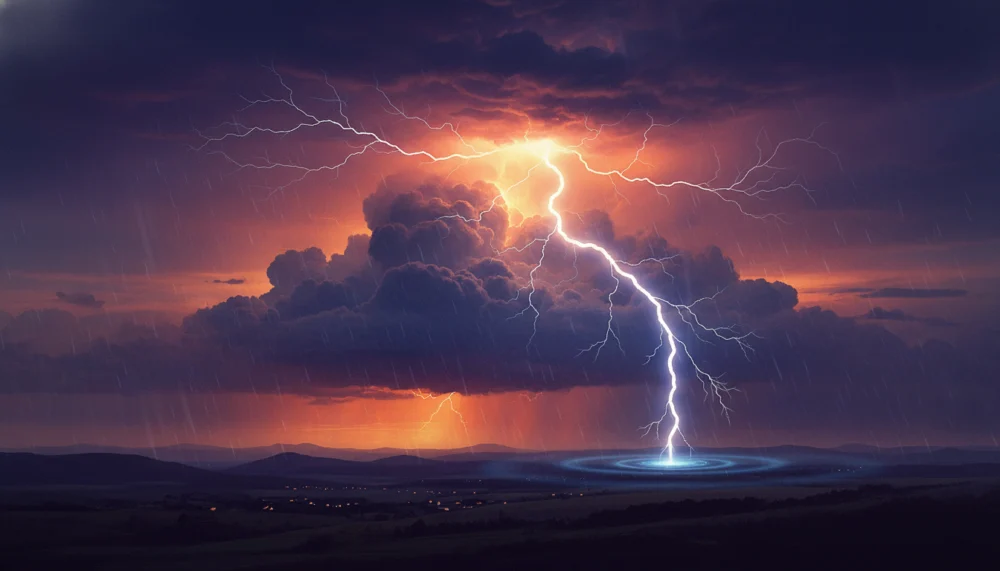
The phenomenon of seeing a brilliant flash of lightning followed moments later by a rolling peal of thunder is one of nature’s most dramatic displays. While these two events are created simultaneously by the same atmospheric discharge, they rarely reach our senses at the same time. This delay is not a trick of the mind but a fundamental result of the laws of physics governing how energy moves through our atmosphere.
The Fundamental Difference in Speed
To understand why lightning precedes thunder, we must first look at the massive disparity between the speed of light and the speed of sound. Light and sound travel in very different ways and at vastly different velocities. Light is an electromagnetic wave that can travel through a vacuum, whereas sound is a mechanical wave that requires a medium, such as air or water, to propagate.
The Velocity of Light
Light is the fastest known entity in the universe. In the vacuum of space, it travels at a staggering 299,792,458 meters per second (approximately 186,282 miles per second). Even when passing through the Earth’s atmosphere, which slows it down slightly, light reaches an observer almost instantaneously. For all practical purposes on Earth, the moment a lightning bolt occurs, the light it emits is visible to anyone within a direct line of sight.
The Velocity of Sound
In contrast, sound travels much more slowly. In dry air at sea level and at a temperature of 20 degrees Celsius (68 degrees Fahrenheit), sound moves at about 343 meters per second (roughly 1,125 feet per second). This means it takes sound approximately five seconds to travel a single mile. Because sound relies on the vibration of molecules in the air, its speed is heavily influenced by environmental factors such as temperature, humidity, and altitude.
The Mechanics of a Lightning Strike
A lightning strike is a massive electrical discharge that balances the difference between the electrical charges in the atmosphere and those on the ground. When the electrical potential becomes too great, a bolt of plasma cuts through the air. This process releases an incredible amount of energy in the form of both heat and light, occurring in a fraction of a second.
How Thunder is Generated
Thunder is the direct acoustic result of the lightning strike. When a bolt of lightning passes through the air, it heats the immediate column of air to temperatures as high as 30,000 degrees Celsius (54,000 degrees Fahrenheit). This is approximately five times hotter than the surface of the sun. This sudden, intense heating causes the air to expand explosively, creating a high-pressure shockwave.
The Thermal Expansion Process
As the heated air expands faster than the speed of sound, it creates a sonic boom. As this shockwave moves outward and the air cools, it transitions into the acoustic wave we recognize as thunder. Because a lightning bolt can be several miles long, the sound from the top of the bolt takes longer to reach you than the sound from the bottom, which is why thunder often sounds like a long, rolling rumble rather than a single sharp crack.
Calculating Your Distance from the Storm
Because of the consistent difference between the speeds of light and sound, you can use a simple mathematical trick to estimate how far away a thunderstorm is located. This is often referred to as the ‘flash-to-bang’ method. By timing the interval between the visual flash and the audible rumble, you can determine your safety margin.
- Step 1: Watch for the flash of lightning.
- Step 2: Immediately begin counting the seconds until you hear the thunder.
- Step 3: Divide the number of seconds by five to find the distance in miles, or by three for the distance in kilometers.
Why Sound Dissipates Over Distance
You may have noticed that the further away a storm is, the quieter and lower-pitched the thunder becomes. This happens because the atmosphere absorbs higher-frequency sound waves more readily than lower-frequency ones. Additionally, as the sound wave spreads out from the source, its energy is distributed over a larger area, causing the volume to decrease significantly until it eventually becomes inaudible.
Heat Lightning: A Common Misconception
Sometimes people observe ‘heat lightning,’ which is lightning that appears to have no accompanying thunder. In reality, heat lightning is simply a normal lightning strike that is occurring too far away for the sound waves to reach the observer. Sound typically carries for about 10 to 15 miles depending on the terrain and atmospheric conditions, while the light from a powerful bolt can be seen from over 100 miles away on a clear night.
Factors Affecting Sound Travel
Several environmental variables can change how you perceive thunder. For instance, temperature inversions in the atmosphere can act like a ceiling, bouncing sound waves back toward the ground and making thunder sound much louder and more resonant. Humidity also plays a role, as moist air is less dense than dry air, allowing sound to travel slightly faster and more efficiently.
Safety Precautions During Storms
Understanding the relationship between lightning and thunder is crucial for safety. If the time between the flash and the bang is 30 seconds or less, you are within striking distance and should seek immediate shelter. The National Weather Service recommends following the ’30-30 Rule’:
- Seek shelter if you hear thunder within 30 seconds of a flash.
- Stay indoors for at least 30 minutes after the last clap of thunder is heard.
Conclusion
The delay between lightning and thunder is a perfect demonstration of physics in action. By recognizing that light travels nearly a million times faster than sound, we can appreciate the scale of the atmosphere and use that knowledge to keep ourselves safe during severe weather. Next time you see the sky light up, start counting—it is your direct link to the incredible math of the natural world.
