

Introduction to the Mystery of Slippery Ice
For centuries, the simple question of why ice is slippery has intrigued scientists and laypeople alike. While it might seem like a straightforward observation, the underlying physics are surprisingly complex and have been the subject of intense scientific debate for generations.
Traditionally, people assumed that ice was simply a smooth surface, but smooth surfaces like glass or polished metal aren’t inherently slippery in the same way. The unique property of ice lies in its ability to create a lubricating layer between itself and the object moving across it, even at temperatures well below freezing.
The Pressure Melting Theory
One of the oldest and most commonly cited explanations for ice’s slipperiness is the pressure melting theory. This concept suggests that when pressure is applied to ice—such as by a person standing on it or a skate blade—the melting point of the ice is lowered, causing a thin film of water to form instantly.
While pressure melting is a real physical phenomenon, modern calculations show that it is often insufficient to explain slipperiness at very low temperatures. For instance, a typical ice skater does not exert enough pressure to melt ice at temperatures significantly below freezing, yet they can still glide effortlessly across the rink.
Friction-Induced Melting
Another significant factor to consider is friction-induced melting. As an object moves across the ice, the kinetic energy generated by friction is converted into heat. This heat is often enough to melt the topmost layer of ice molecules, creating the necessary liquid lubrication for movement.
This theory explains why skaters can move so fast; the faster they go, the more friction they generate, which in turn maintains the liquid layer. However, this doesn’t explain why ice is slippery even when an object is standing still or moving extremely slowly.
The Quasi-Liquid Layer
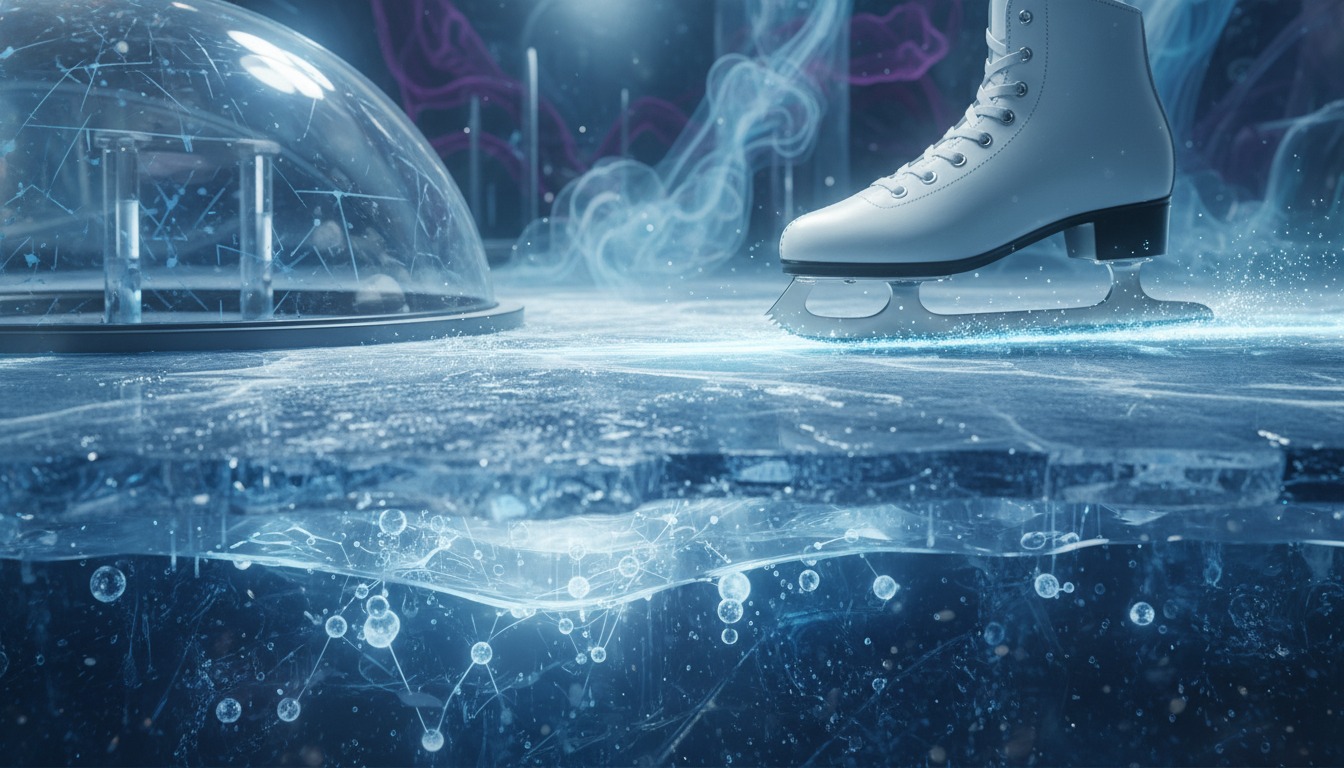
The most widely accepted modern explanation involves the existence of a quasi-liquid layer (QLL). This is a permanent, microscopic film of water-like molecules that exists on the surface of ice even at temperatures well below its official melting point.
This layer is not quite liquid and not quite solid. Because the water molecules at the surface of an ice crystal have fewer neighbors to bond with, they become disordered and behave like a fluid. This ‘pre-melting’ state provides the inherent slipperiness we associate with ice without the need for external pressure.
Characteristics of the Quasi-Liquid Layer
Scientists have identified several key features of this layer that contribute to its lubricating properties:
- It exists at temperatures as low as -30 degrees Celsius.
- The thickness of the layer increases as the temperature approaches the melting point.
- It acts as a high-efficiency lubricant for any object in contact with the surface.
The discovery of the QLL was first proposed by Michael Faraday in the mid-19th century. He observed that two ice cubes would freeze together if pressed against each other, suggesting a liquid-like skin that solidifies upon contact, effectively acting as a glue.
Recent Scientific Breakthroughs
Recent advancements in microscopy have allowed researchers to see these molecular layers in unprecedented detail. Using Atomic Force Microscopy, scientists have confirmed that the surface molecules of ice are highly mobile, moving much more freely than those in the bulk of the ice crystal.
These studies have shown that the slipperiness of ice is not just a macroscopic effect but a fundamental property of how water molecules organize themselves at an interface. This research helps refine our understanding of thermodynamics and surface science across various disciplines.
Temperature and Slipperiness
The slipperiness of ice is highly dependent on temperature. Ice is actually most ‘slippery’ around 0 degrees Celsius. As the temperature drops significantly, the quasi-liquid layer becomes thinner and more viscous, making the ice feel ‘tackier’ or less slick to the touch.
Comparing Ice to Other Solids
Why aren’t other solids, like wood or rock, naturally slippery? Most solids have stable, well-defined surface structures with molecules locked firmly in place. In contrast, the hydrogen bonding in water creates a unique crystal lattice that is prone to surface disordering.
This unique molecular behavior makes water one of the few substances where the solid phase is less dense than the liquid phase, contributing to the unusual properties of ice at its surface and its behavior under varying environmental conditions.
The Role of Crystal Structure
The hexagonal crystal structure of ice plays a vital role in its surface physics. The way these hexagons stack leaves ‘dangling bonds’ at the surface. These unfulfilled bonds allow the surface molecules to vibrate and rotate more freely than those locked within the interior of the crystal.
Practical Implications of Ice Science
Understanding why ice is slippery has massive implications for various industries. From transportation safety to professional sports, the physics of ice surface interaction dictates how we design tools, footwear, and infrastructure.
Winter Safety and Tire Design
Tire manufacturers use the science of ice slipperiness to develop rubber compounds and tread patterns that maximize grip. By understanding the thickness of the quasi-liquid layer, they can create sipes that wick away the microscopic water film to prevent hydroplaning on frozen roads.
Optimizing Sports Performance
In sports like curling and speed skating, athletes rely on manipulating the ice surface. Curlers ‘sweep’ the ice to create friction and momentarily thicken the liquid layer, which reduces friction and allows the stone to travel further and straighter toward the target.
Environmental Factors and Humidity
Humidity also plays a role in how slippery ice feels. High humidity can lead to the formation of frost or ‘hoar ice,’ which can actually increase friction compared to a smooth, clear ice surface by creating tiny physical obstacles.
Conversely, very dry conditions can lead to sublimation, where ice turns directly into gas. This process can alter the surface texture and the behavior of the quasi-liquid layer, impacting everything from glacier movement to winter road maintenance strategies.
Conclusion: A Multi-Factor Phenomenon
In conclusion, the slipperiness of ice is not caused by a single factor but rather a combination of pressure melting, frictional heating, and the existence of a quasi-liquid layer. While the QLL is the primary reason ice is naturally slick, the other factors enhance this effect during movement.
As science continues to probe the molecular depths of water, we gain a better appreciation for this common yet extraordinary substance. The next time you slide across a frozen puddle, you are experiencing one of the most complex and fascinating surface interactions in the natural world.