

The traditional paradigm of mathematics education, once defined by rote memorization and the linear acquisition of arithmetic skills, is undergoing a significant transformation in the 21st century. This shift has placed parents in a complex position, often caught between the methods they utilized decades ago and the conceptual, inquiry-based approaches now favored in modern classrooms. As educational philosophies evolve, a growing movement of educators and parents is advocating for a "playful" approach to mathematics—one that prioritizes curiosity and problem-solving over the mere pursuit of a single correct answer. This transition has sparked a broader national conversation regarding the role of parental support, the impact of gender stereotypes on mathematical identity, and the long-term implications of "math anxiety" in the home.
The Shift Toward Conceptual and Playful Mathematics
At the center of this pedagogical shift is the work of educators like Denise Gaskins, who advocates for a non-linear understanding of mathematical concepts. Gaskins and her contemporaries argue that mathematics should be treated as a "treasure trove" of puzzles rather than a ladder of skills to be climbed. This philosophy encourages students—and their parents—to ponder the "why" behind mathematical relationships. For instance, when students encounter linear equations, the standard curriculum dictates that there can be zero, one, or infinite solutions. However, a playful approach encourages students to ask unconventional questions, such as what it might mean to have "half a solution."
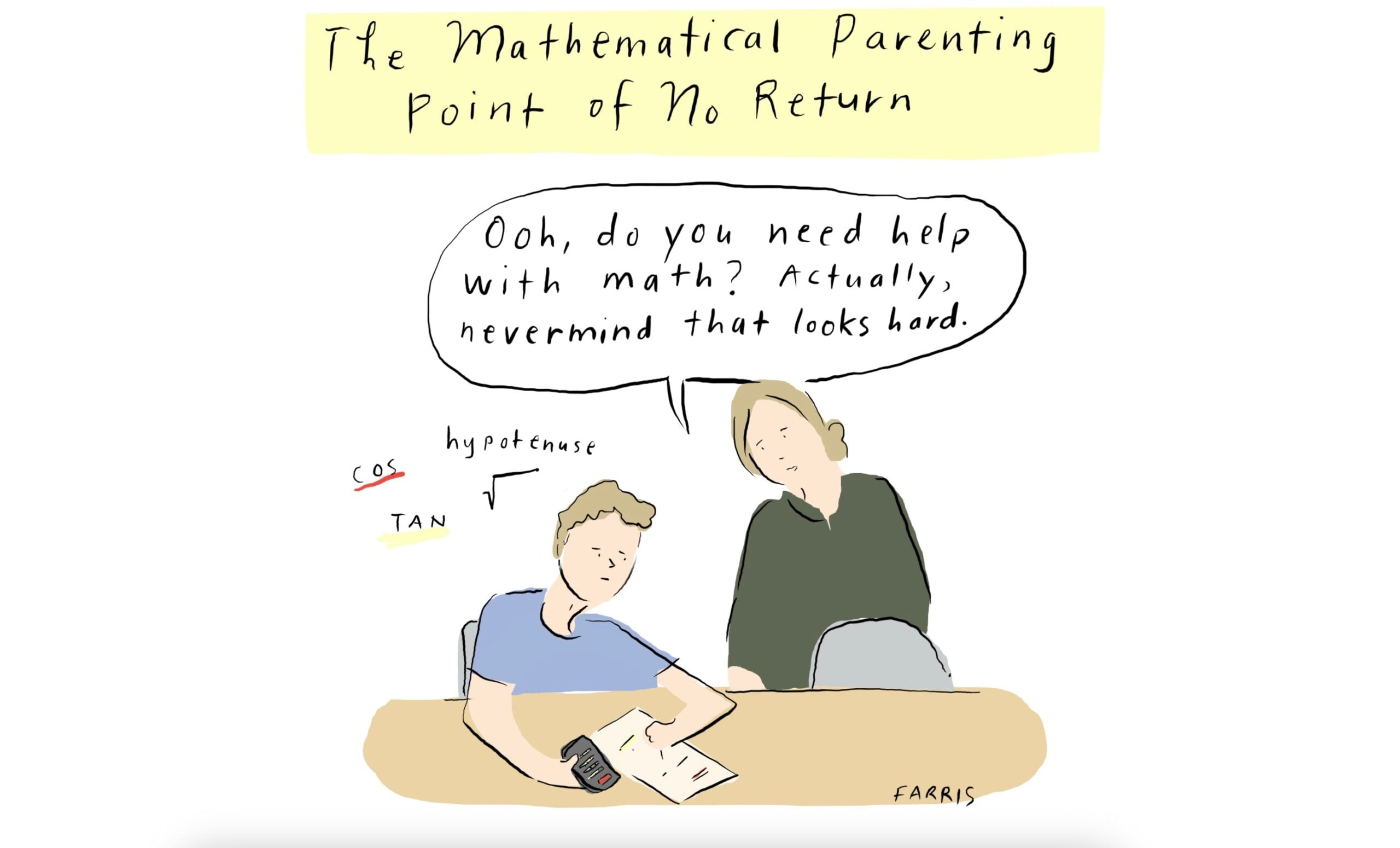
Mathematicians and specialists suggest that modeling curiosity is often more beneficial than providing immediate answers. By positioning themselves as co-investigators rather than authoritative sources of knowledge, parents can foster a growth mindset in their children. This approach is particularly relevant as students progress into higher-level coursework, such as trigonometry or calculus, where the abstract nature of the material often exceeds a parent’s immediate recall.
The Gendered Narrative of Mathematical Ability
One of the most persistent challenges in mathematics education is the prevalence of the "bad at math" stereotype, particularly among women. Recent discourse among parents and educators highlights a concerning trend: the tendency for mothers to self-identify as mathematically incompetent in front of their children. Research from the University of Chicago on "parental math anxiety" suggests that when parents express frustration or a lack of confidence in math, it can negatively influence their children’s perceptions and performance in the subject.
Critics of this gendered narrative argue that the "cute to be bad at math" culture in the United States is a significant barrier to closing the gender gap in STEM (Science, Technology, Engineering, and Mathematics) fields. Educators emphasize that mathematical skill is not an innate trait but a developed competency. While some parents may have moved into careers that do not require daily use of sine, cosine, or tangent, specialists argue that this reflects a loss of specific procedural memory rather than a lack of mathematical intelligence. The distinction is vital for maintaining a positive learning environment; when parents frame math as a "hard thing that anyone can do with effort," they help dismantle the myth that only certain people are "math people."
A Chronology of Curriculum Reform and Parental Challenges
The disconnect many parents feel today can be traced through a timeline of educational reform in the United States and abroad.
- The Mid-20th Century (Post-Sputnik): The "New Math" movement of the 1950s and 60s attempted to introduce set theory and symbolic logic into primary education. It was largely criticized for being too abstract for young learners and confusing for parents.
- The 1980s and 90s: A "Back to Basics" movement refocused on rote memorization, such as multiplication tables and long division. This is the era in which many of today’s parents were educated.
- The 2010s (Common Core Era): The introduction of the Common Core State Standards in 2010 shifted the focus back to conceptual understanding. This "New-New Math" emphasizes multiple strategies for solving a single problem, such as number bonds or "counting up," which often differ significantly from the algorithms parents learned in their youth.
This chronological shift explains why a parent who is a professional in finance might still struggle to assist a 10th-grader with modern geometry homework. The "point of no return"—the moment a child’s coursework surpasses a parent’s ability to assist—is arriving earlier for many families due to the accelerated nature of modern curricula.
The Role of Scaffolding and Time Management
Parental involvement in homework is not a monolithic experience; it varies significantly based on the student’s age, the school’s expectations, and the presence of learning differences. For parents of children with ADHD, dyslexia, or dysgraphia, the role of the parent often shifts from "tutor" to "executive function coach."
In these scenarios, parental assistance involves "scaffolding"—providing the organizational structure necessary for the student to succeed. This might include rewriting notes, quizzing for retention, or simply providing a dedicated, supervised "homework time" while the parent performs other household tasks. Case studies of students with ADHD show that intensive parental support during the freshman and sophomore years of high school can lead to the development of independent study habits by the junior and senior years. For these families, the "work" of homework is as much about discipline and time management as it is about the subject matter itself.
Professional Perspectives and Community Support
The modern parent often relies on a network of "experts" to bridge the gap in their own knowledge. This includes "bonus aunts" with PhDs in mathematics, engineer friends on speed-dial, and online resources provided by teachers through platforms like Google Classroom. The digital age has allowed parents to "refresh" their memories in real-time, using teacher-posted slides and instructional videos to stay one step ahead of their children’s assignments.
Interestingly, some parents have taken extreme measures to stay relevant in their children’s academic lives. There are documented cases of parents returning to university to earn degrees in mathematics specifically to support their children’s education. This "return to school" phenomenon highlights the high value placed on mathematical literacy as a form of social and economic power.
Data and Statistical Context
National data continues to show a correlation between parental attitudes toward math and student achievement. According to the National Assessment of Educational Progress (NAEP), students who report that their parents encourage them to see math as useful and achievable tend to score higher than those who hear negative messaging at home. Furthermore, a 2023 study published in the Journal of Educational Psychology found that "math-anxious" parents who used structured math apps with their children significantly reduced the "contagion" of math anxiety, suggesting that external tools can serve as a buffer between a parent’s insecurity and a child’s learning.
Broader Impact and Implications for the Future
The long-term implications of how families engage with mathematics are profound. As the global economy becomes increasingly data-driven, the ability to "think mathematically" is no longer optional. However, the definition of mathematical literacy is expanding to include the ability to navigate complex systems, analyze patterns, and approach problems with a "playful" mindset.
The evolution of parental involvement suggests a move away from the "all-knowing" model of parenting toward a more collaborative, "lifelong learner" model. When parents admit they do not know the answer but are willing to find out, they teach their children the most valuable skill of all: how to learn.
In conclusion, while the "point of no return" in math homework may be an inevitable milestone for many parents, it does not signify the end of their influence. By fostering a home environment that celebrates curiosity, rejects gendered stereotypes, and utilizes community resources, parents can ensure that their children see mathematics not as a hurdle to be cleared, but as a language for understanding the world. The transition from rote arithmetic to playful inquiry represents not just a change in curriculum, but a fundamental shift in how society values the process of thinking.