

The implementation of baby sign language—a specialized, simplified version of American Sign Language (ASL)—has transitioned from a niche parenting trend to a recognized developmental tool utilized by caregivers and early childhood educators worldwide. Designed to bridge the "communication gap" that exists between an infant’s desire to express needs and their physiological ability to produce articulate speech, baby sign language provides a gestural framework for pre-verbal children. By utilizing motor skills that develop months before the complex coordination required for vocalization, infants as young as six months can begin to communicate specific requirements such as hunger, thirst, or fatigue. This proactive approach to early childhood interaction is increasingly supported by developmental psychologists who view it as a means to reduce frustration, enhance bonding, and potentially foster earlier linguistic milestones.
Developmental Chronology and Milestones
The timeline for introducing baby sign language is closely tied to an infant’s physiological and cognitive maturation. While every child develops at a unique pace, the following chronology represents the standard progression observed by pediatric specialists:
- Four to Six Months (Preparation Phase): At this stage, infants begin to develop the visual acuity necessary to track hand movements and the cognitive "joint attention" required to focus on both an object and a caregiver’s gesture. While they cannot yet replicate signs, this is the optimal period for parents to begin consistent modeling.
- Seven to Nine Months (Recognition and Initial Production): Cognitive development reaches a point where infants begin to associate specific gestures with outcomes (e.g., the sign for "milk" resulting in a feeding). Physical dexterity improves, allowing for the first "approximations"—simplified versions of the signs modeled by adults.
- Ten to Fourteen Months (Active Communication): As fine motor skills sharpen, children often develop a functional "lexicon" of 10 to 50 signs. This period frequently overlaps with the emergence of first words, creating a multi-modal communication system where the child may sign and attempt to vocalize simultaneously.
- Eighteen to Twenty-Four Months (Transition to Verbal Fluency): As vocal cords and mouth muscles mature, verbal language typically becomes the more efficient mode of communication. During this phase, most children naturally phase out signing in favor of spoken words, though the cognitive scaffolding provided by signing often remains evident in their advanced vocabulary and sentence structure.
Supporting Data and Scientific Foundations
Research into infant signing gained significant traction in the late 20th century, spearheaded by researchers such as Dr. Linda Acredolo and Dr. Susan Goodwyn. Their long-term studies, funded by the National Institutes of Health (NIH), compared infants who signed with those who did not. The data suggested that "symbolic gesturing" served as a bridge to spoken language rather than a crutch that delayed it.
Quantitative findings from various longitudinal studies indicate several key outcomes. First, signing infants often score higher on standardized language tests in early childhood. One study found that 24-month-olds who signed had a mean vocabulary significantly larger than their non-signing peers. Second, the reduction in "temper tantrums" is statistically notable. Since many emotional outbursts in toddlers stem from the inability to communicate specific needs, the presence of a gestural outlet serves as a psychological safety valve. Furthermore, neurobiological research suggests that engaging both the visual-manual and auditory-vocal centers of the brain simultaneously can strengthen neural pathways associated with language processing, a phenomenon known as "dual coding."
Instructional Methodology for Caregivers
To successfully integrate sign language into a child’s daily routine, developmental experts recommend a structured, three-pillar approach:
- Contextual Consistency: Signs should always be paired with the spoken word and the physical object or action. For example, when offering a bottle, the caregiver should make the sign for "milk," say the word "milk" clearly, and then provide the bottle. This triple-association reinforces the meaning across different sensory inputs.
- Repetitive Modeling: Infants learn through observation and repetition. Caregivers are encouraged to use signs during every relevant interaction. Experts suggest that a sign may need to be seen several hundred times before an infant attempts to replicate it.
- Positive Reinforcement and Scaffolding: When an infant makes an attempt at a sign—even if it is physically imprecise—the caregiver should respond with enthusiasm and fulfill the request. This "scaffolding" validates the child’s effort and encourages further communicative attempts.
Lexicon of Early Communication: The Primary Signs
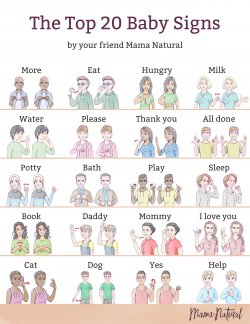
A functional baby sign language vocabulary focuses on high-utility words that relate to the infant’s immediate environment and biological needs. The following twenty signs constitute the standard introductory set for most families:
- More: Bringing the fingertips of both hands together repeatedly. This is often the first sign learned as it relates to the continuation of a pleasurable activity or meal.
- Eat: Touching the fingertips to the lips, mimicking the motion of putting food in the mouth.
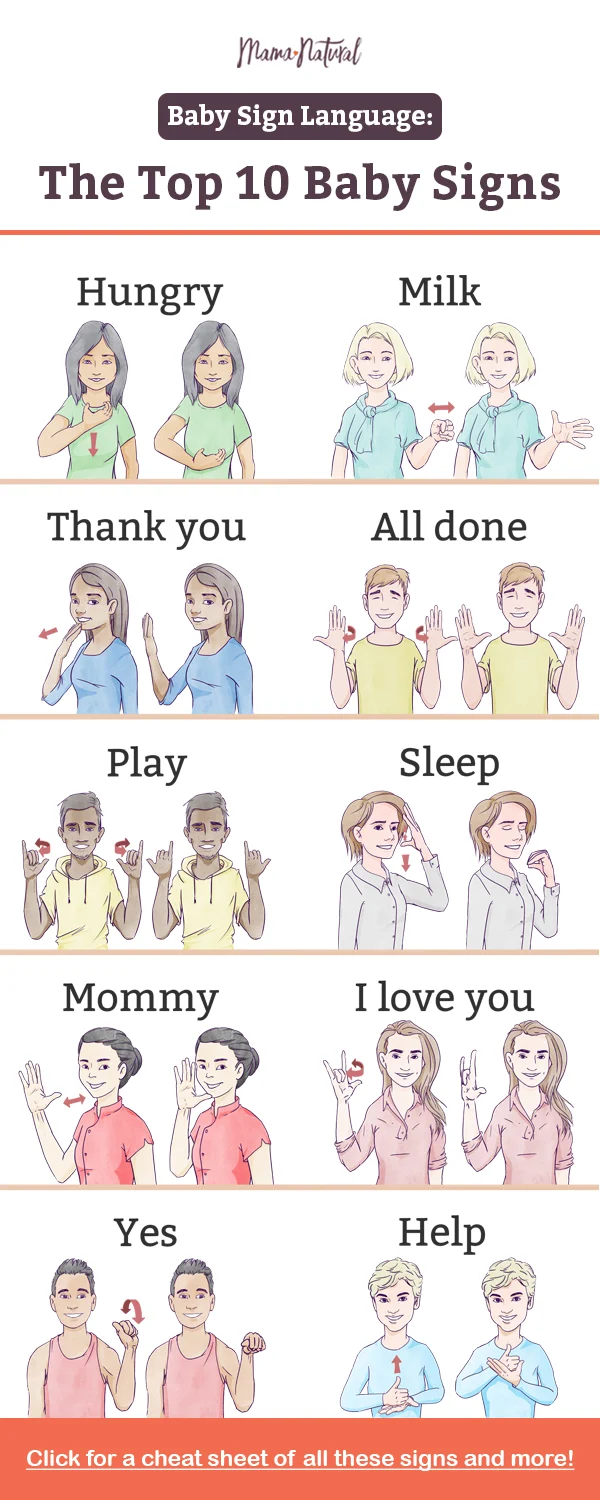
- Hungry: Sliding the hand down the chest toward the stomach, representing the path of food.
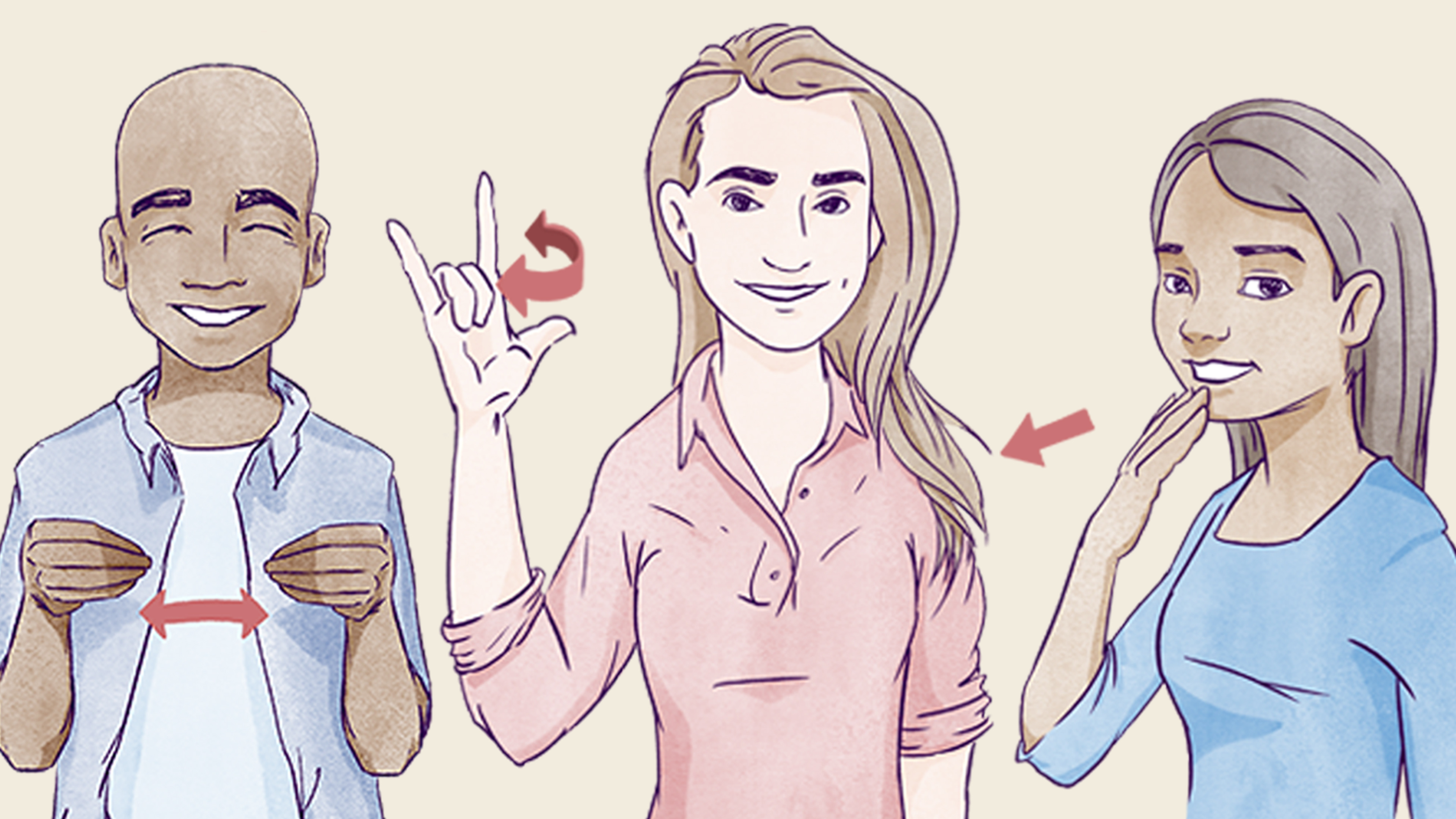
- Milk: A squeezing motion with one or both hands, similar to milking a cow.
- Water: Forming a "W" with the three middle fingers and tapping the index finger against the chin.
- Please: Rubbing a flat palm in a circular motion over the chest.
- Thank You: Touching the fingers to the lips and then moving the hand outward toward the recipient, similar to blowing a kiss.
- All Done: Holding both hands up with palms facing in, then twisting them outward to show the palms.
- Change: Crossing the wrists with hands in a "hook" shape and rotating them, signifying the transition of a diaper change.
- Potty: Making a fist with the thumb tucked between the index and middle fingers (the letter "T" in ASL) and shaking it side-to-side.
- Bath: Moving two closed fists up and down the torso, as if scrubbing the body.
- Play: Extending the thumbs and pinkies while folding the middle fingers (the letter "Y") and twisting the wrists.
- Sleep: Drawing the hand down over the face from the forehead to the chin while closing the fingers and eyes.
- Book: Pressing the palms together and then hinging them open at the pinkies, like opening a cover.
- Daddy: Tapping the thumb of an open hand against the forehead.
- Mommy: Tapping the thumb of an open hand against the chin.
- Dog: Patting the thigh and then snapping the fingers, mimicking the action of calling a canine.
- Cat: Using the thumb and index finger to "pull" imaginary whiskers away from the cheeks.
- I Love You: Crossing both arms over the chest in a self-hug, or using the specific ASL handshape (thumb, index, and pinky extended).
- Yes: Making a fist and tilting it up and down at the wrist, mimicking a nodding head.
- Help: Placing a closed fist with the thumb up (a "thumbs up") on top of a flat palm and lifting both hands together.
Expert Reactions and Pediatric Guidance
The American Academy of Pediatrics (AAP) and various speech-language pathology organizations generally view baby sign language as a positive supplemental tool. Most experts agree that while it is not a "requirement" for healthy development, it offers a valuable enrichment opportunity. Speech-Language Pathologists (SLPs) frequently utilize signing as an intervention for children with speech delays, Down syndrome, or autism spectrum disorder, as it provides a functional communication system while verbal skills are being addressed.
However, professionals emphasize that signing should never replace verbal interaction. The "serve and return" nature of spoken conversation is vital for phonological development. Experts also caution parents not to view signing as a competitive milestone; the goal is not to create a "genius baby" but to foster a deeper, more peaceful connection between parent and child.
Socio-Emotional and Long-Term Implications
Beyond the immediate practical benefits of knowing when a baby wants more applesauce, the long-term implications of early signing involve emotional intelligence and self-efficacy. When a child’s needs are met promptly because they were able to communicate them, it builds a "secure attachment" style. The child learns that their "voice"—even if expressed through their hands—has power and that their caregivers are responsive.
Furthermore, the use of baby sign language introduces children to the concept of linguistic diversity at an early age. It provides a natural entry point for discussing the Deaf community and the validity of non-verbal communication. In an increasingly inclusive society, the widespread adoption of basic ASL signs by the hearing population fosters a broader environment of accessibility.
As digital resources and community classes for baby sign language continue to proliferate, the practice is becoming a standard component of modern parenting. By acknowledging the cognitive capabilities of infants and providing them with the tools to express those capabilities, caregivers are effectively rewriting the early childhood experience, turning the "terrible twos" into a period of sophisticated, gestural dialogue. The ultimate impact of baby sign language is the transformation of the infant from a passive recipient of care into an active, engaged participant in the family unit.
