

The implementation of baby sign language serves as a pivotal bridge in early childhood development, allowing infants to express specific needs and emotions before they possess the physiological ability to form spoken words. This specialized form of communication, primarily derived from American Sign Language (ASL), involves a series of simplified gestures tailored to the developing motor skills of infants. By providing a non-verbal outlet for expression, caregivers can significantly reduce the communicative frustrations that often lead to distress in pre-verbal children. As pediatric research continues to evolve, the integration of signing into daily routines has transitioned from a niche parenting trend to a widely recognized developmental tool endorsed by various early childhood specialists.
Historical Context and Scientific Foundations
The concept of teaching sign language to hearing infants gained significant academic traction in the late 20th century. In the 1970s, Joseph Garcia, a researcher in sign language linguistics, observed that hearing children of Deaf parents began communicating through signs much earlier than their peers began speaking. This observation suggested that while the vocal apparatus (the larynx and tongue) requires approximately 12 to 18 months to mature sufficiently for complex speech, the manual dexterity required for basic gesturing develops much sooner.
Further validation came in the 1980s and 1990s through the work of Dr. Linda Acredolo and Dr. Susan Goodwyn, whose research was funded by the National Institutes of Health (NIH). Their longitudinal studies indicated that infants who learned to sign not only experienced fewer tantrums but also showed signs of accelerated language development and, in some cases, higher IQ scores in later childhood. These findings debunked the long-standing myth that signing might delay verbal speech; instead, the research suggested that signing serves as a "scaffolding" for spoken language.
Developmental Timeline for Manual Communication
Understanding the chronological progression of an infant’s ability to process and replicate signs is essential for realistic expectations and successful implementation.
- Introduction (4 to 6 Months): At this stage, infants begin to develop the visual acuity and focus necessary to observe a caregiver’s hand movements. While the infant will not yet be able to sign back, this period is critical for "receptive language" building.
- Recognition (6 to 8 Months): Infants start to associate specific gestures with their corresponding objects or actions. For instance, a child may show increased excitement when they see the sign for "milk," indicating comprehension.
- Active Production (8 to 12 Months): This is typically when the first intentional signs appear. Because fine motor skills are still developing, an infant’s signs may be "approximations"—simplified versions of the caregiver’s gesture.
- Verbal Transition (12 to 18 Months): As the child begins to produce spoken words, signing often continues as a supplementary tool. Eventually, as spoken vocabulary becomes more efficient, the child will naturally phase out gestures in favor of verbalization.
Psychological and Behavioral Benefits
The benefits of baby sign language extend beyond the mere exchange of information; they encompass significant psychological and emotional advantages for both the child and the caregiver.
Reduction in Frustration and Temper Tantrums
The primary catalyst for temper tantrums in toddlers is the inability to communicate complex needs. When a child can sign "water" or "hungry," they bypass the need for "guessing games" played by the parent. This clarity fosters a calmer environment and prevents the escalation of stress for all parties involved.
Enhancement of Self-Esteem and Confidence
When an infant realizes that their actions can directly influence their environment and elicit a specific response from a caregiver, it builds a foundational sense of agency. Experts in child psychology note that this early success in communication reinforces a child’s self-esteem, making them feel heard and understood.
Strengthening the Parent-Child Bond
The process of teaching and practicing signs requires dedicated face-to-face interaction and eye contact. This focused attention strengthens the emotional attachment between the child and the caregiver, creating a more responsive and intuitive relationship.
Strategic Implementation: How to Teach Sign Language
Successful instruction requires consistency, context, and patience. The following methodology is recommended by developmental experts:
- Contextual Relevance: Introduce signs during the activities to which they relate. Sign "eat" only when the child is in their high chair or "bath" when the water is running. This reinforces the association between the gesture and the reality.
- Verbal Reinforcement: Always say the word clearly while performing the sign. This ensures that the child is learning the auditory and visual components of language simultaneously.
- Repetition and Modeling: Infants learn through imitation. Caregivers should perform the sign frequently, even before the child shows interest in reciprocating.
- Positive Reinforcement: When a child attempts a sign, even if it is imperfect, caregivers should respond enthusiastically and fulfill the request immediately to validate the effort.
A Comprehensive Lexicon for Early Communication
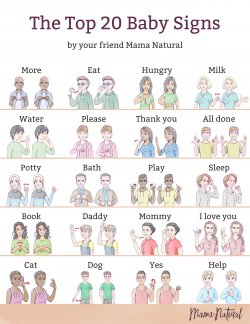
The following twenty signs represent the most common and useful gestures for infants, focusing on biological needs, social interactions, and environmental objects.
Fundamental Needs and Requests
- More: Bring the fingertips of both hands together to touch their respective thumbs, then tap the fingertips of both hands together repeatedly. This is often the first sign a child learns.
- Eat: Using the same hand shape as "more," tap the fingertips against the lips.
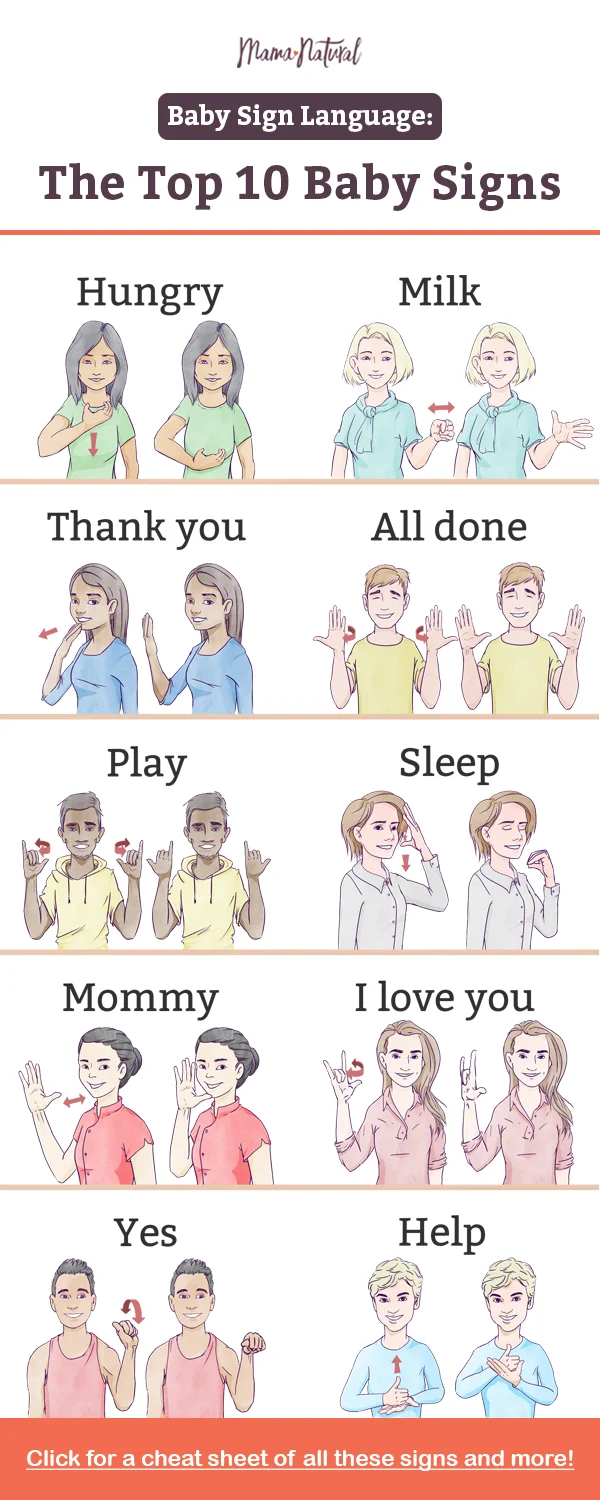
- Hungry: Place a flat palm against the chest and slide it down toward the stomach, mimicking the path of food.
- Milk: Form a fist and then open and close the fingers, simulating the motion of milking an udder.
- Water: Extend the three middle fingers to form a "W" shape while tucking the thumb and pinky, then tap the index finger against the chin.
- Help: Place a closed fist with the thumb extended (a "thumbs up") onto the flat palm of the opposite hand, then move both hands upward together.
Social and Behavioral Signs
- Please: Place a flat palm against the center of the chest and move it in a circular motion.
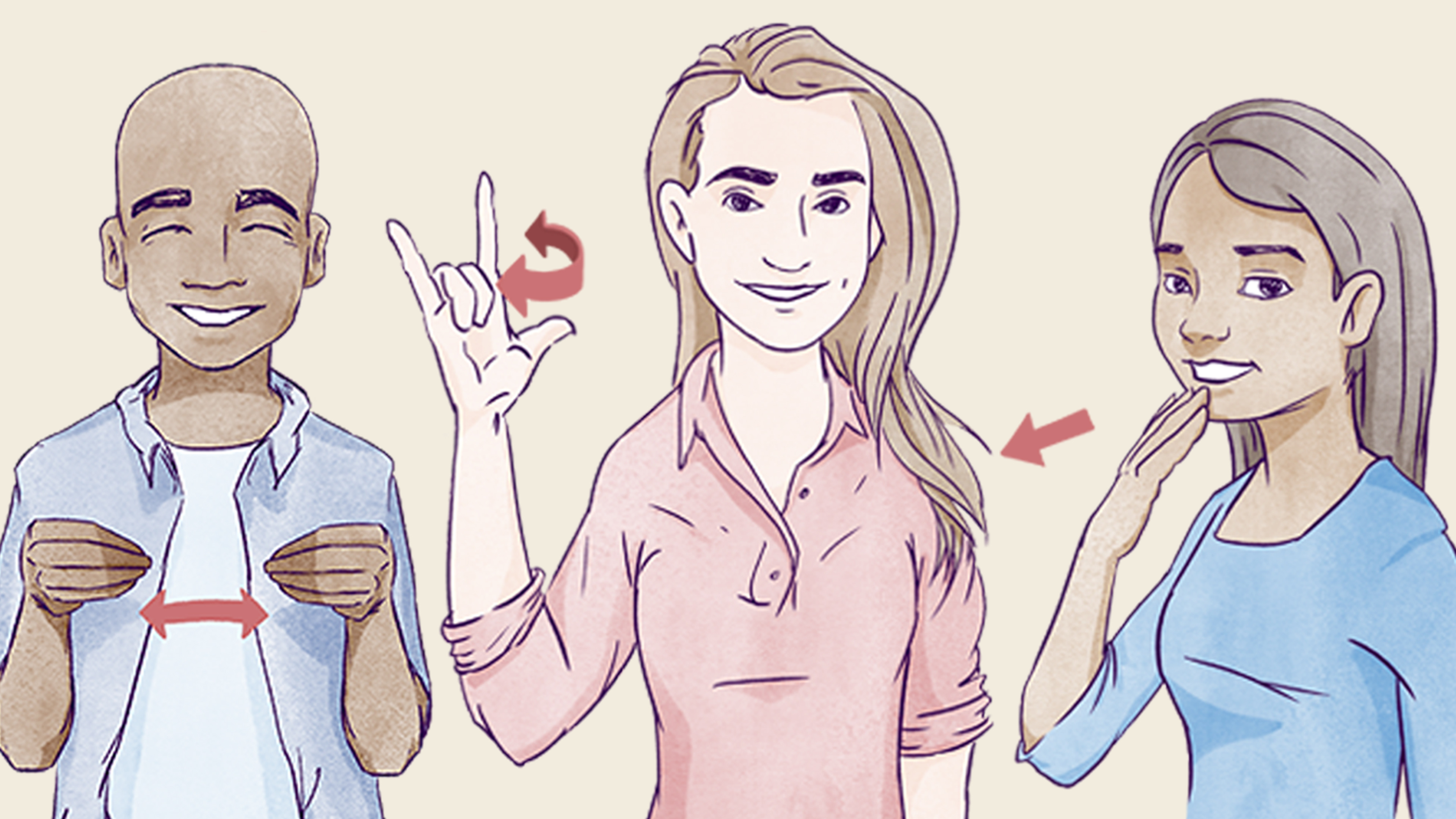
- Thank You: Touch the fingertips to the chin and then move the hand outward and slightly downward toward the person being thanked.
- I Love You: In the traditional ASL "I Love You" sign, extend the thumb, index finger, and pinky while keeping the middle and ring fingers folded. Alternatively, for very young infants, crossing the arms over the chest in a "hug" gesture is a common simplification.
- Yes: Form a fist and tilt it up and down at the wrist, mimicking a nodding head.
- All Done: Start with palms facing the chest, then quickly flip them outward to face the world, indicating completion.
Daily Routines and Objects
- Change: Form both hands into "hooks" with the index fingers, then rotate the hands around each other at the wrists to indicate a transition or diaper change.
- Potty: Form a fist with the thumb tucked between the index and middle fingers (the letter "T" in ASL), then shake the hand side to side.
- Bath: Form both hands into fists and rub them up and down the chest, mimicking the act of scrubbing.
- Sleep: Start with an open hand in front of the face, then draw the hand down while closing the fingers to touch the thumb, symbolizing eyes closing.
- Book: Place the palms together and then open them as if opening the cover of a book, keeping the bottom edges touching.
People and Animals
- Mommy: With an open hand and fingers spread, tap the thumb against the chin.
- Daddy: Using the same open-hand shape, tap the thumb against the forehead.
- Dog: Pat the thigh and then snap the fingers, mimicking the traditional way of calling a canine.
- Cat: Use the thumb and index finger to "pull" imaginary whiskers away from the side of the mouth.
Broader Impact and Educational Implications
The implications of baby sign language extend into the realm of inclusive education and long-term cognitive health. By introducing signs early, children develop a heightened awareness of non-verbal cues and body language, which are essential components of emotional intelligence (EQ). Furthermore, exposure to signing fosters an early respect for and awareness of the Deaf and Hard of Hearing communities, promoting a culture of inclusivity from a formative age.
Pediatricians often note that signing can be particularly beneficial for children with developmental delays or those in bilingual households. In bilingual environments, a sign acts as a "bridge" between two different spoken words for the same object (e.g., "milk" and "leche"), helping the child understand that both sounds refer to the same concept.
Analysis of Longitudinal Outcomes
While the immediate goal of baby sign language is the reduction of daily friction, the longitudinal data remains a subject of great interest to the scientific community. Acredolo and Goodwyn’s follow-up studies on children who signed as infants showed that by the second grade, these children scored an average of 12 points higher on IQ tests than their non-signing peers. While some researchers argue that this may be attributed to the increased parent-child interaction rather than the signing itself, the consensus remains that the practice provides a significant developmental advantage.
In conclusion, baby sign language is a sophisticated yet accessible tool that aligns with the natural trajectory of human development. By acknowledging the gap between an infant’s cognitive desire to communicate and their physical ability to speak, caregivers can empower their children with a voice long before they utter their first word. The result is a more harmonious household, a more confident child, and a foundation for lifelong linguistic and emotional proficiency.
