

Millions of mothers worldwide cherish the ritual of a warm, comforting cup of coffee, a moment of solace in their busy lives. However, for those considering pregnancy, currently pregnant, or breastfeeding, caffeine consumption often requires careful consideration, with health guidelines frequently advising either abstinence or strict moderation. This imperative has led to a significant increase in demand for decaffeinated coffee, presenting a vital question for consumers: how is their decaf coffee produced, and what implications do these methods have for their health and that of their babies? The answer, increasingly, points towards the Swiss Water Process as the industry’s gold standard for chemical-free decaffeination.
The Enduring Allure of Coffee and Modern Health Concerns
Coffee, beyond being a beverage, is a global cultural phenomenon, celebrated for its complex flavors, stimulating effects, and the social rituals it inspires. Its appeal extends to expectant and new mothers who, despite medical advice to limit caffeine, often seek to retain this comforting habit. Organizations such as the American College of Obstetricians and Gynecologists (ACOG) typically recommend that pregnant women limit caffeine intake to less than 200 milligrams per day, roughly equivalent to one 12-ounce cup of coffee. Similar guidelines often apply to breastfeeding mothers, as caffeine can pass into breast milk and potentially affect infant sleep or irritability. These recommendations underscore the growing necessity for safe, high-quality decaffeinated options that do not compromise health through their processing methods.

A Brief History of Decaffeination Technologies
The quest to remove caffeine from coffee beans dates back to the early 20th century. The first commercially successful decaffeination method was developed by Ludwig Roselius in 1903. This process, known as the Roselius method, involved steaming coffee beans with acid or brine, then using benzene—a known carcinogen—as a solvent to extract the caffeine. While effective, the use of such a hazardous chemical quickly raised health concerns, prompting the search for safer alternatives.
Over the decades, other solvent-based methods emerged, primarily using chemicals like methylene chloride or ethyl acetate. Methylene chloride, commonly used in industrial settings, is a potent chemical that can dissolve caffeine efficiently. Ethyl acetate, often derived from fruit, is sometimes labeled as "natural" due to its origin, but it is still a chemical solvent used in an industrial process to extract caffeine. These direct-contact methods involve soaking green coffee beans in water, then introducing the chemical solvent to directly extract the caffeine. While manufacturers assert that these methods result in negligible residual solvent levels within legal limits, consumer awareness and scrutiny regarding chemical residues have intensified significantly in recent years, particularly for vulnerable populations such as pregnant women and infants.

The Emergence of the Swiss Water Process: A Chemical-Free Innovation
In response to the demand for chemical-free alternatives, the Swiss Water Process was developed in Switzerland in 1933 and commercialized in 1988 by the Swiss Water Decaffeinated Coffee Company. This patented method stands apart due to its exclusive reliance on water, temperature, and time to remove caffeine, ensuring no chemical solvents ever come into contact with the coffee beans. It represents a paradigm shift in decaffeination, prioritizing purity and natural flavor preservation.
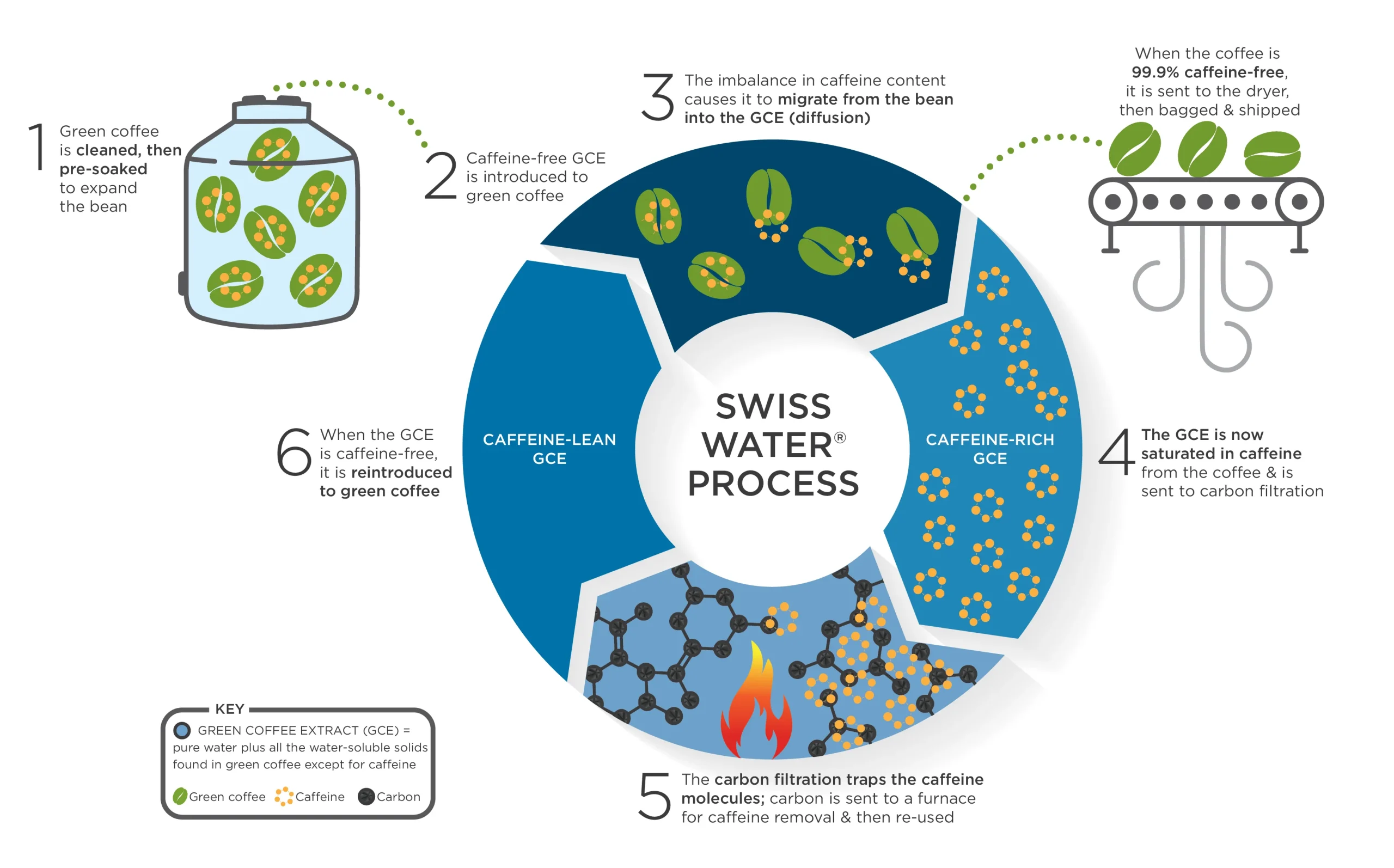
The process begins by sourcing high-quality, organic green coffee beans. These beans are first hydrated in hot water, causing them to expand and making the caffeine molecules more accessible. This initial soaking creates a "Green Coffee Extract" (GCE) saturated with both dissolved caffeine and soluble coffee solids, which carry the coffee’s intrinsic flavor characteristics.
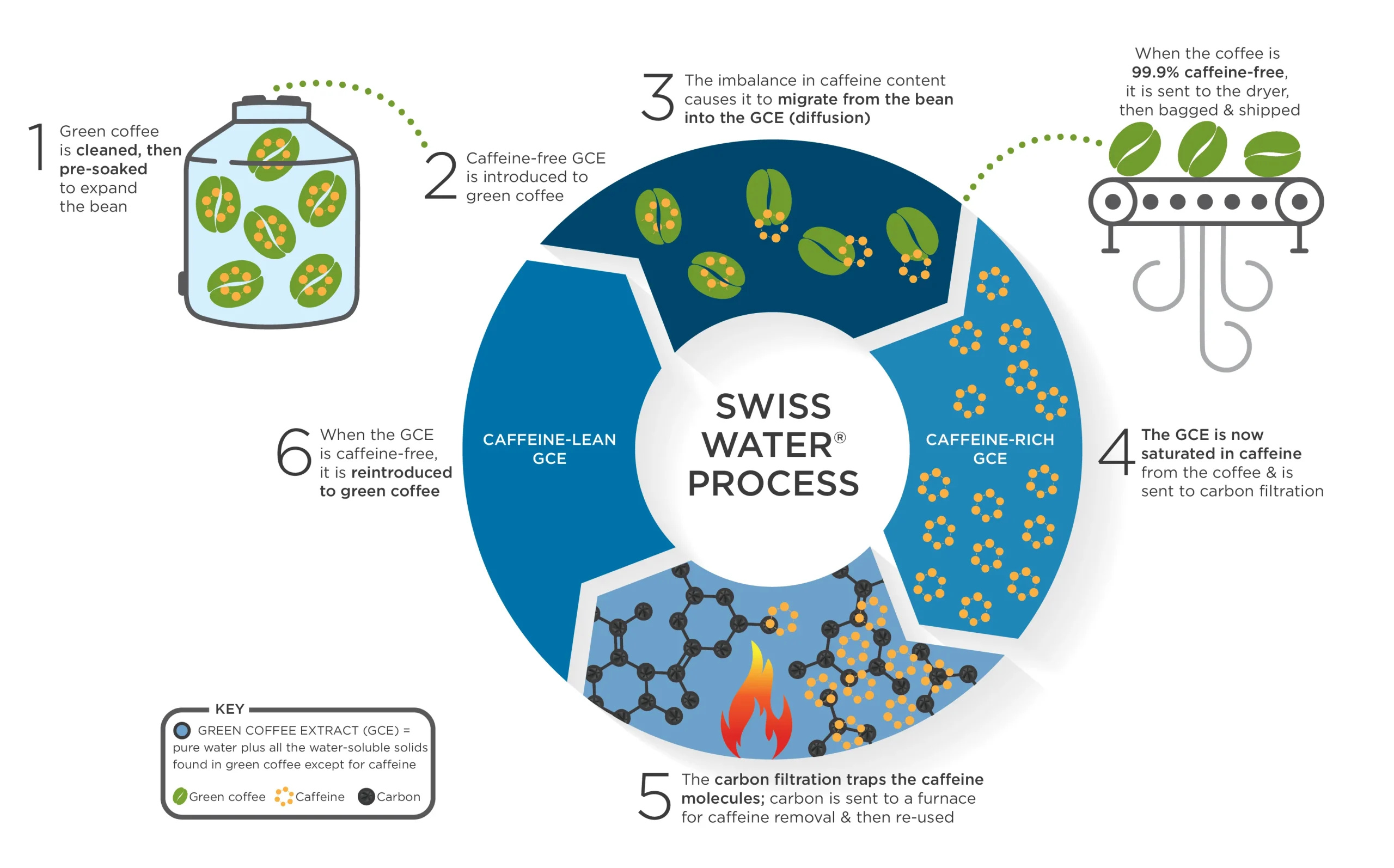
The critical next step involves filtering this caffeine-laden GCE through a series of activated carbon filters. These filters are specifically designed with a pore size that captures only the larger caffeine molecules, allowing the smaller, flavor-carrying coffee solids to pass through unimpeded. This results in a caffeine-free GCE that still contains all the delicate flavor compounds unique to the coffee batch.
Once the GCE is entirely caffeine-free, a fresh batch of green coffee beans is introduced to this caffeine-free, flavor-rich GCE. Because the GCE is already saturated with the soluble coffee solids (the flavor components), the caffeine from the new batch of beans naturally migrates into the GCE until equilibrium is reached, leaving the beans decaffeinated while retaining their original flavor profile. This ingenious method relies on the principle of osmosis and the solubility differences between caffeine and other coffee components.
The entire Swiss Water Process is a meticulous, time-intensive operation, typically taking 8 to 10 hours. It involves continuous monitoring and precise control over water temperature and flow. The end goal is to achieve a minimum of 99.9% caffeine removal, a standard that ensures the coffee truly qualifies as decaffeinated while preserving its aromatic integrity. The visual representation of this sophisticated process, often depicted in an infographic, clearly illustrates the multi-stage filtration and extraction, reinforcing its transparency and efficacy.

The Health Imperative: Mitigating Chemical Exposure
Recent investigative reports and public health discussions have cast a spotlight on the potential health risks associated with chemical-based decaffeination methods. While regulatory bodies like the U.S. Food and Drug Administration (FDA) deem residual levels of certain solvents, such as methylene chloride, safe within prescribed limits, a growing segment of the population, particularly pregnant and breastfeeding mothers, seeks to eliminate any potential exposure to such chemicals. Methylene chloride, for instance, has been linked to concerns ranging from respiratory irritation to more severe health issues with prolonged exposure. Although the amounts found in decaf coffee are typically trace, the precautionary principle often guides dietary choices for vulnerable populations.
Ethyl acetate, while sometimes described as "natural" because it can be derived from fruits, is still a chemical solvent. The process of using it to decaffeinate coffee is industrial and chemical in nature, and concerns about its widespread use and potential residues, however small, persist among health-conscious consumers. These concerns fuel the demand for genuinely chemical-free alternatives like the Swiss Water Process, which offers peace of mind by completely avoiding such substances.

Expert Endorsements and Shifting Consumer Preferences
While specific "statements" from health organizations directly endorsing the Swiss Water Process over other methods are rare due to their non-commercial stance, their overarching recommendations for minimizing exposure to environmental toxins and opting for organic, minimally processed foods implicitly support such methods. Organizations like the American Pregnancy Association, through informative articles like this, guide expectant and new mothers toward safer choices. The emphasis on organic coffee beans further complements the Swiss Water Process, as it ensures that the coffee is free from pesticides and herbicides from cultivation to decaffeination.
The consumer landscape is undeniably shifting. A growing segment of the market prioritizes transparency, sustainability, and health. This trend is particularly pronounced in the food and beverage industry, where consumers are increasingly willing to pay a premium for products that align with their values. Decaffeinated coffee processed via the Swiss Water Method directly addresses these concerns, appealing to those who demand not only caffeine reduction but also absolute purity in their brew. Market data indicates a steady increase in sales of premium, organic, and specialty decaf coffees, reflecting this informed consumer choice.

Making an Informed Choice for Maternal and Infant Health
For expectant and new mothers, the decision about which decaf coffee to consume is an extension of their broader commitment to maternal and infant health. The Gold Standard of the Swiss Water Process offers a compelling solution, marrying the desire for a beloved beverage with rigorous health and safety standards. It assures that the comforting cup is free from the chemicals that have drawn recent public scrutiny.
When selecting decaffeinated coffee, consumers are encouraged to look for explicit labeling. Reputable coffee brands that utilize the Swiss Water Process proudly state this on their packaging, often accompanied by the distinctive Swiss Water logo. This transparency empowers consumers to make choices that align with their health priorities, ensuring they enjoy a delicious, warm, and comforting beverage without compromise.

The availability of such methods also has broader implications for the coffee industry, pushing more producers towards environmentally conscious and health-centric processing. It highlights a future where consumer demand for cleaner, safer products drives innovation and elevates industry standards, ensuring that the simple pleasure of a cup of coffee remains a source of comfort and not concern.
