

Millions of individuals across the globe cherish the ritual of a warm, comforting cup of coffee, a daily staple that offers both sensory pleasure and a momentary reprieve. For a significant demographic, particularly those navigating the journey of pregnancy, contemplating conception, or currently breastfeeding, the beloved stimulant caffeine presents a unique set of considerations. Medical professionals and health organizations routinely advise either complete abstinence from caffeine or strict adherence to minimal intake during these crucial life stages, making the transition to decaffeinated coffee a compelling and often necessary choice. However, not all decaffeination methods are created equal, and understanding the process behind your decaf cup is paramount for ensuring the health and well-being of both mother and child. Amidst a landscape of various decaffeination techniques, the Swiss Water Process stands out as the globally recognized "Gold Standard" for producing caffeine-free coffee without the use of chemical solvents.

The ubiquity of coffee in modern society is undeniable, with billions of cups consumed daily worldwide. Its invigorating properties, attributed primarily to caffeine, have woven it deeply into the fabric of social and professional life. Yet, for many, the stimulating effects of caffeine can be unwelcome, leading to sleep disturbances, anxiety, or in specific health contexts, potential risks. This burgeoning demand for a caffeine-free alternative, offering the rich flavor and aromatic experience of coffee without the jitters, has fueled the growth of the decaffeinated coffee market. For expectant and new mothers, the rationale extends beyond personal preference to critical health implications. Organizations such as the American College of Obstetricians and Gynecologists (ACOG) and the World Health Organization (WHO) recommend limiting caffeine intake to no more than 200 milligrams per day during pregnancy, roughly equivalent to one 12-ounce cup of coffee. Exceeding this limit has been associated with potential risks, including increased chances of miscarriage, low birth weight, and preterm birth. While research continues to evolve, the precautionary principle often guides recommendations for vulnerable populations, making a truly chemical-free decaf option highly desirable.
The journey to effectively remove caffeine from coffee beans without compromising flavor has been a long and innovative one, dating back to the early 20th century. The first commercially successful decaffeination method was developed in 1903 by German coffee merchant Ludwig Roselius, who accidentally discovered the process after a batch of coffee beans was soaked in seawater. His subsequent patented method involved steaming coffee beans with various acids or bases and then using benzene, a known carcinogen, as a solvent to extract the caffeine. While effective, the health implications of benzene quickly became a concern. Over the decades, other chemical solvents, primarily methylene chloride and ethyl acetate, emerged as industry standards. These methods typically involve either a direct solvent process, where the solvent comes into direct contact with the beans, or an indirect process, where the solvent interacts with water that has first extracted caffeine from the beans. While regulatory bodies like the U.S. Food and Drug Administration (FDA) have deemed trace amounts of these solvents safe in decaffeinated coffee, consumer apprehension regarding chemical residues has persistently driven innovation towards cleaner alternatives.

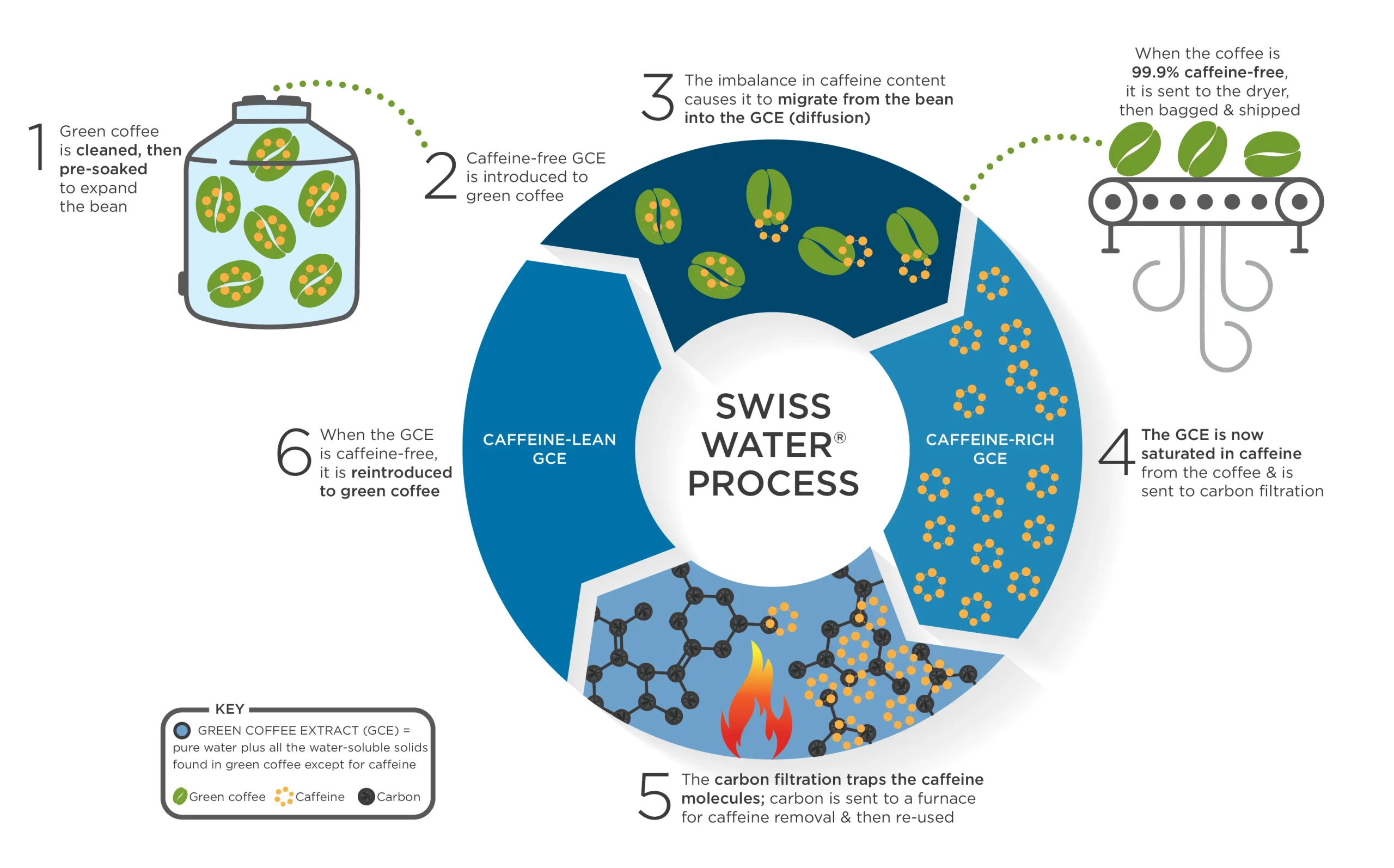
It was against this backdrop of chemical concerns that the Swiss Water Process was conceived in Switzerland in 1933, though it was more formally introduced to the commercial market in 1988. This innovative approach offered a groundbreaking departure from solvent-based methods by utilizing a 100% water-based, chemical-free extraction technique. The process is remarkably elegant in its simplicity and effectiveness, ensuring that up to 99.9% of the caffeine is removed while preserving the bean’s intrinsic flavor characteristics.
The Swiss Water Process unfolds over several meticulous stages:
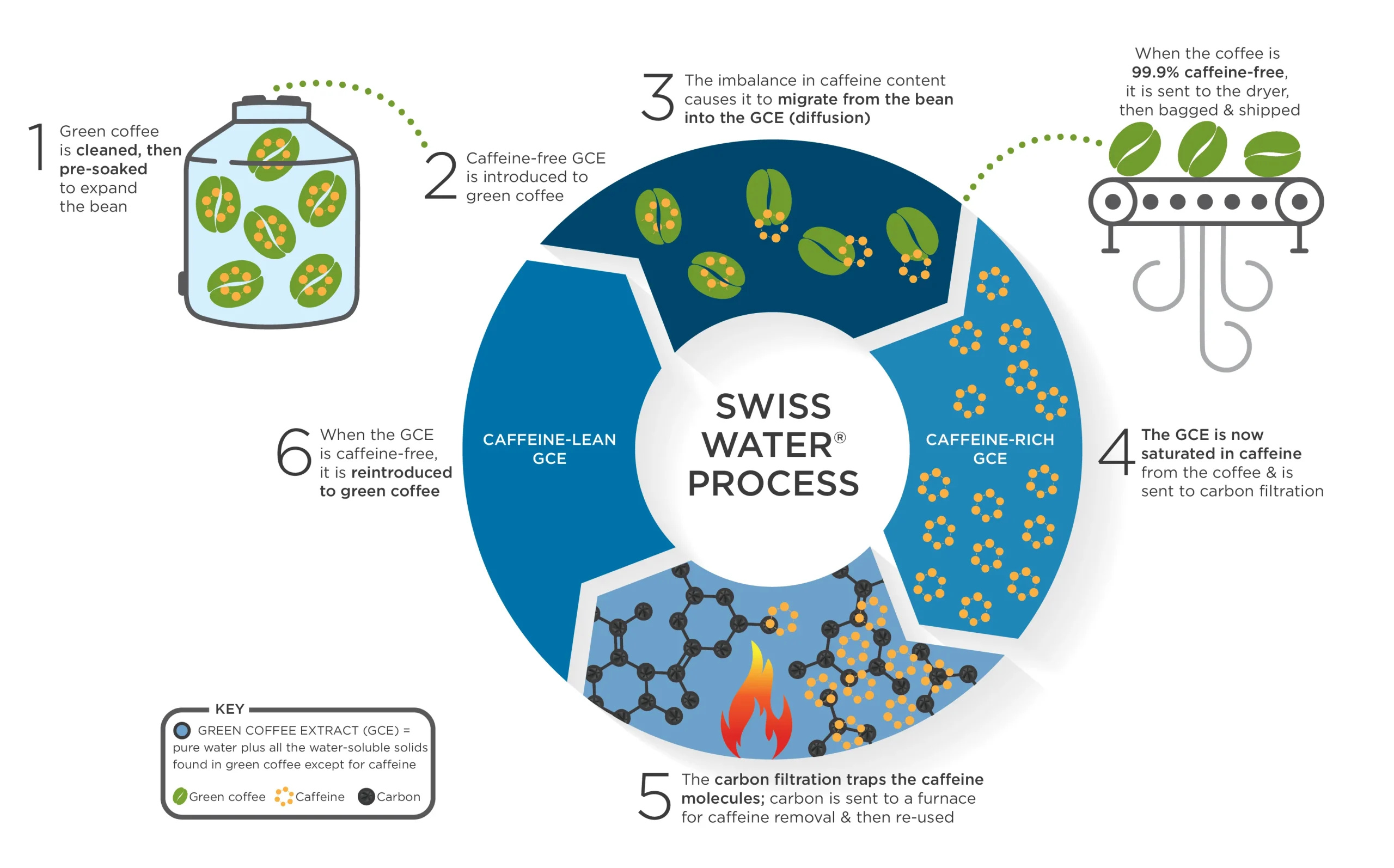
- Green Coffee Beans Immersion: The process begins by taking a batch of green (unroasted) coffee beans and immersing them in hot water. This initial soaking extracts not only the caffeine but also the soluble flavor components present in the beans.
- Green Coffee Extract (GCE) Creation: The water, now infused with both caffeine and flavor, is separated from the coffee beans. This caffeine- and flavor-rich water is known as Green Coffee Extract (GCE).
- Activated Carbon Filtration: The GCE is then directed through a series of proprietary activated carbon filters. These filters are specially designed with a specific porosity that allows the smaller, flavor-carrying molecules to pass through unhindered, while trapping the larger caffeine molecules. This selective filtration is the core innovation, ensuring that the precious flavor compounds are preserved.
- Caffeine-Free GCE Reintroduction: Once the GCE has passed through the carbon filters and is effectively stripped of its caffeine content, it becomes caffeine-free GCE, still rich in the original coffee’s flavor compounds. This caffeine-free GCE is then reintroduced to a fresh batch of green coffee beans. Because the GCE is already saturated with the soluble flavor components, it creates an osmotic pressure gradient that encourages only the caffeine from the new beans to migrate into the GCE, leaving the flavor components within the beans largely untouched.
- Continuous Cycling and Monitoring: This cycle of soaking and filtration continues for approximately 8 to 10 hours, with constant monitoring, until the green coffee beans achieve the stringent target of being 99.9% caffeine-free.
- Drying and Roasting: After decaffeination, the beans are carefully dried to their optimal moisture content and then prepared for roasting, ready to deliver a pure, flavorful, and caffeine-free coffee experience.
The profound advantage of the Swiss Water Process lies in its unwavering commitment to purity. By completely eschewing chemical solvents, it eliminates any concern about residual chemical traces in the final product. This makes it an ideal choice for health-conscious consumers, and particularly for expectant and new mothers who are vigilant about minimizing exposure to potentially harmful substances. Furthermore, the process is inherently compatible with organic certification standards, as it relies solely on water and activated carbon, both natural elements. This aligns perfectly with the increasing consumer demand for organic products, where the absence of dangerous chemicals throughout the cultivation and processing stages is a primary driver of choice. The integrity of the coffee’s original flavor profile is also a significant benefit, as the unique GCE system minimizes the loss of delicate aromatic compounds, resulting in a decaf coffee that genuinely tastes like its caffeinated counterpart.
In contrast, while other decaffeination methods using chemical solvents like methylene chloride or ethyl acetate are approved by regulatory bodies, they continue to be a source of public debate and concern. Methylene chloride, for instance, is a chemical used in various industrial applications and has been linked to health issues at high exposure levels. Ethyl acetate, while naturally occurring in fruits, is typically synthesized for commercial decaffeination. Despite assurances from authorities that residual levels in decaf coffee are negligible and safe, recent media attention and heightened consumer awareness regarding food processing chemicals have underscored the desire for transparent, chemical-free alternatives. This heightened scrutiny further solidifies the position of the Swiss Water Process as a preferred option for those prioritizing an unadulterated product.

The rise of the Swiss Water Process also reflects broader shifts in consumer behavior and market dynamics. There is a discernible trend towards "clean label" products, where consumers demand transparency about ingredients and processing methods. Brands that utilize the Swiss Water Process often highlight this fact prominently, recognizing it as a key differentiator and a mark of quality and safety. The specialty coffee industry, known for its emphasis on bean origin, ethical sourcing, and meticulous roasting, has also embraced chemical-free decaffeination, elevating the status of decaf coffee from a mere afterthought to a premium offering. This commitment to quality ensures that consumers do not have to compromise on taste when opting for decaffeinated coffee.
From a regulatory standpoint, the landscape of decaffeination is complex. While countries worldwide establish maximum residue limits for chemical solvents in decaffeinated coffee, the Swiss Water Process inherently bypasses these concerns by eliminating the use of such compounds altogether. This simplifies compliance and provides an additional layer of assurance for consumers and producers alike. Certifications, such as those for organic products, further validate the chemical-free nature of Swiss Water Process decaf, aligning with stringent environmental and health standards.

In conclusion, for millions who seek to enjoy the warmth and comfort of coffee without caffeine, especially expectant and new mothers for whom caffeine reduction is a health imperative, the method of decaffeination truly matters. The Swiss Water Process represents a pinnacle of innovation in this field, offering a scientifically sound, environmentally conscious, and health-focused approach. By leveraging the natural properties of water and activated carbon, it delivers a 99.9% caffeine-free coffee experience without the use of chemical solvents, thereby safeguarding both flavor and well-being. As consumer demand for safe, transparent, and high-quality food products continues to grow, the Swiss Water Process remains the undisputed "Gold Standard," ensuring that every chemical-free cup contributes to a healthier choice for all.
